Rheumatology Clinic "Mario Carrozzo", Department of Medical and Surgical Sciences, University of Foggia, "Policlinico Riuniti" University Hospital, Foggia, Italy.
Int J Immunopathol Pharmacol. 2021 Jan-Dec;35:20587384211015034. doi: 10.1177/20587384211015034.
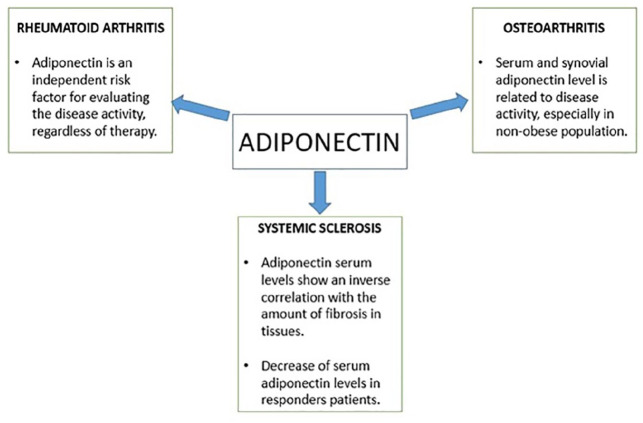
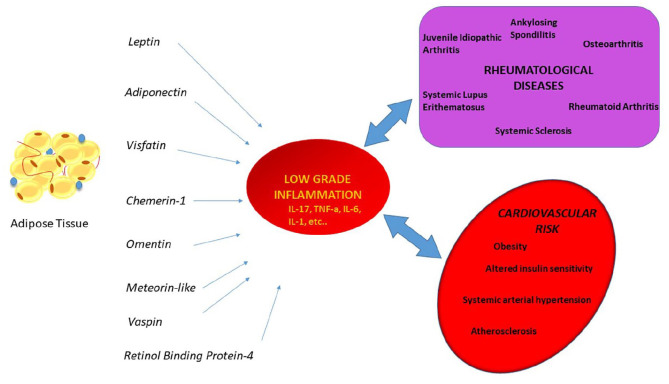
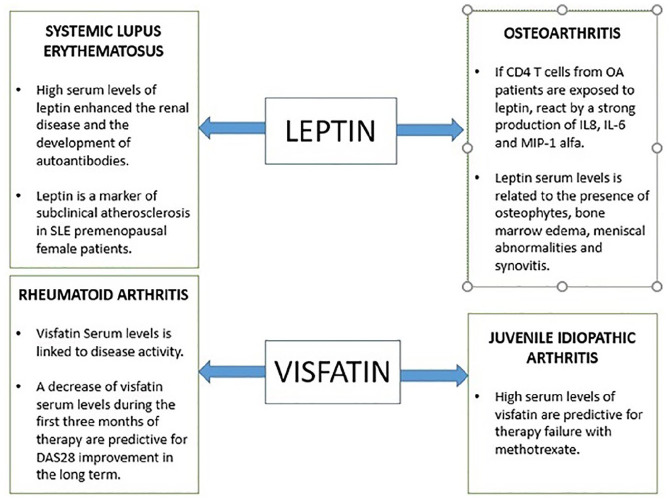
We performed a systematic literature review to summarize the underlying pathogenic mechanisms by which adipokines influence rheumatological diseases and the resulting clinical manifestations. Increasing evidence display that numerous adipokines may significantly influence the development or clinical course of various rheumatological diseases. Despite the normal anti- or pro-inflammatory role of the cytokines, the serum level varies enormously in various rheumatological diseases. The expression of high levels of pro-inflammatory cytokines such as leptin or visfatin, respectively in systemic lupus erythematosus and in rheumatoid arthritis, represents a negative prognostic factor; other adipokines such as adiponectin, broadly known for their anti-inflammatory effects, showed a correlation with disease activity in rheumatoid arthritis. In the near future pro-inflammatory cytokines may represent a potential therapeutic target to restrain the severity of rheumatological diseases. Further studies on adipokines may provide important information on the pathogenesis of these diseases, which are not yet fully understood. The mechanisms by which adipokines induce, worsen, or suppress inflammatory and degenerative musculoskeletal pathologies and their clinical significance will be discussed in this review.
我们进行了系统的文献回顾,总结了脂肪因子影响风湿病的潜在发病机制及其导致的临床表现。越来越多的证据表明,许多脂肪因子可能显著影响各种风湿病的发展或临床过程。尽管细胞因子具有正常的抗炎或促炎作用,但在各种风湿病中,其血清水平差异很大。高水平的促炎细胞因子(如瘦素或内脂素)在系统性红斑狼疮和类风湿关节炎中的表达分别代表一个负预后因素;其他脂肪因子,如脂联素,因其广泛的抗炎作用而广为人知,在类风湿关节炎中与疾病活动度相关。在不久的将来,促炎细胞因子可能成为抑制风湿病严重程度的潜在治疗靶点。进一步研究脂肪因子可能为这些尚未完全了解的疾病的发病机制提供重要信息。本文将讨论脂肪因子引发、加重或抑制炎症和退行性肌肉骨骼病理的机制及其临床意义。