Center of Mental Health, Department of Child and Adolescent Psychiatry, Psychosomatics and Psychotherapy, University Hospital of Würzburg, Würzburg, Germany.
Department of Psychiatry and Psychotherapy, Medical Center-University of Freiburg, Faculty of Medicine, University of Freiburg, Freiburg, Germany.
Eur Child Adolesc Psychiatry. 2022 Oct;31(10):1581-1590. doi: 10.1007/s00787-021-01797-4. Epub 2021 May 13.
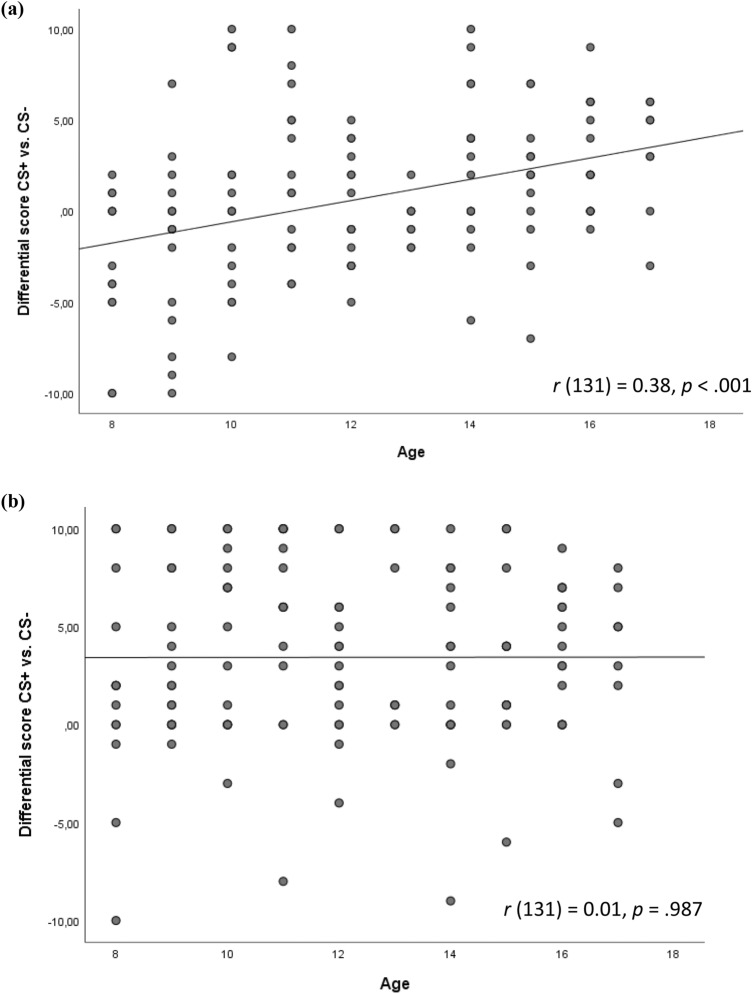
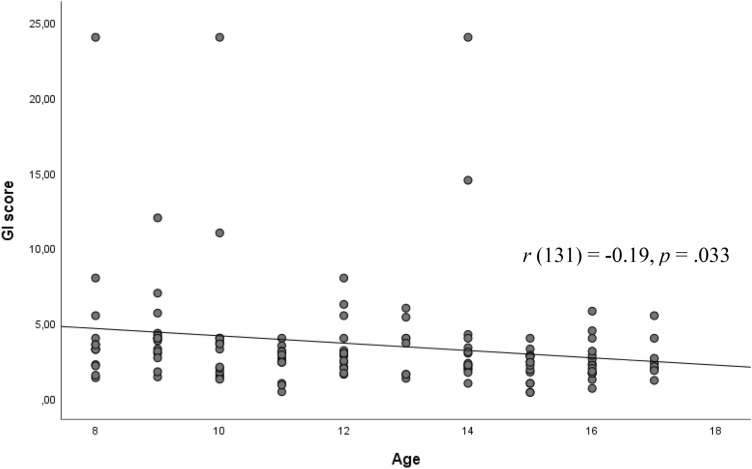
The aim of the study was to investigate age-related differences in fear learning and generalization in healthy children and adolescents (n = 133), aged 8-17 years, using an aversive discriminative fear conditioning and generalization paradigm adapted from Lau et al. (2008). In the current task, participants underwent 24 trials of discriminative conditioning of two female faces with neutral facial expressions, with (CS+) or without (CS-) a 95-dB loud female scream, presented simultaneously with a fearful facial expression (US). The discriminative conditioning was followed by 72 generalization trials (12 CS+, 12 GS1, 12 GS2, 12 GS3, 12 GS4, and 12 CS-): four generalization stimuli depicting gradual morphs from CS+ to CS- in 20%-steps were created for the generalization phases. We hypothesized that generalization in children and adolescents is negatively correlated with age. The subjective ratings of valence, arousal, and US expectancy (the probability of an aversive noise following each stimulus), as well as skin conductance responses (SCRs) were measured. Repeated-measures ANOVAs on ratings and SCR amplitudes were calculated with the within-subject factors stimulus type (CS+, CS-, GS1-4) and phase (Pre-Acquisition, Acquisition 1, Acquisition 2, Generalization 1, Generalization 2). To analyze the modulatory role of age, we additionally calculated ANCOVAs considering age as covariate. Results indicated that (1) subjective and physiological responses were generally lower with increasing age irrespective to the stimulus quality, and (2) stimulus discrimination improved with increasing age paralleled by reduced overgeneralization in older individuals. Longitudinal follow-up studies are required to analyze fear generalization with regard to brain maturational aspects and clarify whether overgeneralization of conditioned fear promotes the development of anxiety disorders or vice versa.
本研究旨在使用 Lau 等人(2008 年)改编的厌恶辨别性恐惧条件作用和泛化范式,研究健康儿童和青少年(n=133,年龄 8-17 岁)中与年龄相关的恐惧学习和泛化差异。在当前任务中,参与者接受了 24 次辨别性条件作用的训练,涉及两个具有中性面部表情的女性面孔,其中(CS+)或不(CS-)伴随 95dB 响亮的女性尖叫,同时呈现恐惧的面部表情(US)。辨别性条件作用后进行 72 次泛化试验(12 个 CS+、12 个 GS1、12 个 GS2、12 个 GS3、12 个 GS4 和 12 个 CS-):为泛化阶段创建了四个泛化刺激,它们描绘了 CS+到 CS-的逐渐形态,步长为 20%。我们假设儿童和青少年的泛化与年龄呈负相关。测量了主观评分的效价、唤醒和 US 预期(每个刺激后出现厌恶噪声的概率)以及皮肤电反应(SCR)。使用刺激类型(CS+、CS-、GS1-4)和阶段(预获取、获取 1、获取 2、泛化 1、泛化 2)的被试内因素,对评分和 SCR 幅度进行了重复测量方差分析。为了分析年龄的调节作用,我们还考虑了年龄作为协变量的 ANCOVA。结果表明:(1)无论刺激质量如何,主观和生理反应通常随年龄增长而降低;(2)刺激辨别随年龄增长而提高,而在年龄较大的个体中,过度泛化减少。需要进行纵向随访研究,以分析与大脑成熟方面相关的恐惧泛化,并澄清条件性恐惧的过度泛化是否促进焦虑症的发展,或者反之亦然。