Department of Earth, Atmospheric & Planetary Sciences, Massachusetts Institute of Technology, Cambridge, MA, USA.
Commun Biol. 2021 May 13;4(1):570. doi: 10.1038/s42003-021-02102-4.
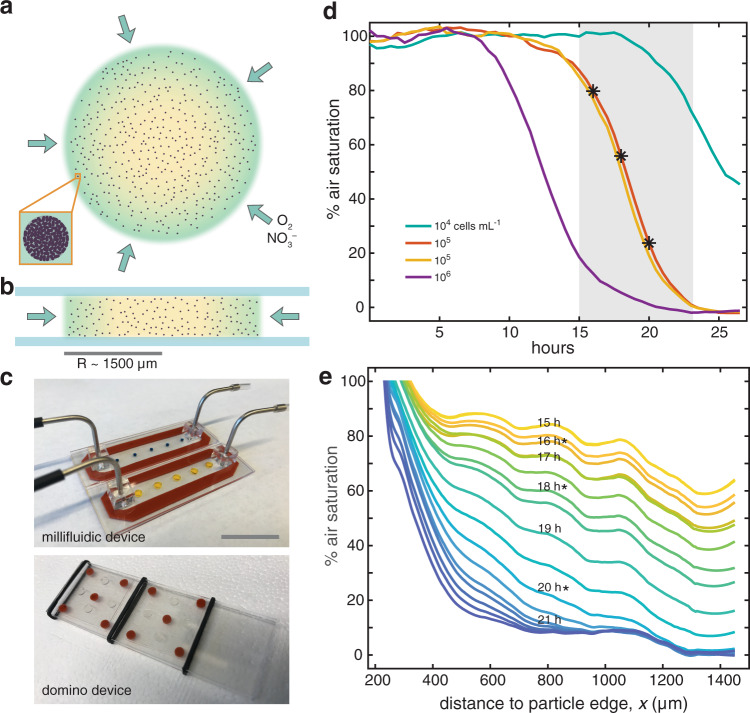
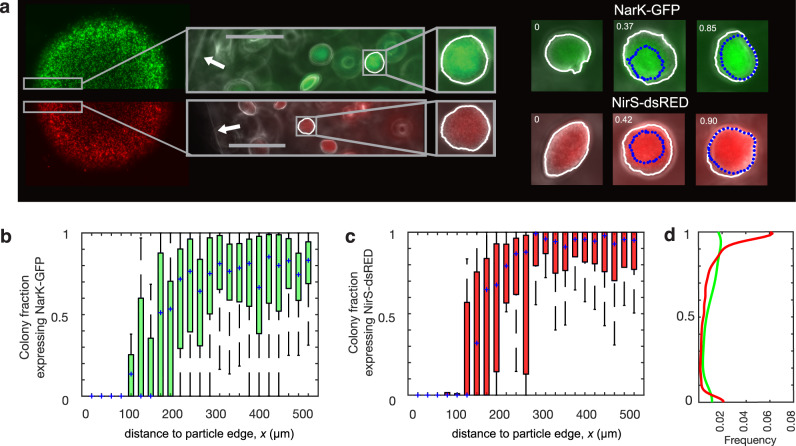
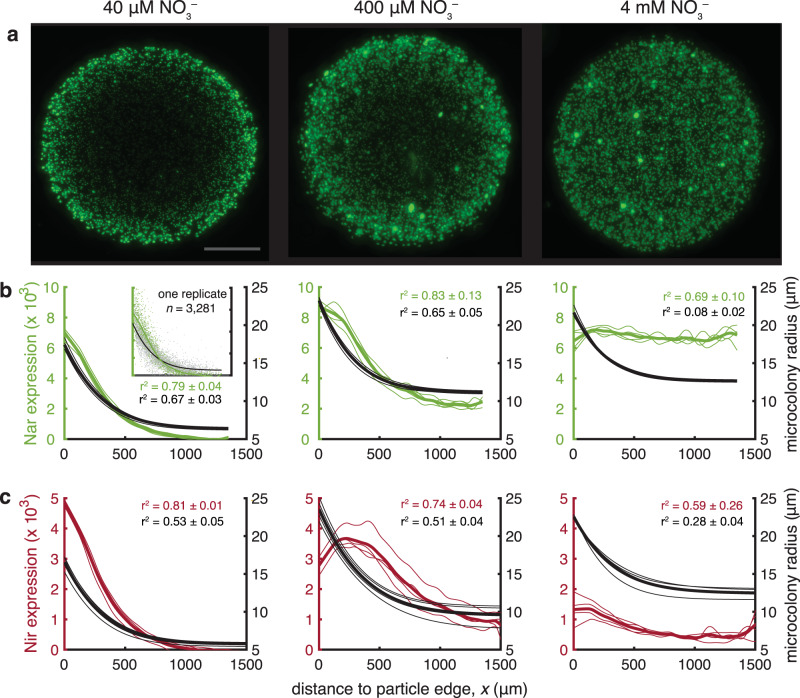
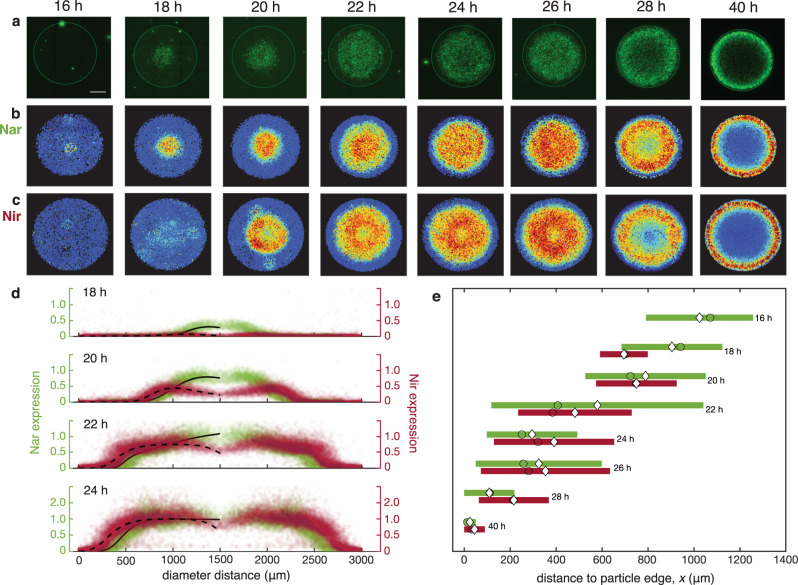
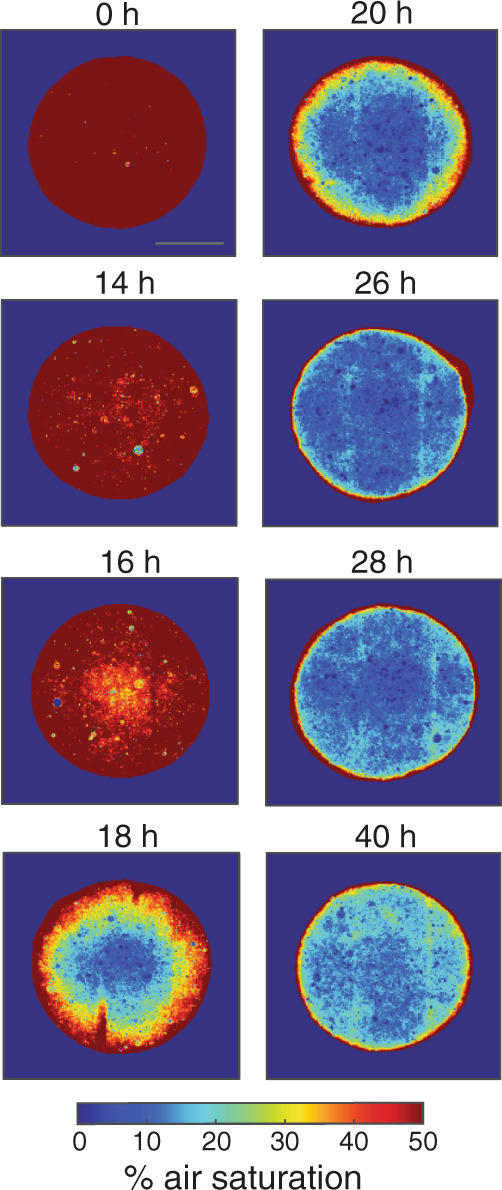
Heterotrophic denitrification enables facultative anaerobes to continue growing even when limited by oxygen (O) availability. Particles in particular provide physical matrices characterized by reduced O permeability even in well-oxygenated bulk conditions, creating microenvironments where microbial denitrifiers may proliferate. Whereas numerical particle models generally describe denitrification as a function of radius, here we provide evidence for heterogeneity of intraparticle denitrification activity due to local interactions within and among microcolonies. Pseudomonas aeruginosa cells and microcolonies act to metabolically shade each other, fostering anaerobic processes just microns from O-saturated bulk water. Even within well-oxygenated fluid, suboxia and denitrification reproducibly developed and migrated along sharp 10 to 100 µm gradients, driven by the balance of oxidant diffusion and local respiration. Moreover, metabolic differentiation among densely packed cells is dictated by the diffusional supply of O, leading to distinct bimodality in the distribution of nitrate and nitrite reductase expression. The initial seeding density controls the speed at which anoxia develops, and even particles seeded with few bacteria remain capable of becoming anoxic. Our empirical results capture the dynamics of denitrifier gene expression in direct association with O concentrations over microscale physical matrices, providing observations of the co-occurrence and spatial arrangement of aerobic and anaerobic processes.
异养反硝化使兼性厌氧菌即使在氧气(O)供应有限的情况下也能继续生长。特别是颗粒,即使在充氧的主体条件下,也提供了具有较低 O 渗透性的物理基质,创造了微生物反硝化菌可能增殖的微环境。虽然数值颗粒模型通常将反硝化作用描述为半径的函数,但这里我们提供了证据,证明由于微菌落内部和之间的局部相互作用,颗粒内反硝化活性存在异质性。铜绿假单胞菌细胞和微菌落相互代谢遮蔽,在离 O 饱和主体水仅几微米的地方促进了厌氧过程。即使在充氧的流体中,缺氧和反硝化也会沿着尖锐的 10 到 100 μm 梯度重现和迁移,这是由氧化剂扩散和局部呼吸之间的平衡驱动的。此外,密集堆积细胞之间的代谢分化由 O 的扩散供应决定,导致硝酸盐和亚硝酸盐还原酶表达的分布呈现明显的双峰性。初始接种密度控制着缺氧发展的速度,即使接种了少量细菌的颗粒仍然能够缺氧。我们的经验结果直接关联 O 浓度捕捉了反硝化基因表达的动力学,对好氧和厌氧过程的共存和空间排列进行了观察。