HIV Vaccine Translational Research Laboratory, Translational Health Sciences & Technology Institute, Faridabad, Haryana, India.
International AIDS Vaccine Initiative, New Delhi, India.
Retrovirology. 2021 May 14;18(1):12. doi: 10.1186/s12977-021-00556-2.
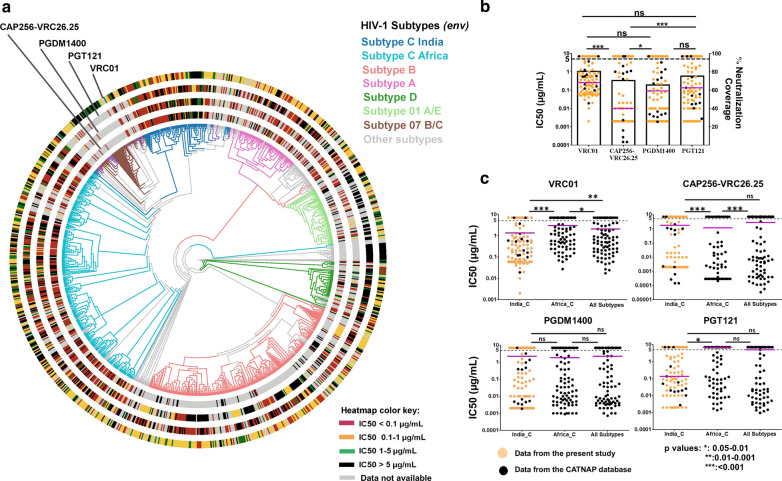
The potential use of the broadly neutralizing monoclonal antibodies (bnAbs) towards prophylaxis and treatment to HIV-1 is currently being explored. While a number of promising bnAbs have been discovered and a few of them have progressed towards clinical development, their extent of neutralization coverage with respect to global HIV-1 variants given the existence of genetically distinct subtypes and recombinants circulating globally is not clearly known. In the present study, we examined the variation in the neutralization susceptibility of pseudoviruses expressing 71 full length primary HIV-1 subtype C envs obtained from limited cross-sectional individuals over different time points against four bnAbs that target gp120 with distinct specificities: VRC01, CAP256-VRC26.25, PGDM1400 and PGT121.
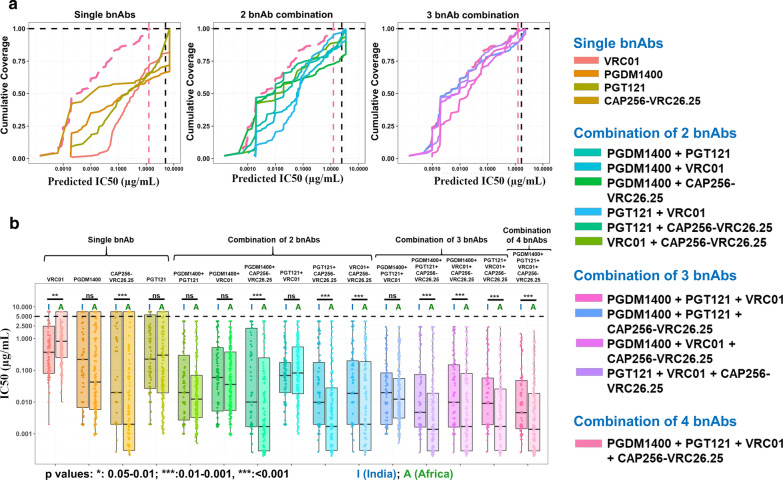
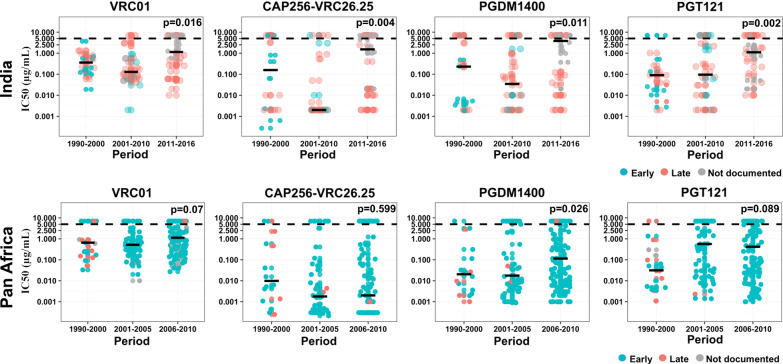
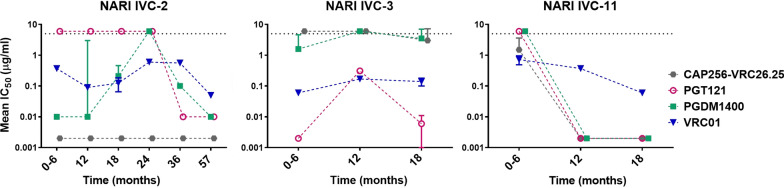
We found significant variations in the susceptibility of Indian clade C to these four bnAbs. These variations were found to be distinct to that observed in African subtype C based on the existing datasets and concordant with their sequence diversity. Trend analysis indicated an increasing neutralization resistance observed over time with CAP25-VRC26.25, PGDM1400 and PGT121 when tested on pseudoviruses expressing envs obtained from 1999 to 2016. However, inconsistent trend in neutralization susceptibility was observed, when pseudoviruses expressing envs obtained from three followed up individuals were examined. Finally, through predictive analysis of the 98 Indian subtype C including those assessed in the present study by employing additive model implemented in CombiNAber ( http://www.hiv.lanl.gov ), we observed two possibilities where combinations of three bnAbs (VRC01/CAP56-VRC26.25/PGT121 and PGDM1400/CAP256-VRC26.25/PGT121) could achieve near 100% neutralization coverage.
Our findings not only indicate disparate intra-clade C genetic vis-à-vis neutralization diversities but also warrant the need for more comprehensive study using additional isolates towards comparing inter and intra-clade neutralization diversities which will be necessary for selecting the bnAb combinations suitable for optimal coverage of the region-specific HIV-1 circulating subtypes. Expanding these efforts is imperative for designing efficacious bnAb based intervention strategies for India as well as subtype C in general.
目前正在探索广泛中和单克隆抗体(bnAb)在预防和治疗 HIV-1 方面的潜在用途。虽然已经发现了许多有前途的 bnAb,并且其中一些已经进入临床开发阶段,但由于存在遗传上不同的亚型和重组体在全球范围内传播,它们对全球 HIV-1 变体的中和覆盖范围尚不清楚。在本研究中,我们检查了来自不同时间点的有限横断面个体表达的 71 个全长 HIV-1 主要 C 型 env 的假病毒对四种以 gp120 为靶点、具有不同特异性的 bnAb 的中和敏感性的变化:VRC01、CAP256-VRC26.25、PGDM1400 和 PGT121。
我们发现印度 C 型对这四种 bnAb 的敏感性存在显著差异。这些变化与基于现有数据集观察到的非洲 C 型不同,与它们的序列多样性一致。趋势分析表明,随着时间的推移,用 CAP25-VRC26.25、PGDM1400 和 PGT121 对 1999 年至 2016 年获得的 env 表达的假病毒进行测试时,观察到中和耐药性逐渐增加。然而,当检测三个随访个体获得的 env 表达的假病毒时,观察到中和敏感性不一致的趋势。最后,通过使用 CombiNAber(http://www.hiv.lanl.gov)中实现的加性模型对包括本研究中评估的 98 个印度 C 型进行预测分析,我们观察到两种可能性,即三种 bnAb(VRC01/CAP56-VRC26.25/PGT121 和 PGDM1400/CAP256-VRC26.25/PGT121)的组合可以实现接近 100%的中和覆盖率。
我们的研究结果不仅表明 C 型内部遗传差异与中和多样性不同,而且还需要使用更多的分离株进行更全面的研究,以比较种间和种内中和多样性,这对于选择适合该地区特定 HIV-1 流行亚型的最佳覆盖范围的 bnAb 组合是必要的。扩大这些努力对于设计针对印度和一般 C 型的有效 bnAb 干预策略至关重要。