Li Jun, Ozden Adnan, Wan Mingyu, Hu Yongfeng, Li Fengwang, Wang Yuhang, Zamani Reza R, Ren Dan, Wang Ziyun, Xu Yi, Nam Dae-Hyun, Wicks Joshua, Chen Bin, Wang Xue, Luo Mingchuan, Graetzel Michael, Che Fanglin, Sargent Edward H, Sinton David
Department of Mechanical and Industrial Engineering, University of Toronto, Toronto, ON, Canada.
Department of Electrical and Computer Engineering, University of Toronto, Toronto, ON, Canada.
Nat Commun. 2021 May 14;12(1):2808. doi: 10.1038/s41467-021-23023-0.
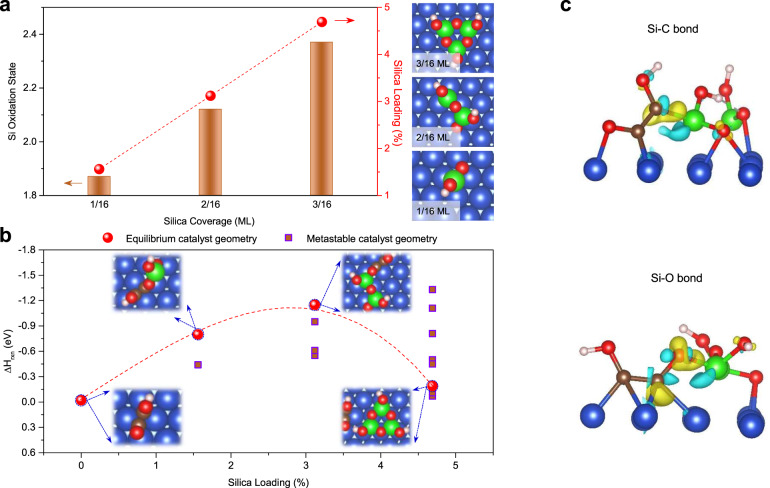
Membrane electrode assembly (MEA) electrolyzers offer a means to scale up CO-to-ethylene electroconversion using renewable electricity and close the anthropogenic carbon cycle. To date, excessive CO coverage at the catalyst surface with limited active sites in MEA systems interferes with the carbon-carbon coupling reaction, diminishing ethylene production. With the aid of density functional theory calculations and spectroscopic analysis, here we report an oxide modulation strategy in which we introduce silica on Cu to create active Cu-SiO interface sites, decreasing the formation energies of OCOH* and OCCOH*-key intermediates along the pathway to ethylene formation. We then synthesize the Cu-SiO catalysts using one-pot coprecipitation and integrate the catalyst in a MEA electrolyzer. By tuning the CO concentration, the Cu-SiO catalyst based MEA electrolyzer shows high ethylene Faradaic efficiencies of up to 65% at high ethylene current densities of up to 215 mA cm; and features sustained operation over 50 h.
膜电极组件(MEA)电解槽提供了一种利用可再生电力扩大一氧化碳到乙烯电转化规模并闭合人为碳循环的方法。迄今为止,MEA系统中催化剂表面一氧化碳覆盖过度且活性位点有限,这干扰了碳-碳偶联反应,降低了乙烯产量。借助密度泛函理论计算和光谱分析,我们在此报告一种氧化物调制策略,即在铜上引入二氧化硅以创建活性铜-二氧化硅界面位点,降低沿乙烯形成途径的OCOH和OCCOH关键中间体的生成能。然后我们采用一锅共沉淀法合成铜-二氧化硅催化剂,并将该催化剂集成到MEA电解槽中。通过调节一氧化碳浓度,基于铜-二氧化硅催化剂的MEA电解槽在高达215 mA cm的高乙烯电流密度下显示出高达65%的高乙烯法拉第效率;并且具有持续运行超过50小时的特性。