Cheryl Spencer Department of Nursing, Faculty of Social Welfare and Health Sciences, University of Haifa, Haifa, Israel.
Surrey Sleep Research Centre, Faculty of Health and Medical Sciences, University of Surrey, Guildford, United Kingdom.
Sleep. 2021 Oct 11;44(10). doi: 10.1093/sleep/zsab123.
Assess the validity of a subjective measure of sleepiness as an indicator of sleep drive by quantifying associations between intraindividual variation in evening sleepiness and bedtime, sleep duration, and next morning and subsequent evening sleepiness, in young adults.
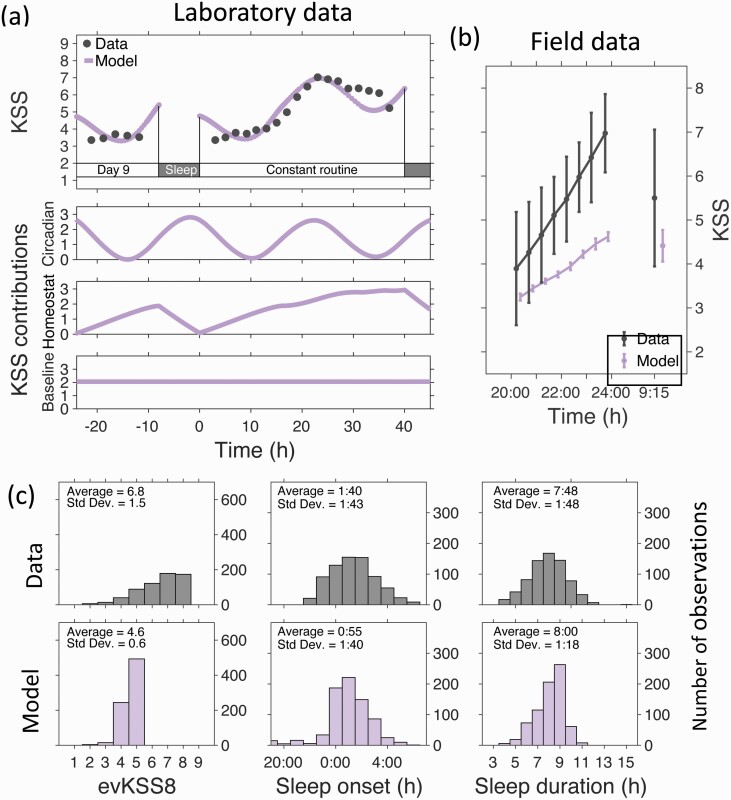
Sleep timing and sleepiness were assessed in 19 students in late autumn and late spring on a total of 771 days. Karolinska Sleepiness Scales (KSS) were completed at half-hourly intervals at fixed clock times starting 4 h prior to participants' habitual bedtime, and in the morning. Associations between sleepiness and sleep timing were evaluated by mixed model and nonparametric approaches and simulated with a mathematical model for the homeostatic and circadian regulation of sleepiness.
Intraindividual variation in evening sleepiness was very large, covering four or five points on the 9-point KSS scale, and was significantly associated with subsequent sleep timing. On average, a one point higher KSS value was followed by 20 min earlier bedtime, which led to 11 min longer sleep, which correlated with lower sleepiness next morning and the following evening. Associations between sleepiness and sleep timing were stronger in early compared to late sleepers. Model simulations indicated that the directions of associations between sleepiness and sleep timing are in accordance with their homeostatic and circadian regulation, even though much of the variance in evening sleepiness and details of its time course remain unexplained by the model.
Subjective sleepiness is a valid indicator of the drive for sleep which, if acted upon, can reduce insufficient sleep.
通过量化个体夜间困倦度在个体内的变化与就寝时间、睡眠时间以及次日早晨和随后的夜间困倦度之间的关联,评估困倦度这一主观睡眠指标作为睡眠驱动力的有效性,研究对象为年轻成年人。
在深秋和晚春季节,对 19 名学生总共进行了 771 天的睡眠定时和困倦度评估。在参与者的习惯性就寝时间前 4 小时开始,以及在早上,使用 Karolinska 睡眠量表(KSS)每隔半小时在固定的时钟时间完成。使用混合模型和非参数方法评估困倦度与睡眠定时之间的关联,并使用睡眠驱动力的稳态和昼夜节律调节的数学模型进行模拟。
夜间困倦度的个体内变化非常大,涵盖了 KSS 量表的 9 个点中的 4 或 5 个点,并且与随后的睡眠定时显著相关。平均而言,KSS 值增加 1 分,就寝时间提前 20 分钟,导致睡眠时间延长 11 分钟,这与次日早晨和随后的晚上困倦度较低相关。与早睡者相比,困倦度与睡眠定时之间的关联在早起者中更强。模型模拟表明,困倦度与睡眠定时之间的关联方向符合其稳态和昼夜节律调节,尽管该模型仍无法解释夜间困倦度的大部分变化及其时间过程的细节。
主观困倦度是睡眠驱动力的有效指标,如果加以利用,可以减少睡眠不足。