Department of Internal Medicine, Seoul National University Hospital, Seoul, Republic of Korea.
Institute of Health and Environment, Graduate School of Public Health, Seoul National University, Seoul, Republic of Korea.
Environ Health. 2021 May 15;20(1):61. doi: 10.1186/s12940-021-00741-y.
Researchers have yet to investigate the specific association between 10-μm particulate matter (PM10) levels and the risk of graft failure, kidney disease, or the functional decline of transplanted kidneys, in kidney transplant recipients (KTRs). Furthermore, we know very little about the association between PM10 levels and the development of allograft rejection in transplanted kidneys. Identification of air pollution as a potential contributor to kidney disease could help reduce future disease burden, stimulate policy discussions on the importance of reducing air pollution with respect to health and disease, and increase public awareness of the hazards of air pollution. We aimed to evaluate the relationship of PM10 with the risk of graft failure, mortality, and decline of graft function in KTRs.
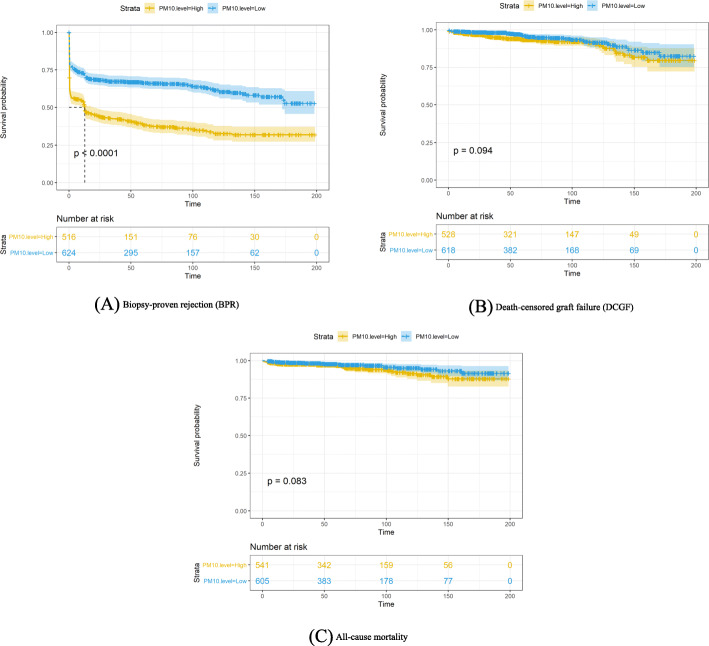
Air pollutant data were obtained from the Korean National Institute of Environmental Research. We then investigated potential associations between these data and the clinical outcomes of 1532 KTRs who underwent kidney transplantation in a tertiary hospital between 2001 and 2015. Survival models were used to evaluate the association between PM10 concentrations and the risk of death-censored graft failure (DCGF), all-cause mortality, and biopsy-proven rejection (BPR), over a median follow-up period of 6.31 years.
The annual mean PM10 exposure after kidney transplantation was 27.1 ± 8.0 μg/m. Based on 1-year baseline exposure, 1 μg/m increase in PM10 concentration was associated with an increased risk of DCGF (hazard ratio (HR): 1.049; 95% confidence interval (CI): 1.014-1.084) and BPR (HR: 1.053; 95% CI: 1.042-1.063). Fully adjusted models showed that all-cause mortality was significantly associated with 1-year average PM10 concentrations (HR, 1.09; 95% CI, 1.043 to 1.140).
Long-term PM10 exposure is significantly associated with BPR, DCGF, and all-cause mortality in KTRs.
研究人员尚未研究 10μm 颗粒物(PM10)水平与移植肾失功、肾脏病或移植肾功能下降风险之间的具体关联,也不太了解 PM10 水平与移植肾同种异体排斥反应发展之间的关系。将空气污染确定为肾脏病的潜在致病因素,有助于降低未来的疾病负担,激发有关减少空气污染对健康和疾病重要性的政策讨论,并提高公众对空气污染危害的认识。我们旨在评估 PM10 与移植肾失功、死亡率和移植肾功能下降风险的关系。
从韩国国家环境研究所获取了空气污染物数据,然后研究了这些数据与 2001 年至 2015 年期间在一家三级医院接受肾移植的 1532 名 KTR 临床结局之间的潜在关联。使用生存模型评估了 PM10 浓度与死亡风险相关的移植物失功(DCGF)、全因死亡率和经活检证实的排斥反应(BPR)风险之间的关系,中位随访时间为 6.31 年。
肾移植后,每年 PM10 暴露的平均值为 27.1±8.0μg/m。基于 1 年的基线暴露,PM10 浓度增加 1μg/m,与 DCGF 风险增加相关(风险比(HR):1.049;95%置信区间(CI):1.014-1.084)和 BPR(HR:1.053;95% CI:1.042-1.063)。完全调整模型显示,全因死亡率与 1 年平均 PM10 浓度显著相关(HR,1.09;95%CI,1.043 至 1.140)。
长期 PM10 暴露与 KTR 中的 BPR、DCGF 和全因死亡率显著相关。