Clinical Epidemiology Center, Research and Education Service and.
Department of Medicine.
J Am Soc Nephrol. 2018 Jan;29(1):218-230. doi: 10.1681/ASN.2017030253. Epub 2017 Sep 21.
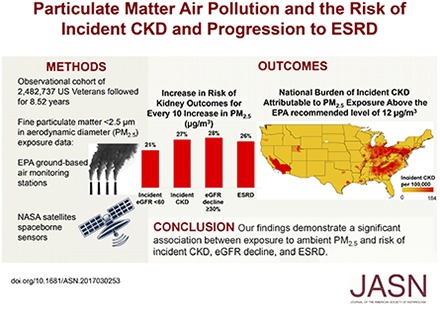
Elevated levels of fine particulate matter <2.5 m in aerodynamic diameter (PM) are associated with increased risk of cardiovascular outcomes and death, but their association with risk of CKD and ESRD is unknown. We linked the Environmental Protection Agency and the Department of Veterans Affairs databases to build an observational cohort of 2,482,737 United States veterans, and used survival models to evaluate the association of PM concentrations and risk of incident eGFR <60 ml/min per 1.73 m, incident CKD, eGFR decline ≥30%, and ESRD over a median follow-up of 8.52 years. County-level exposure was defined at baseline as the annual average PM concentrations in 2004, and separately as time-varying where it was updated annually and as cohort participants moved. In analyses of baseline exposure (median, 11.8 [interquartile range, 10.1-13.7] g/m), a 10-g/m increase in PM concentration was associated with increased risk of eGFR<60 ml/min per 1.73 m (hazard ratio [HR], 1.21; 95% confidence interval [95% CI], 1.14 to 1.29), CKD (HR, 1.27; 95% CI, 1.17 to 1.38), eGFR decline ≥30% (HR, 1.28; 95% CI, 1.18 to 1.39), and ESRD (HR, 1.26; 95% CI, 1.17 to 1.35). In time-varying analyses, a 10-g/m increase in PM concentration was associated with similarly increased risk of eGFR<60 ml/min per 1.73 m, CKD, eGFR decline ≥30%, and ESRD. Spline analyses showed a linear relationship between PM concentrations and risk of kidney outcomes. Exposure estimates derived from National Aeronautics and Space Administration satellite data yielded consistent results. Our findings demonstrate a significant association between exposure to PM and risk of incident CKD, eGFR decline, and ESRD.
细颗粒物(PM)的空气动力学直径(Dp<2.5 m)水平升高与心血管疾病结局和死亡风险增加相关,但与慢性肾脏病(CKD)和终末期肾病(ESRD)风险的关系尚不清楚。我们将美国环境保护署和退伍军人事务部的数据库进行了关联,构建了一个由 2482737 名美国退伍军人组成的观察性队列,并使用生存模型来评估 PM 浓度与 eGFR<60 ml/min per 1.73 m、新发 CKD、eGFR 下降≥30%和 ESRD 的风险之间的关联,中位随访时间为 8.52 年。县一级的暴露在基线时定义为 2004 年的年平均 PM 浓度,也可以作为时间变化的指标,每年更新,并随着队列参与者的移动而更新。在分析基线暴露(中位数,11.8 [四分位距,10.1-13.7] μg/m3)时,PM 浓度每增加 10 μg/m3,eGFR<60 ml/min per 1.73 m(风险比 [HR],1.21;95%置信区间 [95%CI],1.14 至 1.29)、CKD(HR,1.27;95%CI,1.17 至 1.38)、eGFR 下降≥30%(HR,1.28;95%CI,1.18 至 1.39)和 ESRD(HR,1.26;95%CI,1.17 至 1.35)的风险增加。在时间变化的分析中,PM 浓度每增加 10 μg/m3,eGFR<60 ml/min per 1.73 m、CKD、eGFR 下降≥30%和 ESRD 的风险也会相应增加。样条分析显示 PM 浓度与肾脏疾病结局风险之间存在线性关系。从美国国家航空航天局卫星数据得出的暴露估计值得出了一致的结果。我们的研究结果表明,暴露于 PM 与新发 CKD、eGFR 下降和 ESRD 的风险之间存在显著关联。