Chilengi R, Mwila-Kazimbaya K, Chirwa M, Sukwa N, Chipeta C, Velu R M, Katanekwa N, Babji S, Kang G, McNeal M M, Meyer N, Gompana G, Hazra S, Tang Y, Flores J, Bhat N, Rathi N
Centre for Infectious Disease Research in Zambia, Zambia.
The Wellcome Trust Research Laboratory, Vellore, India.
Vaccine. 2021 Jun 16;39(27):3633-3640. doi: 10.1016/j.vaccine.2021.04.060. Epub 2021 May 12.
ROTAVAC® (frozen formulation stored at -20 °C) and ROTAVAC 5D® (liquid formulation stable at 2-8 °C) are rotavirus vaccines derived from the 116E human neonatal rotavirus strain, developed and licensed in India. This study evaluated and compared the safety and immunogenicity of these vaccines in an infant population in Zambia.
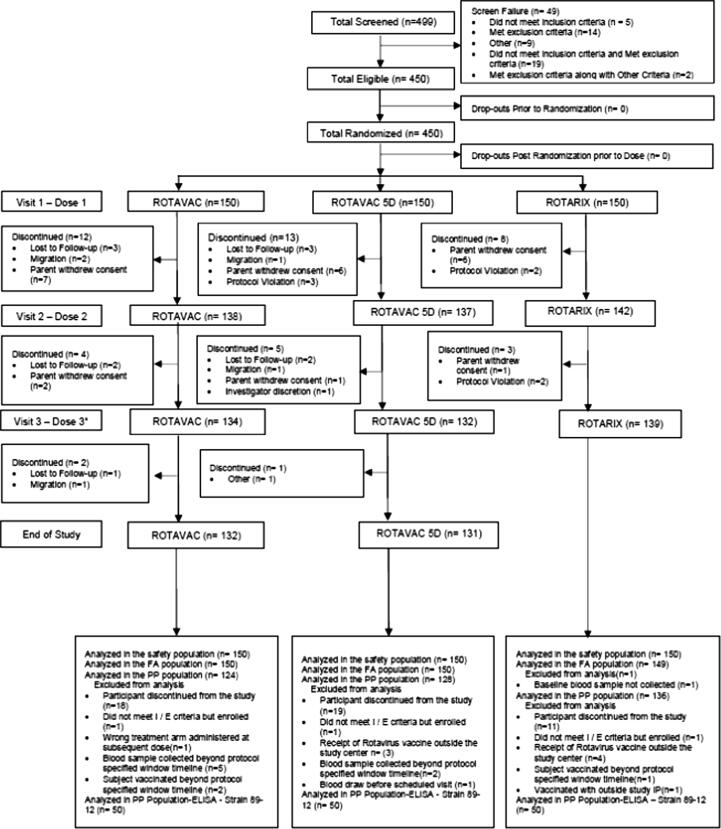
We conducted a phase 2b, open-label, randomized, controlled trial wherein 450 infants 6 to 8 weeks of age were randomized equally to receive three doses of ROTAVAC or ROTAVAC 5D, or two doses of ROTARIX®. Study vaccines were administered concomitantly with routine immunizations. Blood samples were collected pre-vaccination and 28 days after the last dose. Serum anti-rotavirus IgA antibodies were measured by ELISA, with WC3 and 89-12 rotavirus strains as viral lysates in the assays. The primary analysis was to assess non-inferiority of ROTAVAC 5D to ROTAVAC in terms of the geometric mean concentration (GMC) of serum IgA (WC3) antibodies. Seroresponse and seropositivity were also determined. Safety was evaluated as occurrence of immediate, solicited, unsolicited, and serious adverse events after each dose.
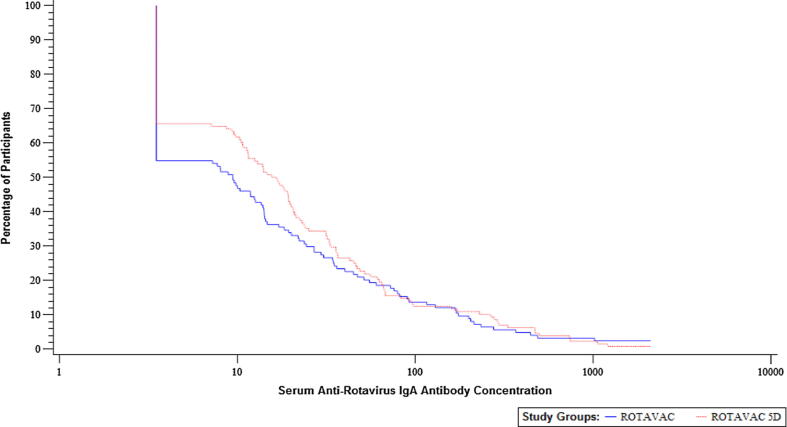
The study evaluated 388 infants in the per-protocol population. All three vaccines were well tolerated and immunogenic. The post-vaccination GMCs were 14.0 U/mL (95% CI: 10.4, 18.8) and 18.1 U/mL (95% CI: 13.7, 24.0) for the ROTAVAC and ROTAVAC 5D groups, respectively, yielding a ratio of 1.3 (95% CI: 0.9, 1.9), thus meeting the pre-set non-inferiority criteria. Solicited and unsolicited adverse events were similar across all study arms. No death or intussusception case was reported during study period.
Among Zambian infants, both ROTAVAC and ROTAVAC 5D were well tolerated and the immunogenicity of ROTAVAC 5D was non-inferior to that of ROTAVAC. These results are consistent with those observed in licensure trials in India and support use of these vaccines across wider geographical areas.
ROTAVAC®(-20°C储存的冻干制剂)和ROTAVAC 5D®(2 - 8°C稳定的液体制剂)是源自116E人新生儿轮状病毒株的轮状病毒疫苗,在印度研发并获得许可。本研究评估并比较了这两种疫苗在赞比亚婴儿群体中的安全性和免疫原性。
我们开展了一项2b期、开放标签、随机、对照试验,将450名6至8周龄的婴儿等分为三组,分别接受三剂ROTAVAC或ROTAVAC 5D,或两剂ROTARIX®。研究疫苗与常规免疫接种同时进行。在接种疫苗前及最后一剂接种后28天采集血样。通过ELISA法检测血清抗轮状病毒IgA抗体,检测中以WC3和89 - 12轮状病毒株作为病毒裂解物。主要分析是评估ROTAVAC 5D在血清IgA(WC3)抗体几何平均浓度(GMC)方面相对于ROTAVAC的非劣效性。还测定了血清反应和血清阳性率。安全性评估为每次接种后即刻、预期、非预期和严重不良事件的发生情况。
符合方案人群中388名婴儿纳入研究评估。所有三种疫苗耐受性良好且具有免疫原性。ROTAVAC组和ROTAVAC 5D组接种疫苗后的GMC分别为14.0 U/mL(95%CI:10.4,18.8)和18.1 U/mL(95%CI:13.7,24.0),比值为1.3(95%CI:0.9,1.9),因此符合预设的非劣效标准。所有研究组中预期和非预期不良事件相似。研究期间未报告死亡或肠套叠病例。
在赞比亚婴儿中,ROTAVAC和ROTAVAC 5D耐受性均良好,且ROTAVAC 5D的免疫原性不劣于ROTAVAC。这些结果与在印度的上市许可试验中观察到的结果一致,支持在更广泛地理区域使用这些疫苗。