Donald Danforth Plant Science Center, St. Louis, MO 63132, USA.
Division of Plant Sciences, University of Missouri, Columbia, MO 65211, USA.
G3 (Bethesda). 2021 Jul 14;11(7). doi: 10.1093/g3journal/jkab140.
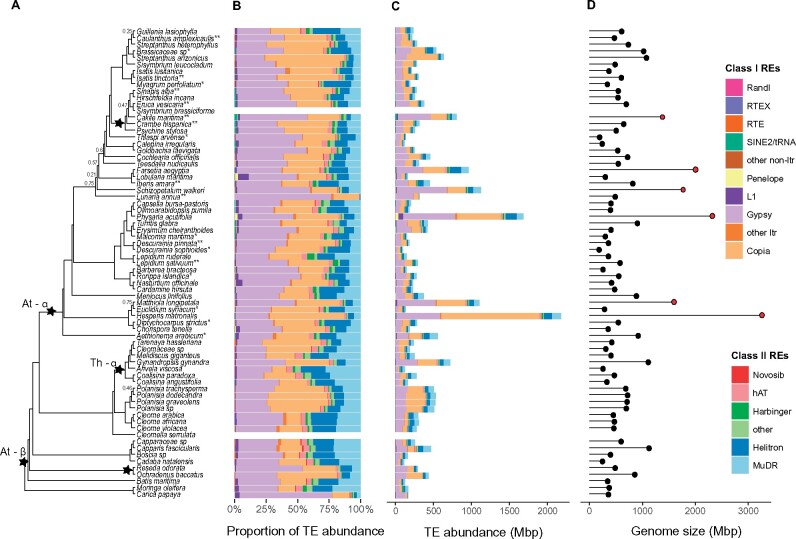
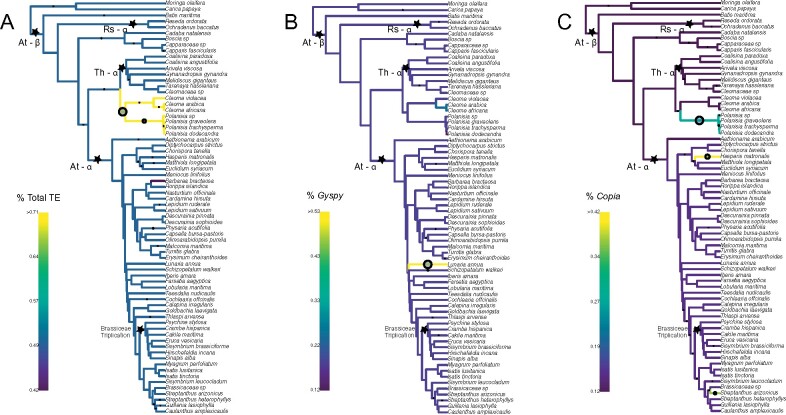
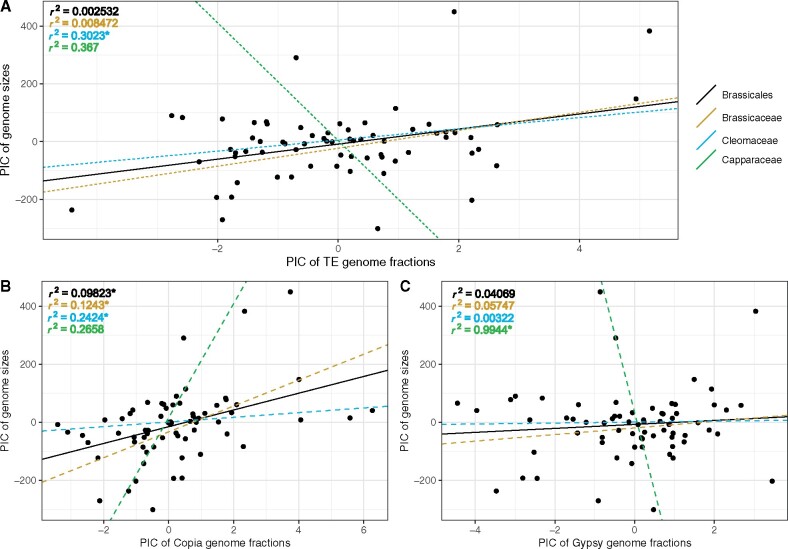
Genome sizes of plants have long piqued the interest of researchers due to the vast differences among organisms. However, the mechanisms that drive size differences have yet to be fully understood. Two important contributing factors to genome size are expansions of repetitive elements, such as transposable elements (TEs), and whole-genome duplications (WGD). Although studies have found correlations between genome size and both TE abundance and polyploidy, these studies typically test for these patterns within a genus or species. The plant order Brassicales provides an excellent system to further test if genome size evolution patterns are consistent across larger time scales, as there are numerous WGDs. This order is also home to one of the smallest plant genomes, Arabidopsis thaliana-chosen as the model plant system for this reason-as well as to species with very large genomes. With new methods that allow for TE characterization from low-coverage genome shotgun data and 71 taxa across the Brassicales, we confirm the correlation between genome size and TE content, however, we are unable to reconstruct phylogenetic relationships and do not detect any shift in TE abundance associated with WGD.
由于生物之间存在巨大差异,植物基因组大小长期以来一直引起研究人员的兴趣。然而,驱动大小差异的机制尚未完全被理解。基因组大小的两个重要影响因素是重复元件(如转座元件(TEs))和全基因组加倍(WGD)的扩张。尽管研究发现基因组大小与 TE 丰度和多倍体之间存在相关性,但这些研究通常在属或种内测试这些模式。植物目芸薹目为进一步测试基因组大小演化模式是否在较大的时间尺度上一致提供了极好的系统,因为这里有许多 WGD。该目也是最小的植物基因组之一拟南芥的所在地——选择它作为该系统的模式植物正是因为这个原因——以及基因组非常大的物种的所在地。通过允许使用来自低覆盖度基因组鸟枪法数据和 Brassicales 中的 71 个分类群的 TE 特征的新方法,我们证实了基因组大小与 TE 含量之间的相关性,然而,我们无法重建系统发育关系,也没有检测到与 WGD 相关的 TE 丰度的变化。