Althagafi Nebras
Department of Pediatric Dentistry and Orthodontics, College of Dentistry, Taibah University, AlMadinah AlMunawwarah, 42353, Saudi Arabia.
Clin Cosmet Investig Dent. 2021 May 7;13:163-172. doi: 10.2147/CCIDE.S304216. eCollection 2021.
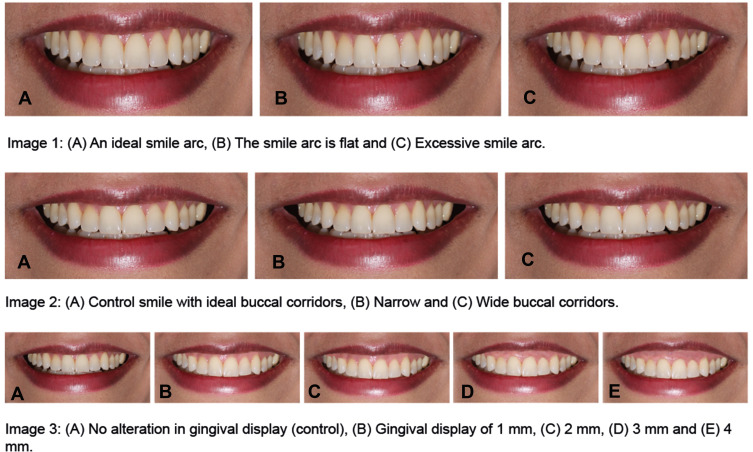
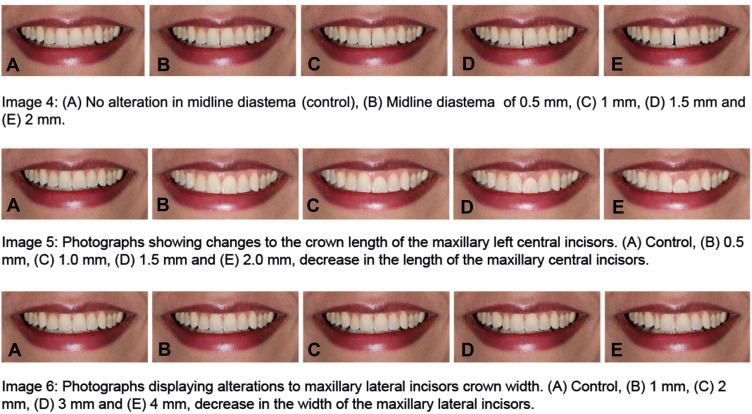
To evaluate the perception of six esthetic components of the smile among dental students and whether such a perception was influenced by different education levels and gender.
This was an analytical cross-sectional study. A self-administered questionnaire was applied to all students (n=182) at clinical levels (year four and five) to evaluate a total of 6 ideal images (smile arc [SA], buccal corridor [BC], gingival display [GD], midline diastema [MD], crown length [CL] and width [CW]). In addition, students were asked to evaluate 20 altered images of these ideal images. A 10-point visual analogue scale was used to assess the ideal images, with the right end of the scale labeled "attractive smile" and represented by the number 10 and the left end of the scale labeled "unattractive smile" and represented by the number 0. The opposite scoring was applied for the altered esthetics smile images. Descriptive statistics was run to report sample characteristics, and the Mann-Whitney -tests were performed to compare clinical levels and gender on aspects of esthetic smile.
The response rate was 80% (77 females and 68 males). Students at level five scored statistically significantly (p<0.001) higher towered attractive esthetic smile in ideal SA, while students at level four scored statistically significantly (p=0.016 and 0.006, respectively) higher towered attractive esthetic smile in ideal GD and CL. At altered smile esthetics images evaluation, fifth year dental students scored statistically significantly (p=0.030, 0.026 and 0.028, respectively) higher towered unattractive esthetic smile in two altered images of SA and one of BC. In contrast, fourth year dental students scored statistically significantly (p=0.022, 0.048, 0.027, respectively) higher towered unattractive esthetic smile in one altered image of GD, midline diastema and crown width. Males in year four were more likely to score higher than females for ideal images meanwhile females in year five scored higher than males towards attractive smile in ideal images. Males and females differences in scoring ideal images on both levels were generally non-significant (P>0.05) although males were statistically significantly to score higher than females towards unattractive images in both levels (p<0.05).
Dental students at the fifth-year level of study had higher perception of esthetic components of smile than those at the fourth-year level. At each level of study, female dental students apparently had higher perceptions of smile esthetics than males.
评估牙科学生对微笑的六个美学组成部分的认知,以及这种认知是否受到不同教育水平和性别的影响。
这是一项分析性横断面研究。对所有临床水平(四年级和五年级)的学生(n = 182)进行了一份自填式问卷,以评估总共6张理想图像(微笑弧度[SA]、颊间隙[BC]、牙龈暴露[GD]、中线间隙[MD]、牙冠长度[CL]和宽度[CW])。此外,要求学生对这些理想图像的20张改变后的图像进行评估。使用10分视觉模拟量表来评估理想图像,量表右端标记为“有吸引力的微笑”,用数字10表示,量表左端标记为“无吸引力的微笑”,用数字0表示。对改变后的美学微笑图像采用相反的评分方式。进行描述性统计以报告样本特征,并进行曼-惠特尼检验以比较临床水平和性别在美学微笑方面的差异。
回复率为80%(77名女性和68名男性)。五年级学生在理想SA中对更具吸引力的美学微笑的评分在统计学上显著更高(p<0.001),而四年级学生在理想GD和CL中对更具吸引力的美学微笑的评分在统计学上显著更高(分别为p = 0.016和0.006)。在改变后的微笑美学图像评估中,五年级牙科学生在SA的两张改变后的图像和BC的一张改变后的图像中对无吸引力的美学微笑的评分在统计学上显著更高(分别为p = 0.030、0.026和0.028)。相比之下,四年级牙科学生在GD、中线间隙和牙冠宽度的一张改变后的图像中对无吸引力的美学微笑的评分在统计学上显著更高(分别为p = 0.022、0.048、0.027)。四年级的男性在理想图像上得分高于女性,而五年级的女性在理想图像中对有吸引力的微笑的评分高于男性。尽管在两个水平上男性在无吸引力图像上的得分在统计学上显著高于女性(p<0.05),但两个水平上男性和女性在理想图像评分上的差异一般不显著(P>0.05)。
五年级的牙科学生对微笑美学组成部分的认知高于四年级的学生。在每个学习水平上,女性牙科学生对微笑美学的认知显然高于男性。