Song Jin, Ma Shiyong, Sokoll Lori J, Eguez Rodrigo V, Höti Naseruddin, Zhang Hui, Mohr Phaedre, Dua Renu, Patil Dattatraya, May Kristen Douglas, Williams Sierra, Arnold Rebecca, Sanda Martin G, Chan Daniel W, Zhang Zhen
Center for Biomarker Discovery and Translation, Department of Pathology, Johns Hopkins University School of Medicine, Baltimore, MD, 21287, USA.
Department of Oncology, Johns Hopkins University School of Medicine, Baltimore, MD, 21287, USA.
Theranostics. 2021 Apr 15;11(13):6214-6224. doi: 10.7150/thno.55676. eCollection 2021.
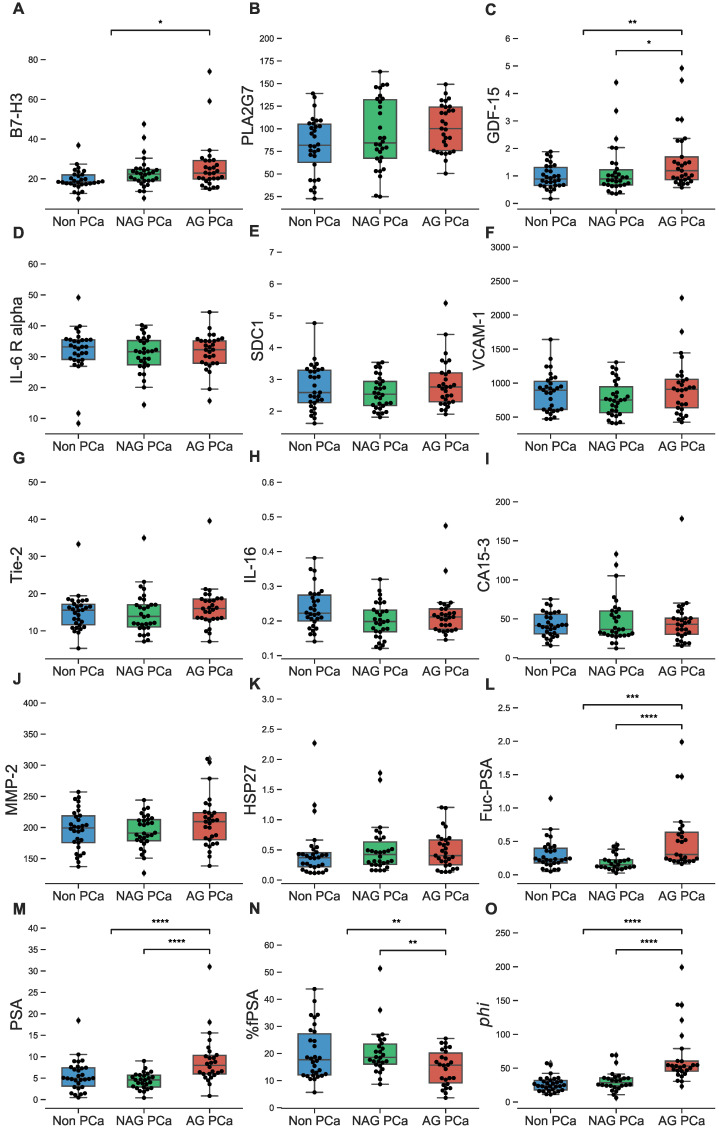
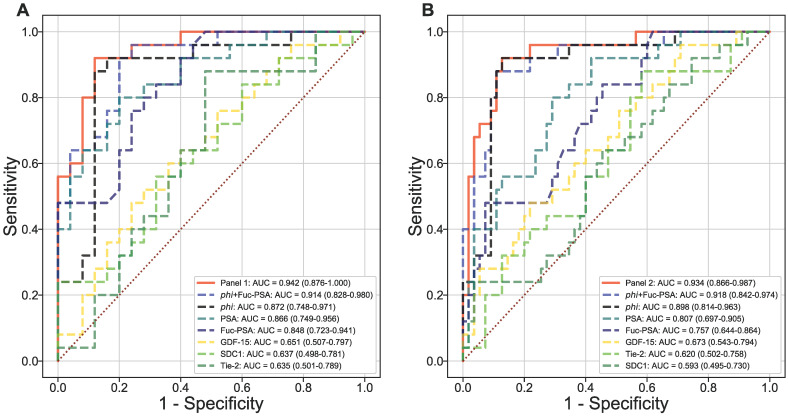
Current PSA-based tests used to detect prostate cancer (PCa) lack sufficient specificity, leading to significant overdetection and overtreatment. Our previous studies showed that serum fucosylated PSA (Fuc-PSA) and soluble TEK receptor tyrosine kinase (Tie-2) had the ability to predict aggressive (AG) PCa. Additional biomarkers are needed to address this significant clinical problem. A comprehensive Pubmed search followed by multiplex immunoassays identified candidate biomarkers associated with AG PCa. Subsequently, multiplex and lectin-based immunoassays were applied to a case-control set of sera from subjects with AG PCa, low risk PCa, and non-PCa (biopsy negative). These candidate biomarkers were further evaluated for their ability as panels to complement the prostate health index () in detecting AG PCa. When combined through logistic regression, two panel of biomarkers achieved the best performance: 1) Fuc-PSA, SDC1, and GDF-15 for the detection of AG from low risk PCa and 2) , Fuc-PSA, SDC1, and Tie-2 for the detection of AG from low risk PCa and non-PCa, with noticeable improvements in ROC analysis over alone (AUCs: 0.942 vs 0.872, and 0.934 vs 0.898, respectively). At a fixed sensitivity of 95%, the panels improved specificity with statistical significance in detecting AG from low risk PCa (76.0% vs 56%, =0.029), and from low risk PCa and non-PCa (78.2% vs 65.5%, =0.010). Multivariate panels of serum biomarkers identified in this study demonstrated clinically meaningful improvement over the performance of , and warrant further clinical validation, which may contribute to the management of PCa.
目前用于检测前列腺癌(PCa)的基于前列腺特异性抗原(PSA)的检测方法缺乏足够的特异性,导致大量过度检测和过度治疗。我们之前的研究表明,血清岩藻糖化PSA(Fuc-PSA)和可溶性TEK受体酪氨酸激酶(Tie-2)能够预测侵袭性(AG)PCa。需要更多的生物标志物来解决这一重大临床问题。通过全面的PubMed检索并随后进行多重免疫测定,确定了与AG PCa相关的候选生物标志物。随后,将基于多重和凝集素的免疫测定应用于一组来自AG PCa、低风险PCa和非PCa(活检阴性)受试者的病例对照血清。这些候选生物标志物作为检测组进一步评估其在检测AG PCa时补充前列腺健康指数()的能力。通过逻辑回归组合时,两组生物标志物表现最佳:1)Fuc-PSA、SDC1和GDF-15用于从低风险PCa中检测AG,2) 、Fuc-PSA、SDC1和Tie-2用于从低风险PCa和非PCa中检测AG,在ROC分析中与单独使用相比有显著改善(AUC分别为:0.942对0.872,以及0.934对0.898)。在固定敏感性为95%时,这些检测组在从低风险PCa中检测AG(76.0%对56%,=0.029)以及从低风险PCa和非PCa中检测AG(78.2%对65.5%,=0.010)时,特异性有统计学意义的提高。本研究中确定的血清生物标志物多变量检测组在性能上比有临床意义的改善,并值得进一步临床验证,这可能有助于PCa的管理。