Barreto Savio George, Pandol Stephen J
Division of Surgery and Perioperative Medicine, Flinders Medical Center, Adelaide, SA, Australia.
College of Medicine and Public Health, Flinders University, Los Angeles, SA, Australia.
Front Oncol. 2021 Apr 29;11:653289. doi: 10.3389/fonc.2021.653289. eCollection 2021.
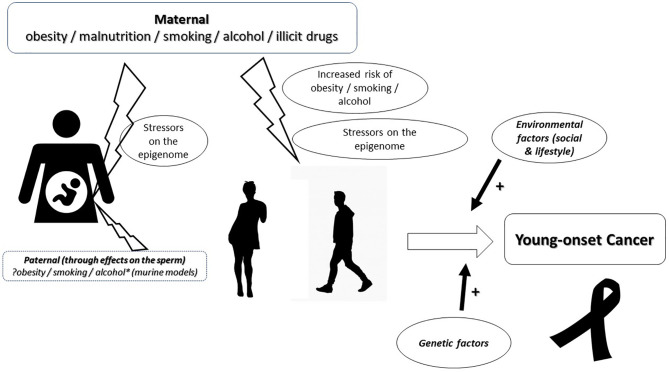
The last decade has witnessed a significant rise in cancers in young adults. This spectrum of solid organ cancers occurring in individuals under the age of 40 years (some reports extending the age-group to <50 years) in whom aetiology of cancer cannot be traced back to pre-existing familial cancer syndromes, is referred to as termed young-, or early- onset cancers. The underlying causes for young-onset carcinogenesis have remained speculative. We recently proposed a hypothesis to explain the causation of this entity. We propose that the risk for young-onset cancer begins in the perinatal period as a result of the exposure of the foetus to stressors, including maternal malnutrition, smoking or alcohol, with the consequent epigenomic events triggered to help the foetus cope/adapt. Exposure to the same stressors, early in the life of that individual, facilitates a re-activation of these 'responses designed to be protective' but ultimately resulting in a loss of regulation at a metabolic and/or genetic level culminating in the evolution of the neoplastic process. In this manuscript, we will provide a rationale for this hypothesis and present evidence to further support it by clarifying the pathways involved, including elucidating a role for Acetyl-CoA and its effect on the epigenome. We present strategies and experimental models that can be used to test the hypothesis. We believe that a concerted effort by experts in different, but complementary fields, such as epidemiology, genetics, and epigenetics united towards the common goal of deciphering the underlying cause for young-onset cancers is the urgent need. Such efforts might serve to prove, or disprove, the presented hypothesis. However, the more important aim is to develop strategies to reverse the disturbing trend of the rise in young-onset cancers.
在过去十年中,青年成年人患癌症的人数显著增加。这种发生在40岁以下个体(一些报告将年龄组扩大到<50岁)的实体器官癌症,其癌症病因无法追溯到既往的家族性癌症综合征,被称为青年或早发性癌症。早发性致癌的潜在原因一直存在推测。我们最近提出了一个假说来解释这一现象的病因。我们认为,早发性癌症的风险始于围产期,由于胎儿暴露于应激源,包括母亲营养不良、吸烟或饮酒,从而引发表观基因组事件以帮助胎儿应对/适应。在该个体生命早期接触相同的应激源,会促使这些“旨在保护的反应”重新激活,但最终导致代谢和/或基因水平的调节丧失,最终导致肿瘤过程的演变。在本手稿中,我们将为这一假说提供理论依据,并通过阐明所涉及的途径,包括阐明乙酰辅酶A的作用及其对表观基因组的影响,提供进一步支持它的证据。我们提出了可用于检验该假说的策略和实验模型。我们认为,不同但互补领域的专家,如流行病学、遗传学和表观遗传学领域的专家,为了解开早发性癌症的潜在病因这一共同目标而齐心协力是当务之急。这些努力可能有助于证明或反驳所提出的假说。然而,更重要的目标是制定策略来扭转早发性癌症上升这一令人不安的趋势。