Song Dong Juan, Shen Jun, Chen Min Hu, Liu Zhan Ju, Cao Qian, Hu Pin Jin, Gao Xiang, Qian Jia Ming, Wu Kai Chun, Lai Li Jie, Ran Zhi Hua
Division of Gastroenterology and Hepatology, Key Laboratory of Gastroenterology and Hepatology, Ministry of Health, Inflammatory Bowel Disease Research Center, Renji Hospital, School of Medicine, Shanghai Jiao Tong University, Shanghai Institute of Digestive Disease, Shanghai, China.
Department of Gastroenterology, The First Affiliated Hospital of Sun Yat-sen University, Guangzhou, China.
Front Med (Lausanne). 2021 Apr 28;8:621337. doi: 10.3389/fmed.2021.621337. eCollection 2021.
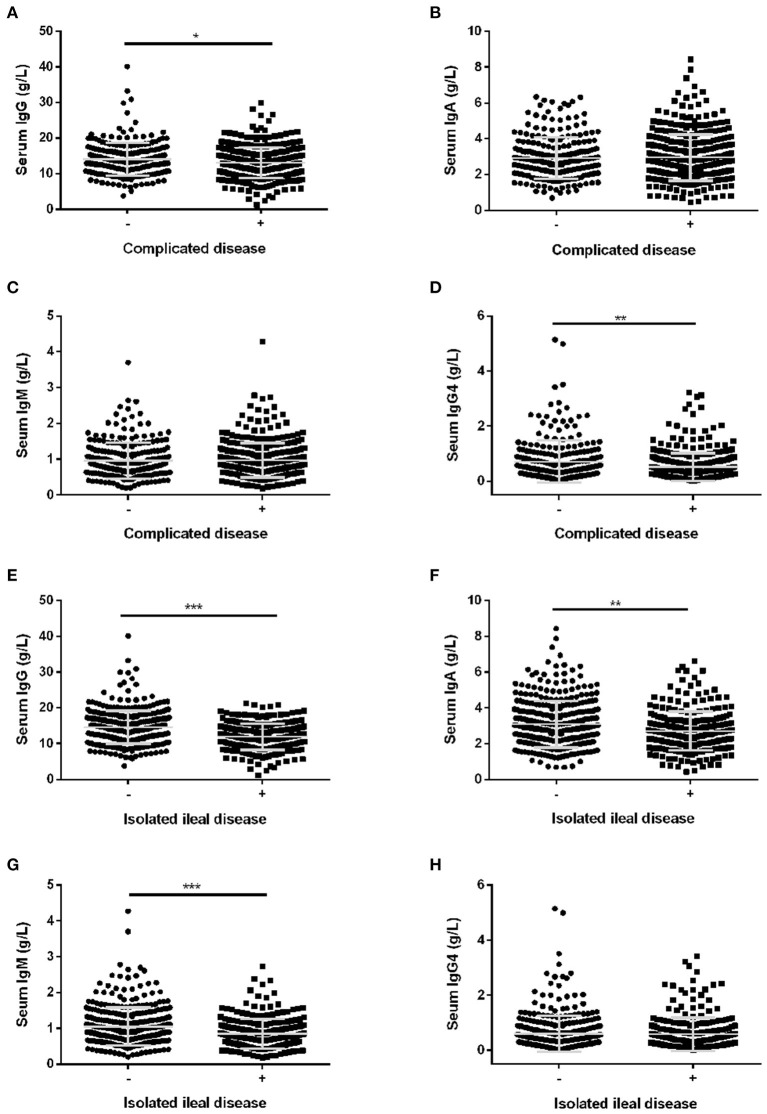
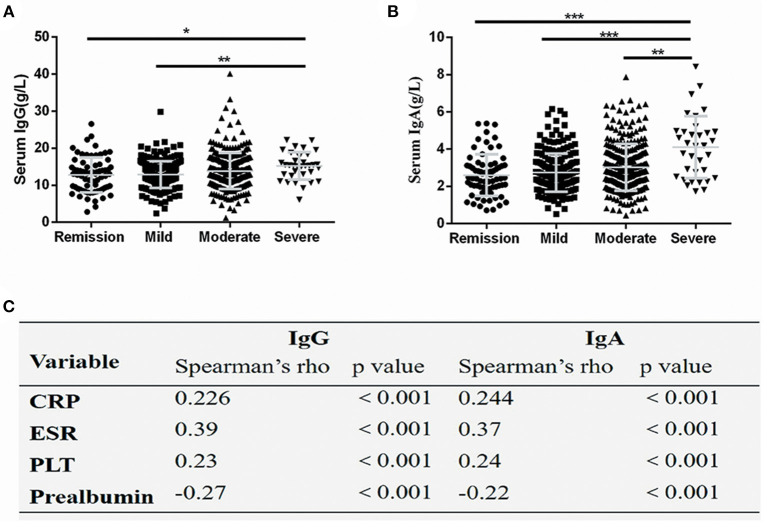
Serum immunoglobulins were reported to be associated with clinical characteristics of inflammatory bowel disease. However, whether a difference exists in the serum immunoglobulins levels in patients with Crohn's disease (CD) with different disease location and behavior phenotypes remains unclear. Therefore, this study aimed to explore the associations of serum immunoglobulins levels with specific CD phenotypes. Patients with CD having recorded serum immunoglobulins levels were recruited through multicenter collaborative efforts. The associations between serum immunoglobulins levels and distinct phenotypes of CD were evaluated using multiple logistic regression models. A total of 608 patients with CD were included in the study. Elevated (above the upper limit of normal) serum immunoglobulin G (IgG), IgA, IgM, and IgG4 were identified in 24.5, 17.4, 2.1, and 8.2% of patients, respectively. Elevated serum IgG4 levels negatively correlated with complicated disease behavior [odds ratio (OR) 0.49, 95% confidence interval (CI) 0.26-0.92]. Elevated serum IgG was linked to isolated ileal disease with an OR of 0.37 (95% CI 0.23-0.61). The ORs of isolated ileal disease progressively reduced across increasing quartiles of IgG ( for trend < 0.001). The adjusted ORs of isolated ileal disease for increasing quartiles of IgM were 1.82 (1.07-3.1), 1.92 (1.14-3.24), 1.17 (0.69-1.98), and 1 ( for trend = 0.008). Besides, serum IgA and IgG levels significantly correlated with several disease activity indices. These results suggested that certain serum immunoglobulins were associated with specific disease phenotypes of CD. Further investigations to account for the associations are warranted.
据报道,血清免疫球蛋白与炎症性肠病的临床特征相关。然而,不同疾病部位和行为表型的克罗恩病(CD)患者血清免疫球蛋白水平是否存在差异仍不清楚。因此,本研究旨在探讨血清免疫球蛋白水平与特定CD表型之间的关联。通过多中心合作招募了记录有血清免疫球蛋白水平的CD患者。使用多重逻辑回归模型评估血清免疫球蛋白水平与CD不同表型之间的关联。本研究共纳入608例CD患者。分别有24.5%、17.4%、2.1%和8.2%的患者血清免疫球蛋白G(IgG)、IgA、IgM和IgG4升高(高于正常上限)。血清IgG4水平升高与复杂疾病行为呈负相关[比值比(OR)0.49,95%置信区间(CI)0.26 - 0.92]。血清IgG升高与孤立性回肠疾病相关,OR为0.37(95%CI 0.23 - 0.61)。随着IgG四分位数增加,孤立性回肠疾病的OR逐渐降低(趋势<0.001)。IgM四分位数增加时,孤立性回肠疾病的校正OR分别为1.82(1.07 - 3.1)、1.92(1.14 - 3.24)、1.17(0.69 - 1.98)和1(趋势=0.008)。此外,血清IgA和IgG水平与多个疾病活动指数显著相关。这些结果表明,某些血清免疫球蛋白与CD的特定疾病表型相关。有必要进一步研究以解释这些关联。