Zhuang Huifu, Wang Chen, Wang Yanan, Jin Tao, Huang Rong, Lin Zihong, Wang Yuhua
Service Center for Information Technology, Kunming Institute of Botany, Chinese Academy of Sciences, Kunming, 650201, China.
Yunnan Key Laboratory for Wild Plant Resources, Kunming Institute of Botany, Chinese Academy of Sciences, Kunming, 650201, China.
Plant Divers. 2020 Sep 12;43(2):134-141. doi: 10.1016/j.pld.2020.09.003. eCollection 2021 Apr.
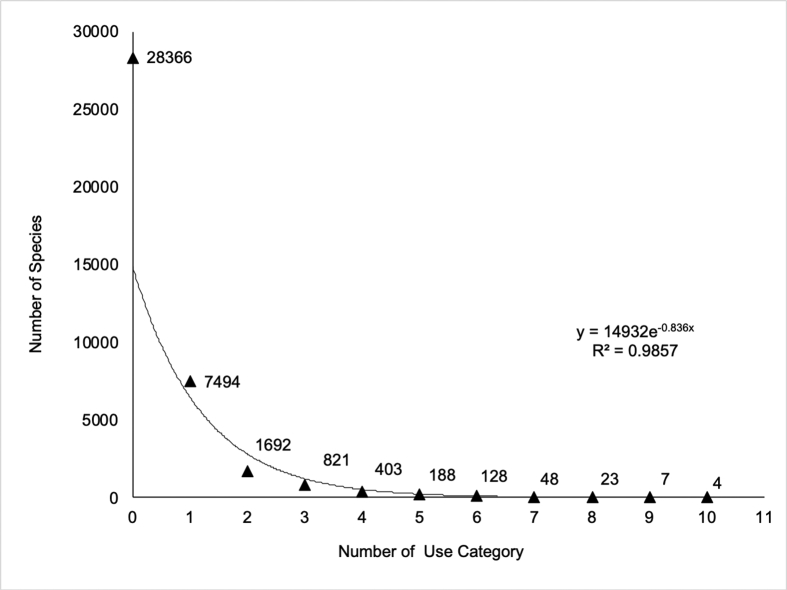
Of all types of interactions between humans and plants, the utilization of plants by people is the most direct and influential. China has a long history of using native plants and a large body of recorded knowledge on uses. Here, we present an inventory of plant uses in China based on an extensive survey of the literature. Twelve categories of usage are recognized (medicinal, edible, etc.), these categories being chosen according to an integration of various current standards. A total of 50,521 use-citations were recorded, covering 10,808 species and infraspecies, representing 28% of the Chinese flora. Additional information is included in the dataset on taxonomy and endangerment status. Analysis of the data reveals that the eight plant families with the greatest numbers of species used in China, namely Asteraceae, Fabaceae, Rosaceae, Ranunculaceae, Poaceae, Lamiaceae, Orchidaceae, and Liliaceae, are also the top eight most species-rich Chinese plant families. However, there are some families that are over-represented or under-representation in certain use categories, compared with their relative abundance in the total flora. There are indications that rare and endangered species are being subject to some degree of over-exploitation. A disproportionately high number of used species are Chinese endemics (3552 species, representing over 33% of used species). A total of 20% of used species have been classified as threatened nationally or globally, according to at least one of the various threat assessments that have been made for the Chinese flora. This comprehensive inventory of the useful plants of China, with relevant ethnobotanical information included, provides a baseline for further studies of plant resources. It will be useful in follow-up research. The scientific dataset it contains will be useful for the protection and sustainable utilization of plant resources in China.
在人类与植物的所有互动类型中,人类对植物的利用是最直接且最具影响力的。中国利用本土植物的历史悠久,并有大量关于用途的记载知识。在此,我们基于对文献的广泛调查,呈现了一份中国植物用途清单。确认了十二类用途(药用、食用等),这些类别是根据多种现行标准综合选定的。共记录了50521条用途引用,涵盖10808个物种及种下分类单元,占中国植物区系的28%。数据集中还包含了关于分类学和濒危状况的附加信息。数据分析表明,在中国被利用物种数量最多的八个植物科,即菊科、豆科、蔷薇科、毛茛科、禾本科、唇形科、兰科和百合科,也是中国物种最丰富的前八个植物科。然而,与它们在整个植物区系中的相对丰度相比,有些科在某些用途类别中的占比过高或过低。有迹象表明,珍稀濒危物种正受到一定程度的过度开发。被利用的物种中有相当高比例是中国特有种(3552种,占被利用物种的33%以上)。根据对中国植物区系所做的各种威胁评估中的至少一种,共有20%的被利用物种被列为国家或全球受威胁物种。这份包含相关民族植物学信息的中国有用植物综合清单,为进一步研究植物资源提供了一个基线。它将对后续研究有用。其中包含的科学数据集将有助于中国植物资源的保护和可持续利用。