Rinfret Stéphane, Jahan Israth, McKenzie Kevin, Dendukuri Nandini, Bainey Kevin R, Mansour Samer, Natarajan Madhu, Ybarra Luiz F, Chong Aun-Yeong, Bérubé Simon, Breton Robert, Curtis Michael J, Rodés-Cabau Josep, Shy Shoaib Amlani, Bagherli Alireza, Ball Warren, Barolet Alan, Beydoun Hussein K, Brass Neil, Chan Albert W, Colizza Franco, Constance Christian, Fam Neil P, Gobeil François, Haghighat Tinouch, Hodge Steven, Joyal Dominique, Kim Hahn Hoe, Lutchmedial Sohrab, MacDougall Andrea, Malik Paul, Miner Steve, Minhas Kunal, Orvold Jason, Palisaitis Donald, Parfrey Brendan, Potvin Jean-Michel, Puley Geoffrey, Radhakrishnan Sam, Spaziano Marco, Tanguay Jean-François, Vijayaraghaban Ram, Webb John G, Zimmermann Rodney H, Wood David A, Brophy James M
Division of Cardiology, McGill University Health Centre, McGill University, Montreal, Quebec, Canada.
Department of Medicine and Biostatistics, McGill University Health Centre, McGill University, Montreal, Quebec, Canada.
CJC Open. 2021 Sep;3(9):1125-1131. doi: 10.1016/j.cjco.2021.04.017. Epub 2021 May 12.
As a result of the COVID-19 pandemic first wave, reductions in ST-elevation myocardial infarction (STEMI) invasive care, ranging from 23% to 76%, have been reported from various countries. Whether this change had any impact on coronary angiography (CA) volume or on mechanical support device use for STEMI and post-STEMI mechanical complications in Canada is unknown.
We administered a Canada-wide survey to all cardiac catheterization laboratory directors, seeking the volume of CA use for STEMI performed during the period from March 1 2020 to May 31, 2020 (pandemic period), and during 2 control periods (March 1, 2019 to May 31, 2019 and March 1, 2018 to May 31, 2018). The number of left ventricular support devices used, as well as the number of ventricular septal defects and papillary muscle rupture cases diagnosed, was also recorded. We also assessed whether the number of COVID-19 cases recorded in each province was associated with STEMI-related CA volume.
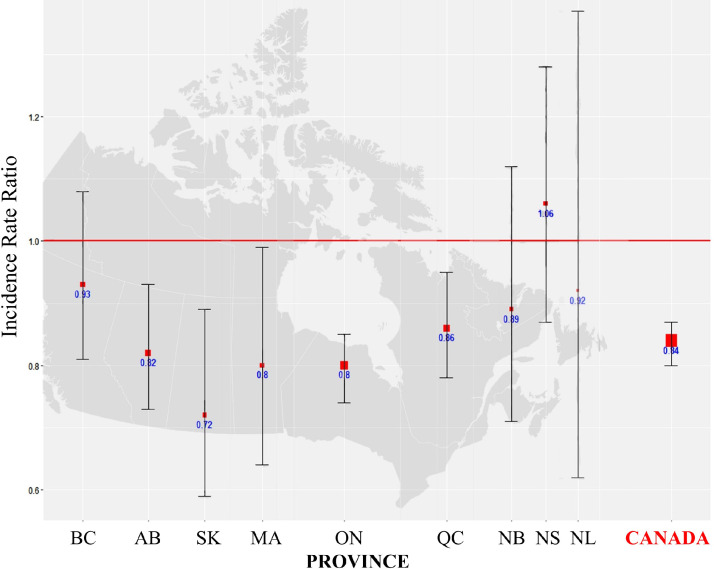
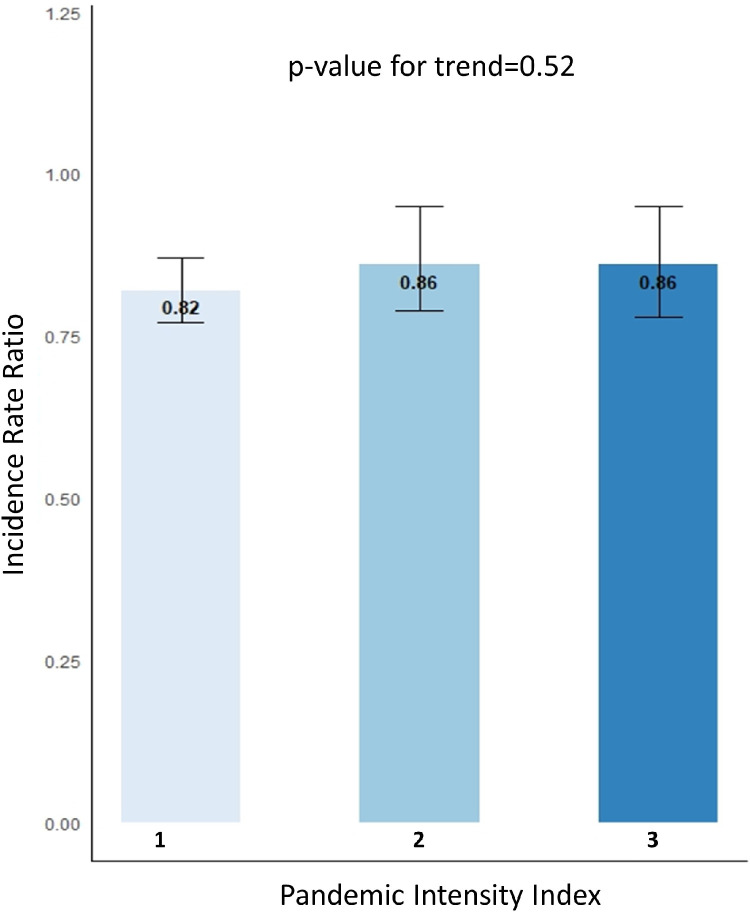
A total of 41 of 42 Canadian catheterization laboratories (98%) provided data. There was a modest but statistically significant 16% reduction (incidence rate ratio [IRR] 0.84; 95% confidence interval 0.80-0.87) in CA for STEMI during the first wave of the pandemic, compared to control periods. IRR was not associated with provincial COVID-19 caseload. We observed a 26% reduction (IRR 0.74; 95% confidence interval 0.61-0.89) in the use of intra-aortic balloon pump use for STEMI. Use of an Impella pump and mechanical complications from STEMI were exceedingly rare.
We observed a modest 16% decrease in use of CA for STEMI during the pandemic first wave in Canada, lower than the level reported in other countries. Provincial COVID-19 caseload did not influence this reduction.
由于新冠疫情第一波冲击,各国报告的ST段抬高型心肌梗死(STEMI)侵入性治疗减少幅度在23%至76%之间。在加拿大,这种变化是否对冠状动脉造影(CA)量或STEMI及STEMI后机械并发症的机械支持装置使用产生影响尚不清楚。
我们对加拿大所有心脏导管实验室主任进行了一项全国性调查,以了解2020年3月1日至2020年5月31日(疫情期间)以及两个对照期(2019年3月1日至2019年5月31日和2018年3月1日至2018年5月31日)期间用于STEMI的CA使用量。还记录了左心室支持装置的使用数量以及诊断出的室间隔缺损和乳头肌破裂病例数。我们还评估了每个省份记录的新冠病例数是否与STEMI相关的CA量有关。
42个加拿大导管实验室中有41个(98%)提供了数据。与对照期相比,疫情第一波期间用于STEMI的CA量有适度但具有统计学意义的16%下降(发病率比[IRR]0.84;95%置信区间0.80 - 0.87)。IRR与省级新冠病例数无关。我们观察到用于STEMI的主动脉内球囊泵使用量减少了26%(IRR 0.74;95%置信区间0.61 - 0.89)。Impella泵的使用以及STEMI的机械并发症极为罕见。
我们观察到加拿大疫情第一波期间用于STEMI的CA使用量适度下降了16%,低于其他国家报告的水平。省级新冠病例数并未影响这一下降。