Griffith Criminology Institute, Mt Gravatt, Brisbane, Queensland, Australia.
Skills for Employment Investment Program (SEIP) Project, Finance Division, Ministry of Finance, Dhaka, Bangladesh.
PLoS One. 2021 May 17;16(5):e0251419. doi: 10.1371/journal.pone.0251419. eCollection 2021.
Early termination of exclusive breastfeeding (EBF) and postpartum depression (PPD) are both recognized as global health problems. Recent literature reviews demonstrate a notable link between PPD and breastfeeding outcomes, however, the underlying mechanisms linking the two remain unclear.
The aim of the study is to: 1) explore the comparative risk for PPD among new mothers who terminated EBF before the 6-month mark, compared to those who did not; and 2) test whether maternal stress and social support operate to mediate and/or moderate the relationship between EBF and PPD.
Between October 2015 and January 2016, a cross-sectional study was carried out among 426 new mothers of Bangladesh who were six months postpartum.
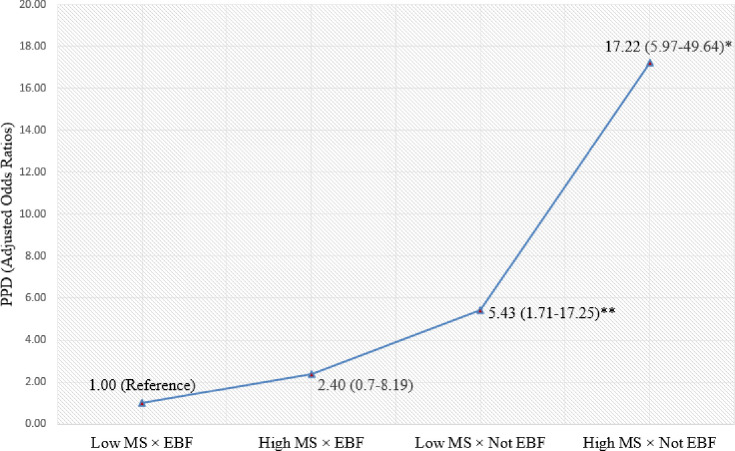
Based on the multivariate logistic regression model, non-exclusively breastfeeding mothers were 7.58-fold more likely to experience PPD (95% CI [3.94, 14.59]) than exclusively breastfeeding mothers. Additionally, maternal stress and social support not only partially mediate the relationship between EBF and PPD but also substantially moderate this relationship. Specifically, the odds of PPD are significantly higher among mothers who had early EBF interruption in conjunction with increased stress levels and limited social support.
Current evidence suggests that concurrent screening for EBF difficulties and maternal stress are important red flags that might hint at complications even before mother's screen positive for PPD. Support and care from family members can provide assistance in overcoming this issue.
早期终止纯母乳喂养(EBF)和产后抑郁症(PPD)均被认为是全球性健康问题。最近的文献综述表明,PPD 与母乳喂养结果之间存在显著关联,但两者之间的潜在机制仍不清楚。
本研究旨在:1)探讨在 6 个月前终止 EBF 的新妈妈中 PPD 的相对风险,与未终止 EBF 的新妈妈相比;2)检验母亲压力和社会支持是否在 EBF 和 PPD 之间起中介和/或调节作用。
2015 年 10 月至 2016 年 1 月期间,在孟加拉国进行了一项横断面研究,共纳入 426 名产后 6 个月的新妈妈。
基于多变量逻辑回归模型,非纯母乳喂养的母亲发生 PPD 的可能性是纯母乳喂养母亲的 7.58 倍(95%CI[3.94, 14.59])。此外,母亲压力和社会支持不仅部分中介了 EBF 和 PPD 之间的关系,而且还显著调节了这种关系。具体而言,在早期 EBF 中断的同时,压力水平升高和社会支持有限的母亲中,PPD 的发生几率显著更高。
目前的证据表明,同时筛查 EBF 困难和母亲压力是重要的预警信号,可能在母亲出现 PPD 之前就提示存在并发症。家庭成员的支持和关怀可以提供帮助,克服这一问题。