Unité de Surveillance Démographique et de Santé (Kaya-HDSS), Institut de Recherche en Sciences de la Santé (IRSS), 03 B.P. 7047, Ouagadougou, 03, Burkina Faso.
Ecole doctorale Sciences de la Santé, Université Joseph KI-ZERBO, 03 B.P. 7021, Ouagadougou, 03, Burkina Faso.
BMC Public Health. 2021 May 19;21(1):946. doi: 10.1186/s12889-021-10964-w.
After testing the interventions for improving the prevalence of contraceptive use, very few studies have measured the long-term effects thereafter the end of the implementation. This study aimed to measure Yam Daabo interventions' effects on contraceptive use in Burkina Faso at twelve months after completion of the intervention.
Yam Daabo was a two-group, multi-intervention, single-blind, cluster randomized controlled trial. Interventions comprised refresher training for the provider, a counseling tool, supportive supervision, availability of contraceptive services 7 days a week, client appointment cards, and invitation letters for partners. We used generalized linear mixed-effects models (log Poisson) to compare the modern contraceptive prevalence at 12 months post-intervention in the two groups. We collected data between September and November 2018. We conducted an intention-to-treat analysis and adjusted the prevalence ratios on cluster effects and unbalanced baseline characteristics.
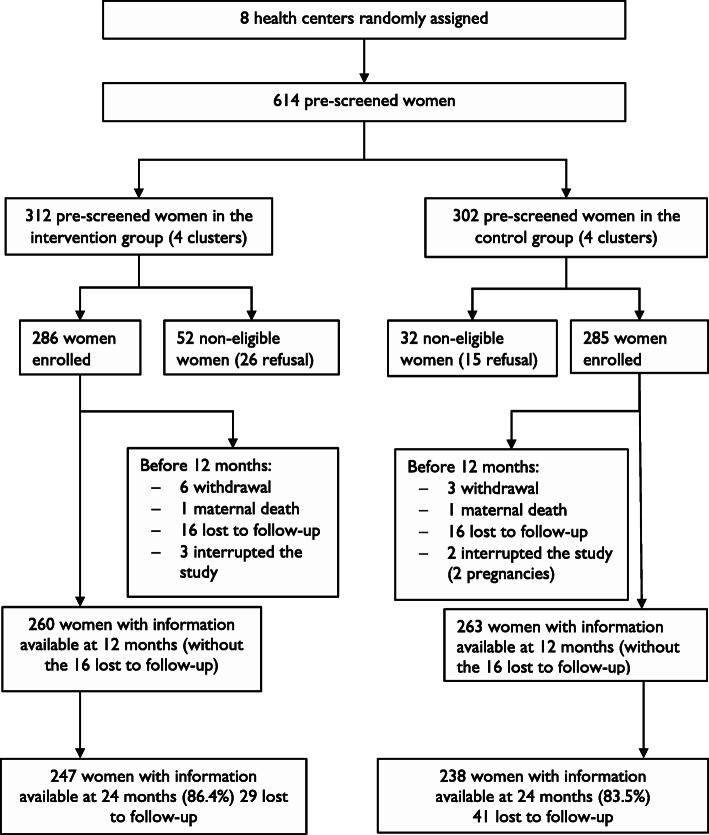
Twelve months after the completion of the Yam Daabo trial, we interviewed 87.4% (485 out of 555 women with available data at 12 months, that is, 247/276 in the intervention group (89.5%) and 238/279 in the control group (85.3%). No difference was observed in the use of hormonal contraceptive methods between the intervention and control groups (adjusted prevalence ratio = 1.21; 95% confidence interval [CI] = [0.91-1.61], p = 0.191). By contrast, women in the intervention group were more likely to use long-acting reversible contraceptives (LARC) than those in the control group (adjusted prevalence ratio = 1.35; 95% CI = [1.08-1.69], p = 0.008).
Twelve months after completion of the intervention, we found no significant difference in hormonal contraceptive use between women in the intervention and their control group counterparts. However, women in the intervention group were significantly more likely to use long-acting reversible contraceptives than those in the control group.
The trial registration number at the Pan African Clinical Trials Registry is PACTR201609001784334 . The date of the first registration is 27/09/2016.
在测试了提高避孕措施普及率的干预措施后,很少有研究在干预结束后测量其长期效果。本研究旨在测量布基纳法索的 Yam Daabo 干预措施在干预结束后 12 个月对避孕措施使用的影响。
Yam Daabo 是一项两组成、多干预、单盲、群组随机对照试验。干预措施包括为提供者提供强化培训、咨询工具、支持性监督、每周 7 天提供避孕服务、预约卡和伴侣邀请信。我们使用广义线性混合效应模型(对数泊松)比较两组在干预后 12 个月的现代避孕措施普及率。我们于 2018 年 9 月至 11 月间收集数据。我们进行了意向治疗分析,并根据群组效应和不平衡的基线特征调整了流行率比。
在 Yam Daabo 试验完成 12 个月后,我们对 87.4%(485 名 12 个月时有数据的妇女,即干预组 247/276 名和对照组 238/279 名)进行了访谈。干预组和对照组在激素避孕方法的使用方面没有差异(调整后的流行率比=1.21;95%置信区间[CI]=[0.91-1.61],p=0.191)。相比之下,干预组的妇女比对照组更有可能使用长效可逆避孕方法(LARC)(调整后的流行率比=1.35;95%CI=[1.08-1.69],p=0.008)。
干预结束 12 个月后,我们发现干预组和对照组妇女在激素避孕方法的使用方面没有显著差异。然而,干预组的妇女比对照组更有可能使用长效可逆避孕方法。
该试验在泛非临床试验注册中心的注册号为 PACTR201609001784334,首次注册日期为 2016 年 9 月 27 日。