Division of Psychology, Department of Clinical Neuroscience, Karolinska Institutet, Stockholm, Sweden.
Department of Social and Behavioral Sciences, Yale University School of Public Health, New Haven, CT, USA.
Eur J Public Health. 2021 Oct 11;31(4):803-808. doi: 10.1093/eurpub/ckab032.
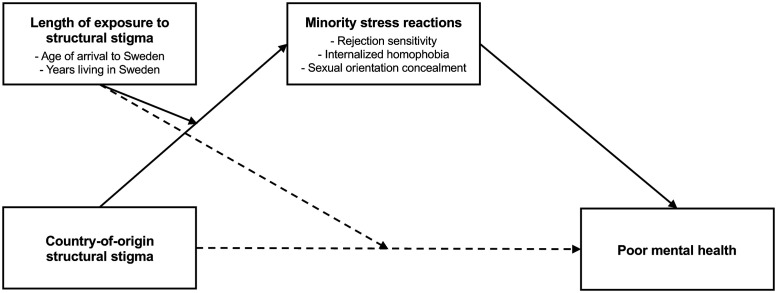
Increasing evidence suggests that structural stigma (e.g. discriminatory laws, policies and population attitudes) can give rise to minority stress reactions (i.e. rejection sensitivity, internalized homophobia and identity concealment) to compromise sexual minorities' mental health. Yet, many sexual minorities encounter divergent structural stigma climates over the life course, with potential implications for their experience of minority stress reactions and mental health. We take advantage of sexual minority male migrants' lifecourse-varying exposures to structural stigma contexts to examine this possibility.
A sample of 247 sexual minority men who had migrated from 71 countries to the low-structural-stigma context of Sweden completed a survey regarding migration experiences, minority stress reactions and mental health. This survey was linked to objective indices of structural stigma present in these men's countries of origin, diverse in terms of structural stigma.
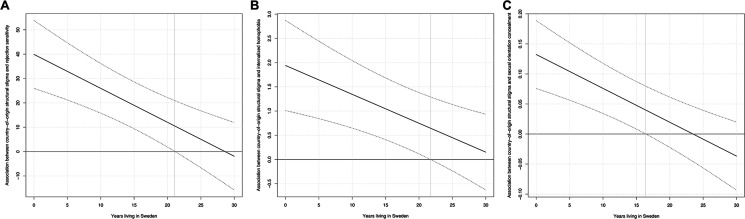
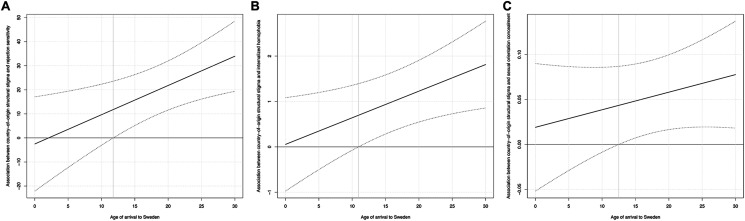
Country-of-origin structural stigma was significantly associated with poor mental health and this association was mediated by rejection sensitivity and internalized homophobia, but only among those who arrived to Sweden at an older age and more recently.
Prolonged exposure to high levels of structural stigma can give rise to stressful cognitive, affective and behavioural coping patterns to jeopardize sexual minority men's mental health; yet, these consequences of structural stigma may wane with increased duration of exposure to more supportive structural contexts.
越来越多的证据表明,结构性污名(例如歧视性法律、政策和人口态度)可能会引发少数群体应激反应(即拒绝敏感、内化的恐同和身份隐瞒),从而损害性少数群体的心理健康。然而,许多性少数群体在整个生命过程中会遇到不同的结构性污名环境,这可能会对他们经历少数群体应激反应和心理健康产生影响。我们利用性少数男性移民在生命过程中不断接触结构性污名环境的机会来检验这种可能性。
一组从 71 个国家移民到瑞典低结构性污名环境的 247 名性少数男性完成了一份关于移民经历、少数群体应激反应和心理健康的调查。这项调查与这些男性原籍国存在的结构性污名的客观指标相关联,这些国家在结构性污名方面存在多样性。
原籍国的结构性污名与心理健康状况不佳显著相关,这种关联通过拒绝敏感和内化的恐同来介导,但仅在那些年龄较大和最近才移民到瑞典的人中间存在。
长期接触高水平的结构性污名可能会导致性少数男性产生应激性认知、情感和行为应对模式,从而危害他们的心理健康;然而,随着接触更支持性的结构性环境的时间延长,结构性污名的这些后果可能会减弱。