Department of Biochemistry, Faculty of Medicine, Urmia University of Medical Sciences, 5714783734, Urmia, Iran.
Cellular and Molecular Research Center, Urmia University of Medical Sciences, 5714783734, Urmia, Iran.
Anal Bioanal Chem. 2021 Jul;413(16):4137-4159. doi: 10.1007/s00216-021-03377-6. Epub 2021 May 18.
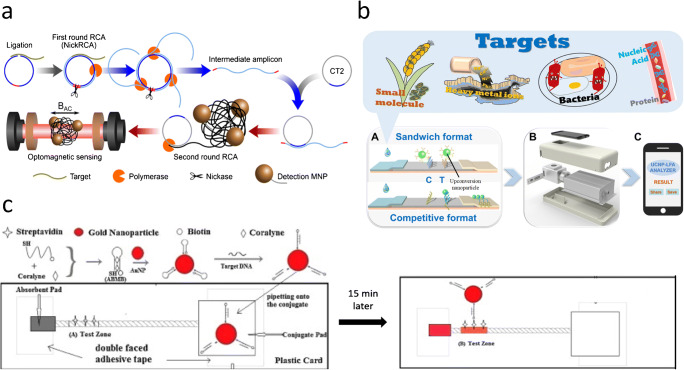
Coronavirus disease 2019 (COVID-19) pandemic is currently a serious global health threat. While conventional laboratory tests such as quantitative real-time polymerase chain reaction (qPCR), serology tests, and chest computerized tomography (CT) scan allow diagnosis of COVID-19, these tests are time-consuming and laborious, and are limited in resource-limited settings or developing countries. Point-of-care (POC) biosensors such as chip-based and paper-based biosensors are typically rapid, portable, cost-effective, and user-friendly, which can be used for COVID-19 in remote settings. The escalating demand for rapid diagnosis of COVID-19 presents a strong need for a timely and comprehensive review on the POC biosensors for COVID-19 that meet ASSURED criteria: Affordable, Sensitive, Specific, User-friendly, Rapid and Robust, Equipment-free, and Deliverable to end users. In the present review, we discuss the importance of rapid and early diagnosis of COVID-19 and pathogenesis of COVID-19 along with the key diagnostic biomarkers. We critically review the most recent advances in POC biosensors which show great promise for the detection of COVID-19 based on three main categories: chip-based biosensors, paper-based biosensors, and other biosensors. We subsequently discuss the key benefits of these biosensors and their use for the detection of antigen, antibody, and viral nucleic acids. The commercial POC biosensors for COVID-19 are critically compared. Finally, we discuss the key challenges and future perspectives of developing emerging POC biosensors for COVID-19. This review would be very useful for guiding strategies for developing and commercializing rapid POC tests to manage the spread of infections.Graphical abstract.
新型冠状病毒病(COVID-19)大流行目前是一项严重的全球健康威胁。虽然常规实验室检测,如实时定量聚合酶链反应(qPCR)、血清学检测和胸部计算机断层扫描(CT),可用于诊断 COVID-19,但这些检测耗时费力,在资源有限的环境或发展中国家受到限制。即时检测(POC)生物传感器,如基于芯片和基于纸的生物传感器,通常快速、便携、具有成本效益且易于使用,可用于远程环境中的 COVID-19。对 COVID-19 快速诊断的需求不断增加,这强烈需要及时和全面地审查符合 ASSURED 标准的 COVID-19 POC 生物传感器:负担得起、敏感、特异、用户友好、快速、稳健、无需设备和可交付给最终用户。在本综述中,我们讨论了 COVID-19 快速和早期诊断的重要性以及 COVID-19 的发病机制和关键诊断生物标志物。我们批判性地回顾了基于三个主要类别(基于芯片的生物传感器、基于纸的生物传感器和其他生物传感器)的 COVID-19 POC 生物传感器的最新进展,这些传感器显示出在 COVID-19 检测方面的巨大潜力。我们随后讨论了这些生物传感器的关键优势及其用于检测抗原、抗体和病毒核酸的用途。对用于 COVID-19 的商业 POC 生物传感器进行了批判性比较。最后,我们讨论了开发新兴 COVID-19 POC 生物传感器所面临的关键挑战和未来展望。本综述将非常有助于指导开发和商业化快速 POC 检测以管理感染传播的策略。