Department of Internal Medicine, Hôpital Erasme, 808 Route de Lennik, 1070, Brussels, Belgium.
Institute for Medical Immunology, Université Libre de Bruxelles, 6041 Gosselies, Brussels, Belgium.
Semin Immunopathol. 2021 Jun;43(3):439-458. doi: 10.1007/s00281-021-00857-w. Epub 2021 May 19.
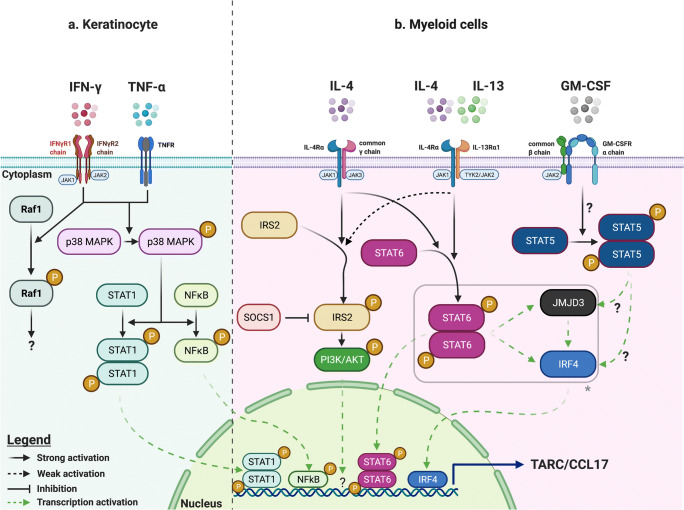
Eosinophilic disorders encompass a large spectrum of heterogeneous diseases sharing the presence of elevated numbers of eosinophils in blood and/or tissues. Among these disorders, the role of eosinophils can vary widely, ranging from a modest participation in the disease process to the predominant perpetrator of tissue damage. In many cases, eosinophilic expansion is polyclonal, driven by enhanced production of interleukin-5, mainly by type 2 helper cells (Th2 cells) with a possible contribution of type 2 innate lymphoid cells (ILC2s). Among the key steps implicated in the establishment of type 2 immune responses, leukocyte recruitment toward inflamed tissues is particularly relevant. Herein, the contribution of the chemo-attractant molecule thymus and activation-regulated chemokine (TARC/CCL17) to type 2 immunity will be reviewed. The clinical relevance of this chemokine and its target, C-C chemokine receptor 4 (CCR4), will be illustrated in the setting of various eosinophilic disorders. Special emphasis will be put on the potential diagnostic, prognostic, and therapeutic implications related to activation of the TARC/CCL17-CCR4 axis.
嗜酸性粒细胞疾病涵盖了一大类具有血液和/或组织中嗜酸性粒细胞数量升高的异质性疾病。在这些疾病中,嗜酸性粒细胞的作用差异很大,从对疾病过程的适度参与到组织损伤的主要元凶不等。在许多情况下,嗜酸性粒细胞扩增是多克隆的,这是由白细胞介素-5(主要由 2 型辅助性 T 细胞(Th2 细胞)产生)增强产生驱动的,2 型先天淋巴细胞(ILC2)可能也有一定的贡献。在涉及 2 型免疫反应建立的关键步骤中,白细胞向炎症组织的募集尤为重要。本文将回顾趋化因子分子胸腺激活调节趋化因子(TARC/CCL17)对 2 型免疫的贡献。在各种嗜酸性粒细胞疾病中,将说明这种趋化因子及其靶标 C-C 趋化因子受体 4(CCR4)的临床相关性。将特别强调与 TARC/CCL17-CCR4 轴的激活相关的潜在诊断、预后和治疗意义。