Relation Therapeutics, London, UK.
The Computer Laboratory, University of Cambridge, UK.
Brief Bioinform. 2021 Nov 5;22(6). doi: 10.1093/bib/bbab159.
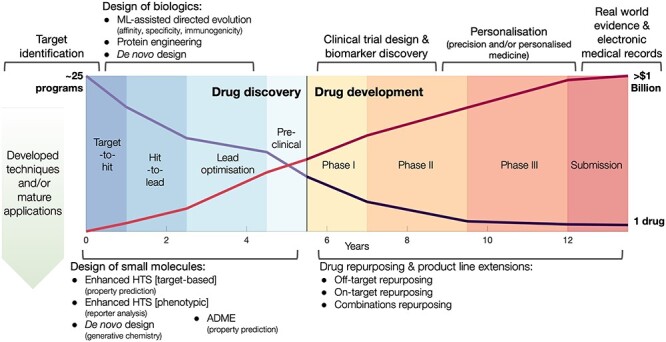
Graph machine learning (GML) is receiving growing interest within the pharmaceutical and biotechnology industries for its ability to model biomolecular structures, the functional relationships between them, and integrate multi-omic datasets - amongst other data types. Herein, we present a multidisciplinary academic-industrial review of the topic within the context of drug discovery and development. After introducing key terms and modelling approaches, we move chronologically through the drug development pipeline to identify and summarize work incorporating: target identification, design of small molecules and biologics, and drug repurposing. Whilst the field is still emerging, key milestones including repurposed drugs entering in vivo studies, suggest GML will become a modelling framework of choice within biomedical machine learning.
图机器学习(GML)因其能够对生物分子结构、它们之间的功能关系以及整合多组学数据集(以及其他类型的数据)进行建模而在制药和生物技术行业受到越来越多的关注。本文在药物发现和开发的背景下,对该主题进行了多学科的学术-工业综述。在介绍了关键术语和建模方法之后,我们按照药物开发管道的时间顺序进行,以确定和总结以下工作:目标识别、小分子和生物制品的设计以及药物再利用。虽然该领域仍在发展之中,但包括重新利用的药物进入体内研究在内的关键里程碑表明,GML 将成为生物医学机器学习中的首选建模框架。