From the Department of Medicine, Emory University School of Medicine, Atlanta, GA, USA.
Department of Medicine, Universidad de Oriente, Ciudad Bolivar, Venezuela.
J Clin Rheumatol. 2022 Mar 1;28(2):e368-e374. doi: 10.1097/RHU.0000000000001728.
BACKGROUND/OBJECTIVE: The Latin American population living with lupus lacks reliable and culturally competent health education resources. We describe a Spanish and Portuguese online program to educate Latin American people about lupus.
An extensive network of Latin American stakeholders participated in the program design, implementation, dissemination, and evaluation. Patients and rheumatologists selected core topics. Rheumatologists prepared the content using evidence-based data. Adaptations were conducted to meet the audience's health literacy and cultural values. Social media was used to post audiovisual resources and facilitate users' interactions with peers and educators, and a Web site was created to offer in-depth knowledge.
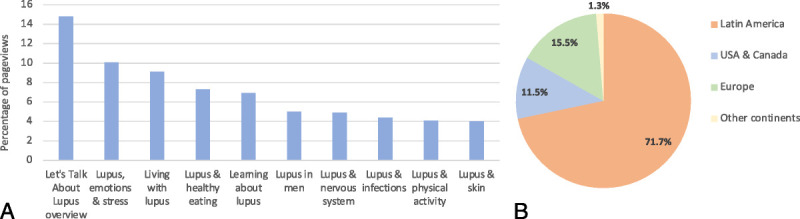
The most massive outreach was through Facebook, with more than 20 million people reached and 80,000 followers at 3 months, between the Spanish and Portuguese pages. Nearly 90% of followers were from Latin America. A high engagement and positive responses to a satisfaction survey indicate that Facebook users valued these resources. The Spanish and Portuguese Web sites accumulated more than 62,000 page views, and 71.7% of viewers were from Latin American.
The engagement of patients and stakeholders is critical to provide and disseminate reliable lupus education. Social media can be used to educate and facilitate interactions between people affected by lupus and qualified health care professionals. Social media-based health education has extensive and scalable outreach but is more taxing for the professional team than the Web site. However, the Web site is less likely to be used as a primary education source by Latin American people because they value social interactions when seeking lupus information.
背景/目的:拉丁美洲的狼疮患者缺乏可靠且文化上适宜的健康教育资源。我们描述了一个西班牙语和葡萄牙语的在线项目,旨在为拉丁美洲人提供狼疮教育。
广泛的拉丁美洲利益相关者网络参与了项目设计、实施、传播和评估。患者和风湿病学家选择了核心主题。风湿病学家使用基于证据的数据准备内容。进行了适应性调整,以满足受众的健康素养和文化价值观。利用社交媒体发布视听资源,并促进用户与同行和教育者的互动,同时创建了一个网站,提供深入的知识。
最广泛的传播途径是通过 Facebook,西班牙语和葡萄牙语页面在 3 个月内覆盖了超过 2000 万人,拥有 80000 名关注者。近 90%的关注者来自拉丁美洲。高参与度和对满意度调查的积极回应表明,Facebook 用户重视这些资源。西班牙语和葡萄牙语网站的页面浏览量超过 62000 次,71.7%的访问者来自拉丁美洲。
患者和利益相关者的参与对于提供和传播可靠的狼疮教育至关重要。社交媒体可用于教育和促进狼疮患者与合格的医疗保健专业人员之间的互动。基于社交媒体的健康教育具有广泛且可扩展的影响力,但对专业团队的要求比网站更高。然而,网站不太可能成为拉丁美洲人获取狼疮信息的主要教育来源,因为他们在寻求狼疮信息时更重视社交互动。