Vector Control Product Testing Unit, Ifakara Health Institute, Environmental Health and Ecological Sciences, P.O. Box 74, Bagamoyo, Tanzania.
Swiss Tropical & Public Health Institute, Socinstrasse 57, 4051, Basel, Switzerland.
Parasit Vectors. 2021 May 20;14(1):265. doi: 10.1186/s13071-021-04754-x.
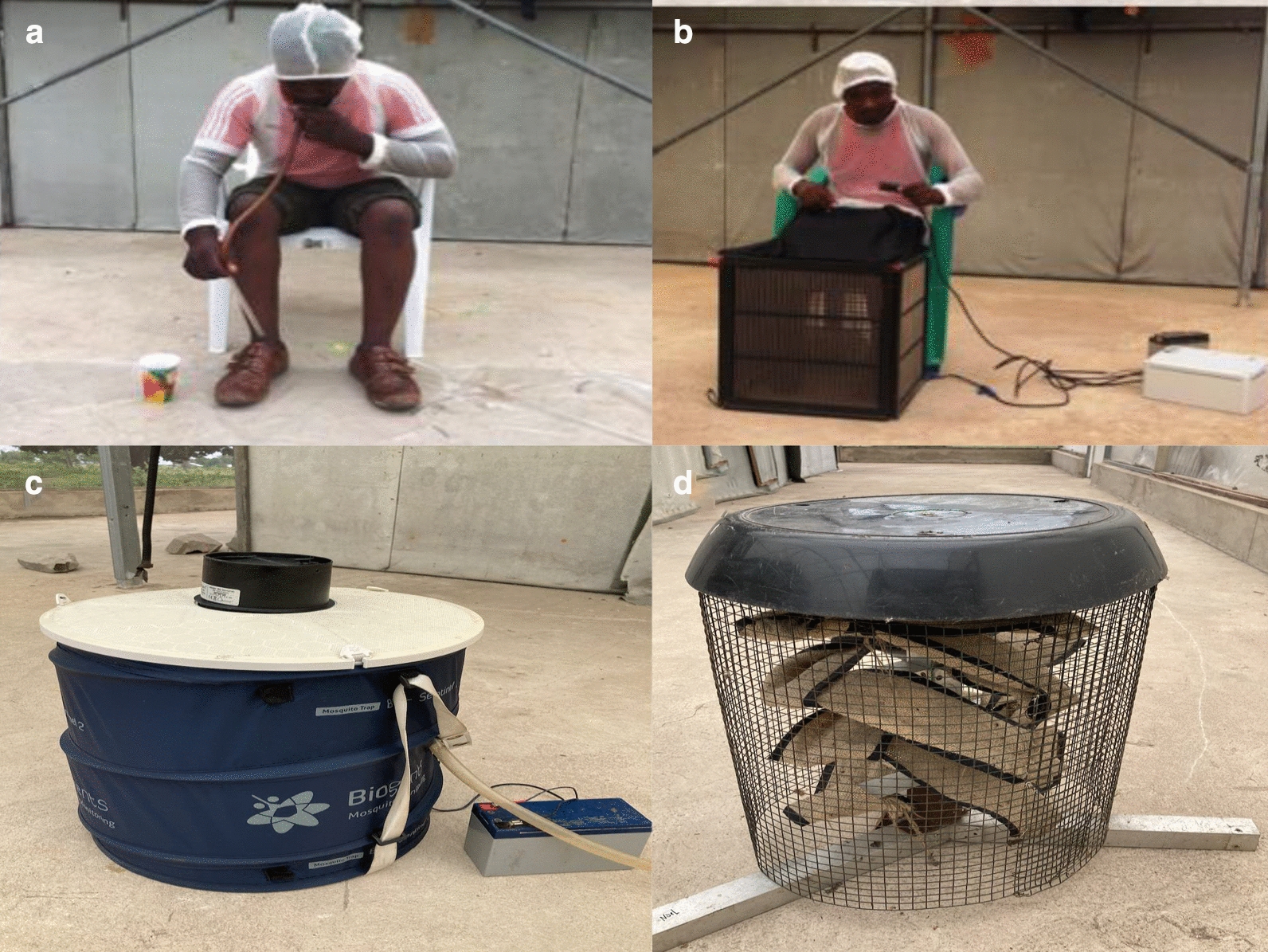
The human landing catch (HLC) measures human exposure to mosquito bites and evaluates the efficacy of vector control tools. However, it may expose volunteers to potentially infected mosquitoes. The mosquito electrocuting trap (MET) and BG-Sentinel traps (BGS) represent alternative, exposure-free methods for sampling host-seeking mosquitoes. This study investigates whether these methods can be effectively used as alternatives to HLC for measuring the efficacy of transfluthrin emanator against Aedes aegypti.
The protective efficacy (PE) of freestanding passive transfluthrin emanators (FTPEs), measured by HLC, MET and BGS, was compared in no-choice and choice tests. The collection methods were conducted 2 m from an experimental hut with FTPEs positioned at 3 m on either side of them. For the choice experiment, a competitor HLC was included 10 m from the first collection point. One hundred laboratory-reared Ae. aegypti mosquitoes were released and collected for 3 consecutive h.
In the no-choice test, each method measured similar PE: HLC: 66% (95% confidence interval [CI]: 50-82), MET: 55% (95% CI: 48-63) and BGS: 64% (95% CI: 54-73). The proportion of mosquitoes recaptured was consistent between methods (20-24%) in treatment and varied (47-71%) in the control. However, in choice tests, the PE measured by each method varied: HLC: 37% (95% CI: 25-50%), MET: 76% (95% CI: 61-92) and BGS trap: 0% (95% CI: 0-100). Recaptured mosquitoes were no longer consistent between methods in treatment (2-26%) and remained variable in the control (7-42%). FTPE provided 50% PE to the second HLC 10 m away. In the control, the MET and the BGS were less efficacious in collecting mosquitoes in the presence of a second HLC.
Measuring the PE in isolation was fairly consistent for HLC, MET and BGS. Because HLC is not advisable, it is reasonable to use either MET or BGS as a proxy for HLC for testing volatile pyrethroid (VP) in areas of active arbovirus-endemic areas. The presence of a human host in close proximity invalidated the PE estimates from BGS and METs. Findings also indicated that transfluthrin can protect multiple people in the peridomestic area and that at short range mosquitoes select humans over the BGS.
人体着陆捕获(HLC)用于测量人类被蚊子叮咬的情况,并评估蚊虫控制工具的效果。然而,这种方法可能会使志愿者接触到潜在感染的蚊子。电击诱蚊器(MET)和 BG-诱蚊器(BGS)是两种替代的、无需接触的宿主寻找蚊子采样方法。本研究旨在探讨这些方法是否可有效替代 HLC 来评估对埃及伊蚊的氟氯氰菊酯挥发棒的效果。
在无选择和选择测试中,比较了 HLC、MET 和 BGS 测量的独立式被动氟氯氰菊酯挥发棒(FTPEs)的保护效果(PE)。在距离实验小屋 2 米处进行采集方法,FTPEs 位于小屋两侧 3 米处。在选择实验中,包括了一个距离第一个收集点 10 米的竞争 HLC。释放了 100 只实验室饲养的埃及伊蚊,并在连续 3 小时内进行收集。
在无选择测试中,每种方法测量的 PE 相似:HLC:66%(95%置信区间[CI]:50-82)、MET:55%(95% CI:48-63)和 BGS:64%(95% CI:54-73)。在处理组中,各方法捕获的蚊子比例(20-24%)一致,而在对照组中(47-71%)变化较大。然而,在选择测试中,每种方法测量的 PE 不同:HLC:37%(95% CI:25-50%)、MET:76%(95% CI:61-92%)和 BGS 陷阱:0%(95% CI:0-100%)。在处理组中,各方法重新捕获的蚊子比例不再一致(2-26%),而对照组中仍然存在差异(7-42%)。距离第二个 HLC 10 米处的第二个 HLC 提供了 50%的 PE。在对照组中,MET 和 BGS 在存在第二个 HLC 的情况下收集蚊子的效果较差。
HLC、MET 和 BGS 单独测量的 PE 较为一致。由于 HLC 不可取,因此在活跃的虫媒病毒流行地区,使用 MET 或 BGS 作为 HLC 的替代品来测试挥发性拟除虫菊酯(VP)是合理的。在靠近人类宿主的地方,BGS 和 MET 的 PE 估计值无效。研究结果还表明,在周围环境中,氟氯氰菊酯可以保护多个人,并且在短距离内,蚊子会选择人类而不是 BGS。