Department of Medicine, Division of Infectious Diseases, Duke University School of Medicine, Durham, NC, United States of America.
J. Craig Venter Institute, Rockville, MD, United States of America.
PLoS One. 2024 Jul 29;19(7):e0307968. doi: 10.1371/journal.pone.0307968. eCollection 2024.
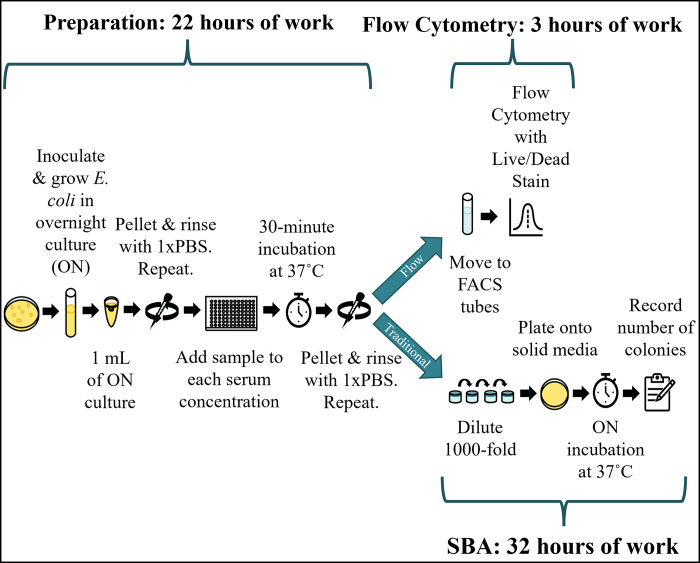
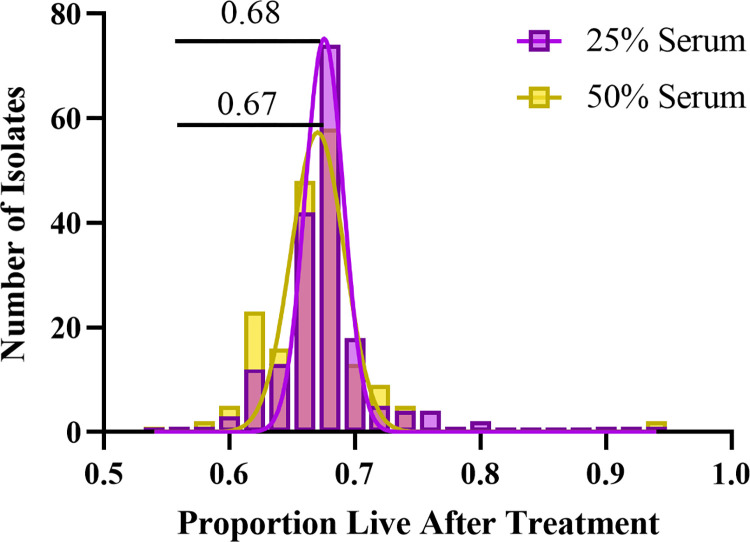
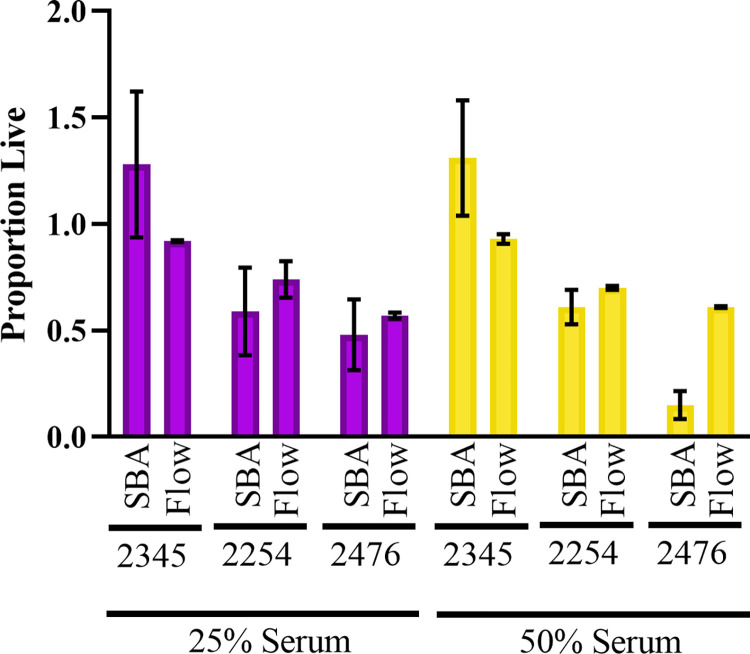
The innate immune system eliminates bloodstream pathogens such as Escherichia coli in part through complement protein deposition and subsequent bacterial death (i.e., "serum killing"). Some E. coli strains have developed mechanisms to resist serum killing, though the extent of variation in serum killing among bloodstream infection (BSI) isolates and the clinical impact of this variation is not well understood. To address this issue, we developed a novel assay that uses flow cytometry to perform high throughput serum bactericidal assays (SBAs) with E. coli BSI isolates (n = 183) to define the proportion of surviving bacteria after exposure to serum. We further determined whether E. coli resistance to serum killing is associated with clinical outcomes (e.g., in-hospital attributable mortality, in-hospital total mortality, septic shock) and bacterial genotype in the corresponding patients with E. coli BSI. Our novel flow cytometry-based SBA performed similarly to a traditional SBA, though with significantly decreased hands-on bench work. Among E. coli BSI isolates, the mean proportion that survived exposure to 25% serum was 0.68 (Standard deviation 0.02, range 0.57-0.93). We did not identify associations between E. coli resistance to serum killing and clinical outcomes in our adjusted models. Together, this study describes a novel flow cytometry-based approach to the bacterial SBA that allowed for high-throughput testing of E. coli BSI isolates and identified high variability in resistance to serum killing among a large set of BSI isolates.
固有免疫系统通过补体蛋白沉积和随后的细菌死亡(即“血清杀菌”)部分消除血流中的病原体,如大肠杆菌。一些大肠杆菌菌株已经开发出抵抗血清杀菌的机制,尽管血流感染(BSI)分离株中血清杀菌的变异程度以及这种变异的临床影响尚不清楚。为了解决这个问题,我们开发了一种新的测定方法,该方法使用流式细胞术对大肠杆菌 BSI 分离株(n = 183)进行高通量血清杀菌测定(SBA),以确定暴露于血清后存活细菌的比例。我们进一步确定大肠杆菌对血清杀菌的抵抗是否与临床结果(例如,住院归因死亡率、住院总死亡率、感染性休克)以及相应的大肠杆菌 BSI 患者的细菌基因型相关。我们新的基于流式细胞术的 SBA 与传统 SBA 表现相似,但实际的工作台工作明显减少。在大肠杆菌 BSI 分离株中,暴露于 25%血清后存活的细菌比例平均值为 0.68(标准差为 0.02,范围为 0.57-0.93)。在我们的调整模型中,我们没有发现大肠杆菌对血清杀菌的抵抗与临床结果之间的关联。总的来说,这项研究描述了一种新的基于流式细胞术的细菌 SBA 方法,该方法允许对大量 BSI 分离株进行高通量测试,并确定了对血清杀菌的抵抗存在很大的变异性。