Cook Diane J, Schmitter-Edgecombe Maureen
School of Electrical Engineering and Computer Science, Washington State University, Pullman, WA 99164, USA.
Department of Psychology, Washington State University, Pullman, WA 99164, USA.
IEEE Access. 2021;9:65033-65043. doi: 10.1109/access.2021.3076362. Epub 2021 Apr 28.
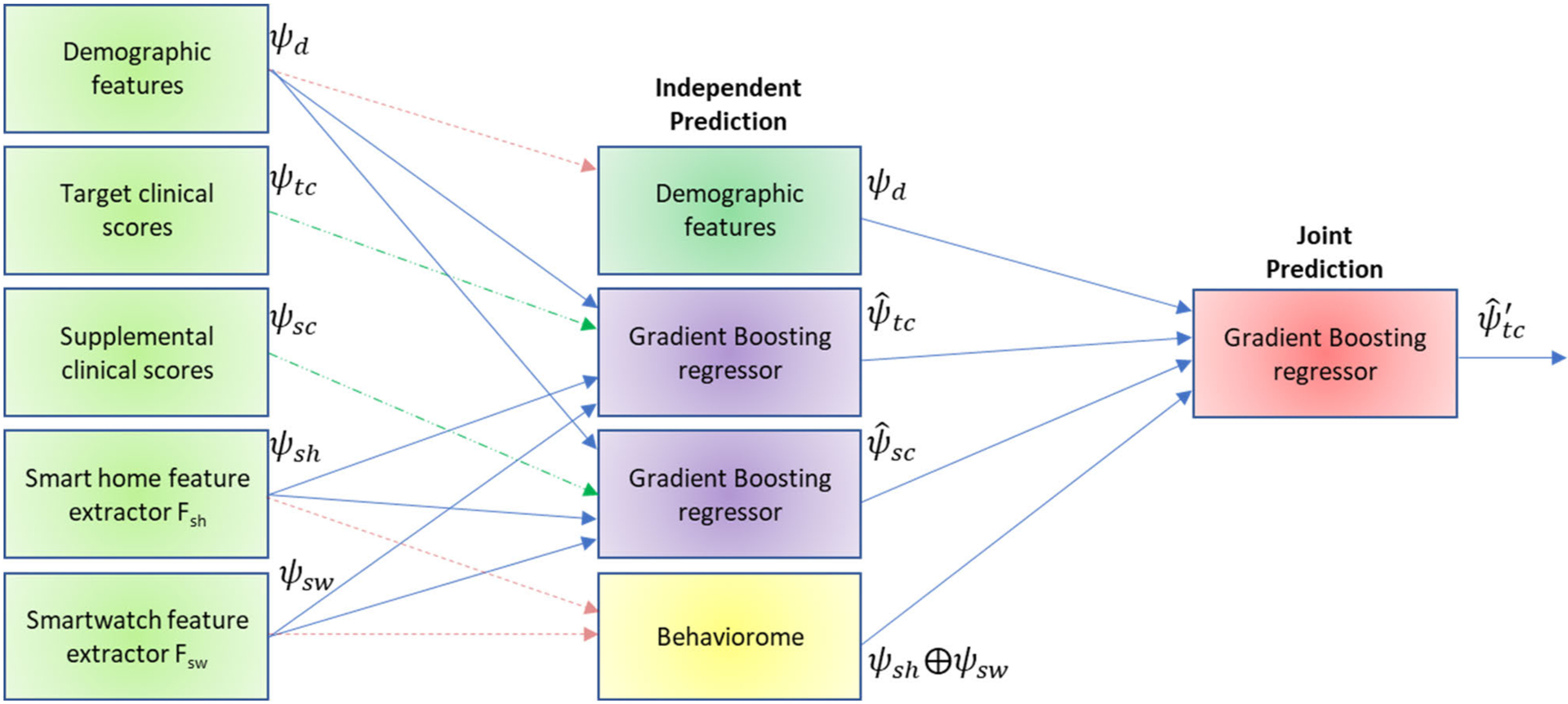
Advances in machine learning and low-cost, ubiquitous sensors offer a practical method for understanding the predictive relationship between behavior and health. In this study, we analyze this relationship by building a behaviorome, or set of digital behavior markers, from a fusion of data collected from ambient and wearable sensors. We then use the behaviorome to predict clinical scores for a sample of n = 21 participants based on continuous data collected from smart homes and smartwatches and automatically labeled with corresponding activity and location types. To further investigate the relationship between domains, including participant demographics, self-report and external observation-based health scores, and behavior markers, we propose a joint inference technique that improves predictive performance for these types of high-dimensional spaces. For our participant sample, we observe correlations ranging from small to large for the clinical scores. We also observe an improvement in predictive performance when multiple sensor modalities are used and when joint inference is employed.
机器学习以及低成本、无处不在的传感器的发展,为理解行为与健康之间的预测关系提供了一种实用方法。在本研究中,我们通过融合从环境传感器和可穿戴传感器收集的数据,构建一个行为组(即一组数字行为标记)来分析这种关系。然后,我们使用行为组,根据从智能家居和智能手表收集的连续数据,并自动标记相应的活动和位置类型,来预测n = 21名参与者样本的临床评分。为了进一步研究包括参与者人口统计学、自我报告和基于外部观察的健康评分等领域与行为标记之间的关系,我们提出了一种联合推理技术,该技术可提高这些高维空间类型的预测性能。对于我们的参与者样本,我们观察到临床评分的相关性从小到大都有。我们还观察到,当使用多种传感器模式以及采用联合推理时,预测性能有所提高。