Department of Environmental and Molecular Toxicology, College of Agricultural Sciences, Oregon State University, Corvallis, Oregon 97333, United States.
Sinnhuber Aquatic Research Laboratory, College of Agricultural Sciences, Oregon State University, Corvallis, Oregon 97333, United States.
Chem Res Toxicol. 2021 Jun 21;34(6):1409-1416. doi: 10.1021/acs.chemrestox.1c00101. Epub 2021 May 21.
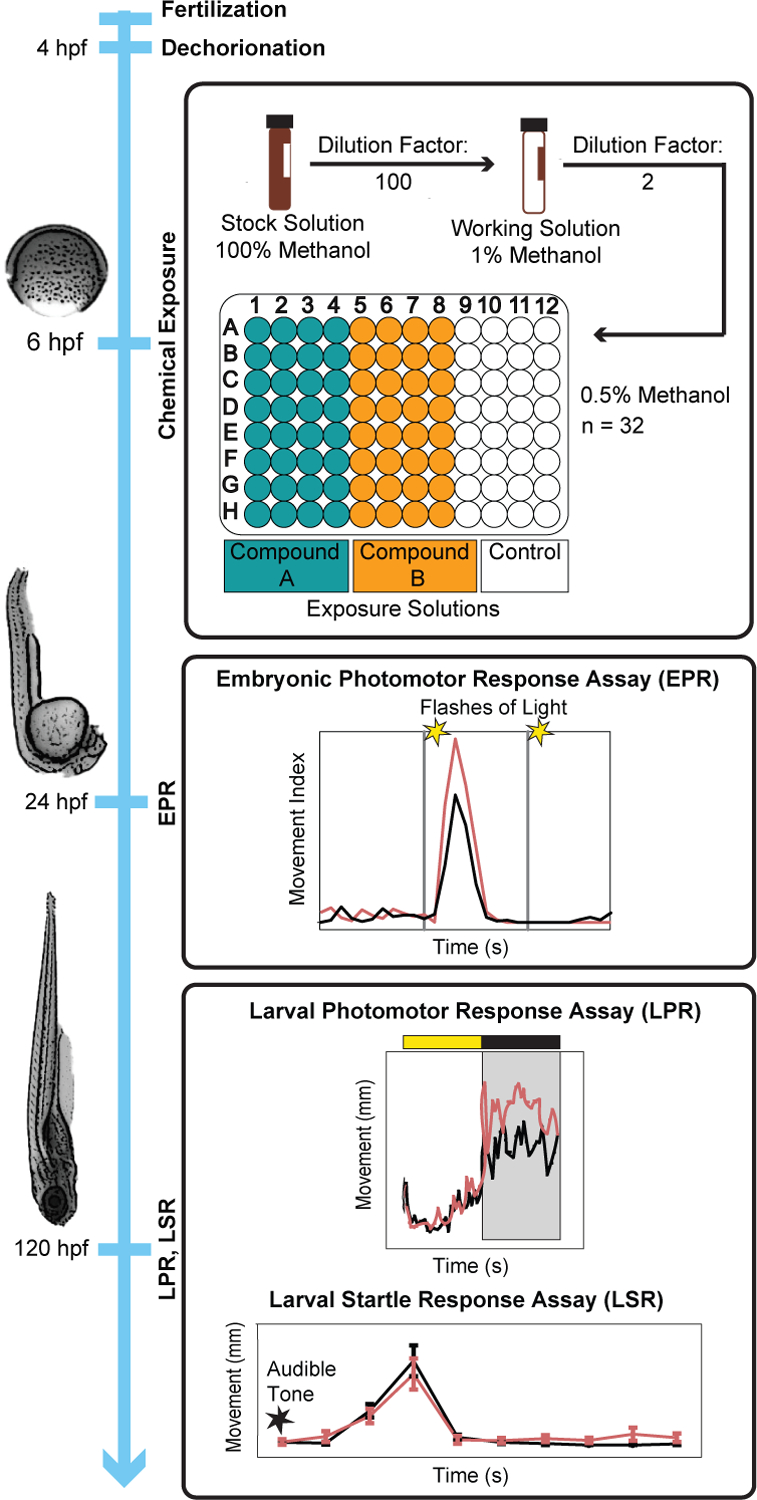
Per- and polyfluoroalkyl substances (PFAS) are ubiquitously detected in the environment, and some pose significant human and environmental health concerns globally. While some PFAS induce adverse health effects, relatively few toxicological studies adequately address the broad structural diversity of this chemical class. In the current study, we evaluated 58 individual PFAS spanning 14 structural subclasses and 2 mixtures at single concentrations for developmental toxicity in zebrafish using highly sensitive behavior endpoints. Following developmental exposure to PFAS, zebrafish were assessed for mortality and challenged with an embryonic photomotor response (EPR) assay at 24 h postfertilization (hpf) and with larval photomotor response (LPR) and larval startle response assays at 120 hpf. We found that none of the tested PFAS exposures elicited significant mortality or aberrant EPR; however, exposure to 21 individual PFAS from multiple structural subclasses and 1 mixture induced aberrant larval behavior. We then evaluated developmental toxicity across a concentration range of 0-100 μM for 10 perfluoroalkyl carboxylic acids (PFCAs; 4-carbon perfluorobutanoic acid through the 13-carbon perfluorotridecanoic acid). Exposure to the PFCAs did not cause significant mortality or morphological effects, with the exception of perfluorooctanoic acid and perfluorononanoic acid, and did not induce aberrant EPR. All PFCAs, except for longer-chain perfluorododecanoic acid caused abnormal LPR following exposure to at least one concentration. In this study, we evaluated a broad set of PFAS not previously assessed for sublethal behavior endpoints and confirmed previous findings that exposure to some PFAS induces abnormal behavior in developing zebrafish. The data from this study will guide the selection of PFAS for which to investigate modes of toxic action.
全氟和多氟烷基物质(PFAS)在环境中广泛存在,其中一些对全球人类和环境健康构成重大威胁。虽然一些 PFAS 会引起不良健康影响,但相对较少的毒理学研究充分考虑了此类化学物质的广泛结构多样性。在当前的研究中,我们评估了 58 种单一浓度的 PFAS,涵盖了 14 种结构亚类和 2 种混合物,使用高度敏感的行为终点评估其对斑马鱼的发育毒性。在 PFAS 发育暴露后,在受精后 24 小时(hpf)进行胚胎光运动反应(EPR)测定,并在 120 hpf 进行幼虫光运动反应(LPR)和幼虫惊跳反应测定,评估斑马鱼的死亡率和挑战。我们发现,没有一种测试的 PFAS 暴露会引起显著的死亡率或异常的 EPR;然而,来自多个结构亚类和 1 种混合物的 21 种 PFAS 会引起异常的幼虫行为。然后,我们评估了 10 种全氟羧酸(PFCAs;从 4 碳全氟丁烷酸到 13 碳全氟十三烷酸)在 0-100 μM 浓度范围内的发育毒性。暴露于 PFCAs 不会引起显著的死亡率或形态学效应,除了全氟辛酸和全氟壬酸,也不会引起异常的 EPR。所有 PFCAs,除了长链全氟十二烷酸,在暴露于至少一种浓度后都会引起异常的 LPR。在这项研究中,我们评估了一组以前未评估过亚致死行为终点的广泛的 PFAS,并证实了以前的研究结果,即暴露于某些 PFAS 会导致发育中的斑马鱼出现异常行为。本研究的数据将指导选择要研究毒性作用模式的 PFAS。