Gonzalez-Meljem Jose Mario, Martinez-Barbera Juan Pedro
Tecnologico de Monterrey, School of Engineering and Sciences, Mexico City, Mexico.
Developmental Biology and Cancer Research and Teaching Programme, Birth Defects Research Centre, UCL Great Ormond Street Institute of Child Health, London, UK.
Cell Mol Life Sci. 2021 May;78(10):4521-4544. doi: 10.1007/s00018-021-03798-7. Epub 2021 Mar 26.
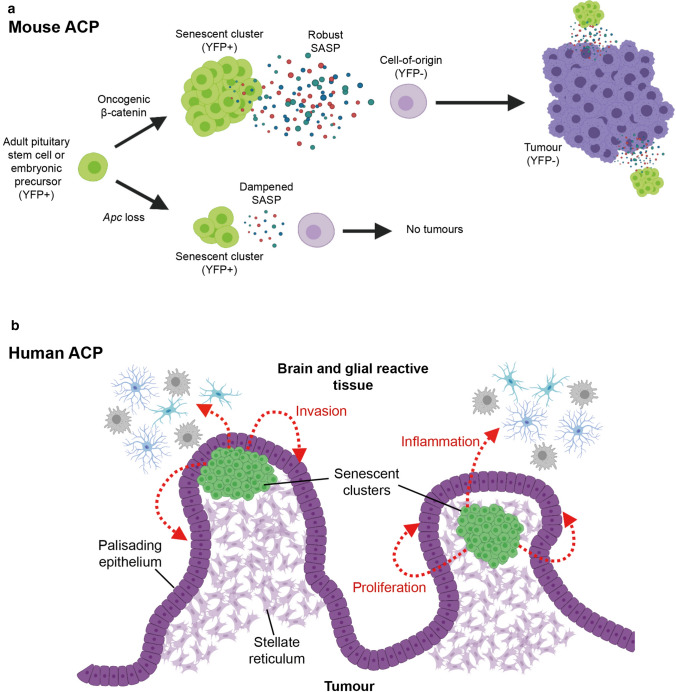
Cellular senescence is a process that can prevent tumour development in a cell autonomous manner by imposing a stable cell cycle arrest after oncogene activation. Paradoxically, senescence can also promote tumour growth cell non-autonomously by creating a permissive tumour microenvironment that fuels tumour initiation, progression to malignancy and metastasis. In a pituitary tumour known as adamantinomatous craniopharyngioma (ACP), cells that carry oncogenic β-catenin mutations and overactivate the WNT signalling pathway form cell clusters that become senescent and activate a senescence-associated secretory phenotype (SASP). Research in mouse models of ACP has provided insights into the function of the senescent cell clusters and revealed a critical role for SASP-mediated activities in paracrine tumour initiation. In this review, we first discuss this research on ACP and subsequently explore the theme of paracrine tumourigenesis in other tumour models available in the literature. Evidence is accumulating supporting the notion that paracrine signalling brought about by senescent cells may underlie tumourigenesis across different tumours and cancer models.
细胞衰老过程可通过在癌基因激活后使细胞周期稳定停滞,以细胞自主的方式预防肿瘤发生。矛盾的是,衰老也能以细胞非自主的方式促进肿瘤生长,其机制是通过创造一个有利于肿瘤起始、进展为恶性肿瘤及转移的肿瘤微环境。在一种称为牙釉质型颅咽管瘤(ACP)的垂体肿瘤中,携带致癌β-连环蛋白突变并过度激活WNT信号通路的细胞形成细胞簇,这些细胞簇会衰老并激活衰老相关分泌表型(SASP)。对ACP小鼠模型的研究为衰老细胞簇的功能提供了见解,并揭示了SASP介导的活动在旁分泌肿瘤起始中的关键作用。在这篇综述中,我们首先讨论关于ACP的这项研究,随后探讨文献中其他可用肿瘤模型中的旁分泌肿瘤发生主题。越来越多的证据支持这样一种观点,即衰老细胞产生的旁分泌信号可能是不同肿瘤和癌症模型中肿瘤发生的基础。