Cell Proliferation Group, MRC Clinical Sciences Centre, Imperial College London, Hammersmith Campus, London W12 0NN, UK.
Nat Cell Biol. 2013 Aug;15(8):978-90. doi: 10.1038/ncb2784. Epub 2013 Jun 16.
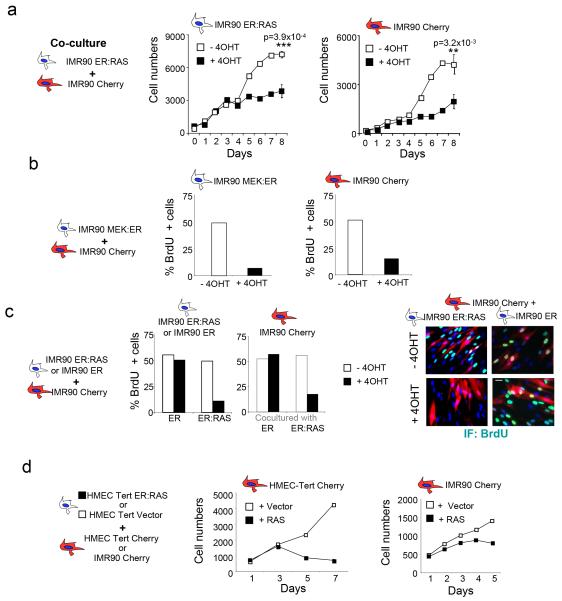
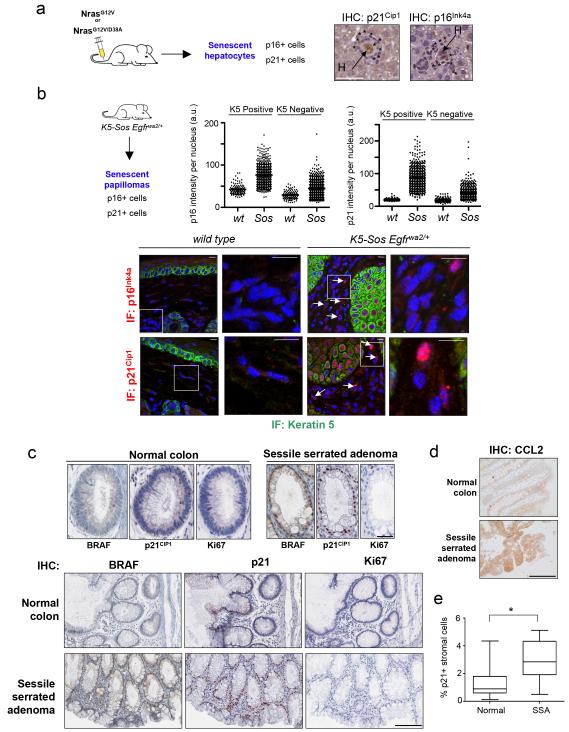
Oncogene-induced senescence (OIS) is crucial for tumour suppression. Senescent cells implement a complex pro-inflammatory response termed the senescence-associated secretory phenotype (SASP). The SASP reinforces senescence, activates immune surveillance and paradoxically also has pro-tumorigenic properties. Here, we present evidence that the SASP can also induce paracrine senescence in normal cells both in culture and in human and mouse models of OIS in vivo. Coupling quantitative proteomics with small-molecule screens, we identified multiple SASP components mediating paracrine senescence, including TGF-β family ligands, VEGF, CCL2 and CCL20. Amongst them, TGF-β ligands play a major role by regulating p15(INK4b) and p21(CIP1). Expression of the SASP is controlled by inflammasome-mediated IL-1 signalling. The inflammasome and IL-1 signalling are activated in senescent cells and IL-1α expression can reproduce SASP activation, resulting in senescence. Our results demonstrate that the SASP can cause paracrine senescence and impact on tumour suppression and senescence in vivo.
癌基因诱导的衰老(OIS)对于肿瘤抑制至关重要。衰老细胞会实施一种复杂的促炎反应,称为衰老相关分泌表型(SASP)。SASP 会增强衰老、激活免疫监视,但也具有促肿瘤特性。在这里,我们提供的证据表明,SASP 还可以在培养物中和体内 OIS 的人类和小鼠模型中诱导正常细胞的旁分泌衰老。通过定量蛋白质组学与小分子筛选相结合,我们鉴定出多种介导旁分泌衰老的 SASP 成分,包括 TGF-β 家族配体、VEGF、CCL2 和 CCL20。其中,TGF-β 配体通过调节 p15(INK4b) 和 p21(CIP1) 发挥主要作用。SASP 的表达受炎症小体介导的 IL-1 信号控制。炎症小体和 IL-1 信号在衰老细胞中被激活,IL-1α 的表达可以重现 SASP 的激活,导致衰老。我们的研究结果表明,SASP 可以引起旁分泌衰老,并对体内肿瘤抑制和衰老产生影响。