Woods Carl T, Rudd James, Gray Rob, Davids Keith
Institute for Health and Sport, Victoria University, Melbourne, Australia.
Research Institute for Sport and Exercise Sciences, Liverpool John Moores University, Liverpool, UK.
Sports Med Open. 2021 May 21;7(1):33. doi: 10.1186/s40798-021-00326-6.
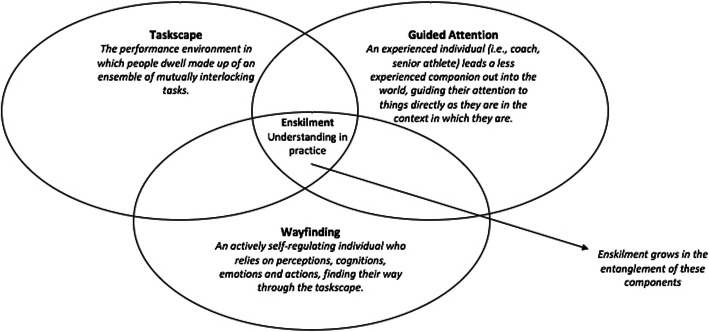
The aim of this paper is to explore a different, more relational worldview of skill, learning and education in sport. To do this, we turn to the work of social anthropologist, Tim Ingold, leaning on the notion of enskilment, which proposes that learning is inseparable from doing and place. From this worldview, what is learned is not an established body of knowledge, transmitted into the mind of a passive recipient from an authorised being, but is a progressively deepening embodied-embedded attentiveness, where an individual learns to self-regulate by becoming more responsive to people and environmental features by 'looking, listening and feeling'. As we discuss, Ingold's perspectives on enskilment are rooted in the etymological connotations of education-ex-ducere, which roughly means 'to lead out'. In applying this notion to sport, we unpack three of its entangled components, taskscapes, guided attention, and wayfinding, detailing the implications of each for the growth of enskilled sports performers. To promote the translation of these ideas, in addition to encouraging their inquiry beyond the scope of what is discussed here, sporting examples are threaded throughout the paper.
本文旨在探讨体育领域中一种不同的、更具关联性的关于技能、学习和教育的世界观。为此,我们借鉴社会人类学家蒂姆·英戈尔德的研究成果,依据技能习得的概念展开探讨,该概念认为学习与实践及场所密不可分。从这种世界观来看,所学内容并非是由权威者传递给被动接受者头脑中的既定知识体系,而是一种不断深化的身体嵌入式专注,即个体通过“观察、倾听和感受”,学会对人和环境特征做出更积极的反应,从而实现自我调节。正如我们所讨论的,英戈尔德关于技能习得的观点源于教育一词(education)的词源内涵——ex-ducere,大致意为“引出”。将这一概念应用于体育领域时,我们剖析了其相互交织的三个组成部分:任务场景、引导式注意力和路径导航,并详细阐述了每一部分对熟练掌握体育技能者成长的影响。为推动这些观点的转化,除鼓励在此讨论范围之外对其进行探究外,本文还穿插了诸多体育实例。