Gayoso Miriannette, Lim Whei Ying, Mulekar Madhuri S, Kaulfers Anne-Marie D
Department of Pediatrics, University of South Alabama, Strada Patient Care Center, 1601 Center St, Suite 1 S, Mobile, AL, 36604, USA.
Department of Mathematics and Statistics, University of South Alabama, 411 N University Blvd North, Mobile, AL, 36688, USA.
Clin Diabetes Endocrinol. 2021 May 21;7(1):9. doi: 10.1186/s40842-021-00122-x.
With the onset of the COVID-19 pandemic and state-mandated school closures in the spring of 2020, the management of type 1 diabetes in children underwent significant changes. The aim of our study was to assess the effect of stay-at-home orders on glycemic control in children.
We conducted a retrospective review of 238 children with type 1 and type 2 diabetes who were seen in the Pediatric Endocrinology Clinic at the University of South Alabama. Average Hemoglobin A1c (A1c) levels in the year prior to stay-at home orders (May 2019-April 2020) were compared with A1c values during the quarantine period (May 2020-July 2020) using a paired t-test. We also analyzed the change of A1c level with respect to sex, race, type of diabetes, type of insurance, and mode of insulin administration, using a 2-sample t-test.
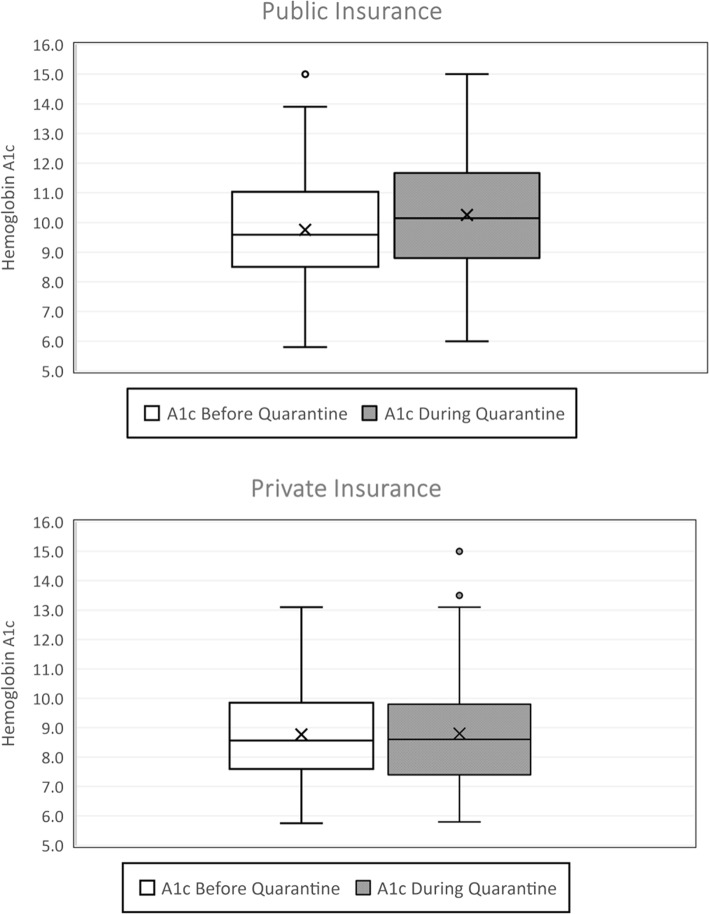
The average A1c significantly increased from 9.2% during the previous year to 9.5% during the quarantine period (p = 0.0097). The increase of A1c was significantly higher in public insurance patients (0.49% increase) compared to private insurance patients (0.03% increase), (p = 0.0137). We also observed a significant association between the direction of change and type of insurance. Forty-eight percent of public insurance patients had an A1c increase of > 0.5% while 54% of private insurance patients had no change or decrease in A1c (p = 0.0079).
The COVID-19 pandemic resulted in worsening glycemic control in children with type 1 diabetes, with those on public insurance affected in greater proportion than those with private insurance.
随着2020年春季新冠疫情的爆发以及各州强制学校关闭,儿童1型糖尿病的管理发生了显著变化。我们研究的目的是评估居家令对儿童血糖控制的影响。
我们对在南阿拉巴马大学儿科内分泌诊所就诊的238例1型和2型糖尿病患儿进行了回顾性研究。使用配对t检验比较居家令前一年(2019年5月至2020年4月)的平均糖化血红蛋白(A1c)水平与隔离期间(2020年5月至2020年7月)的A1c值。我们还使用双样本t检验分析了A1c水平在性别、种族、糖尿病类型、保险类型和胰岛素给药方式方面的变化。
平均A1c从前一年的9.2%显著增加到隔离期间的9.5%(p = 0.0097)。与私人保险患者(增加0.03%)相比,公共保险患者的A1c增加显著更高(增加0.49%),(p = 0.0137)。我们还观察到变化方向与保险类型之间存在显著关联。48%的公共保险患者A1c增加>0.5%,而54%的私人保险患者A1c没有变化或下降(p = 0.0079)。
新冠疫情导致1型糖尿病患儿的血糖控制恶化,公共保险患儿受影响的比例高于私人保险患儿。