Tenner Brian, Zhang Jason Z, Kwon Yonghoon, Pessino Veronica, Feng Siyu, Huang Bo, Mehta Sohum, Zhang Jin
Department of Pharmacology, University of California, San Diego, La Jolla, CA 92093, USA.
Department of Biophysics and Biophysical Chemistry, The Johns Hopkins University School of Medicine, Baltimore, MD 21205, USA.
Sci Adv. 2021 May 21;7(21). doi: 10.1126/sciadv.abe4091. Print 2021 May.
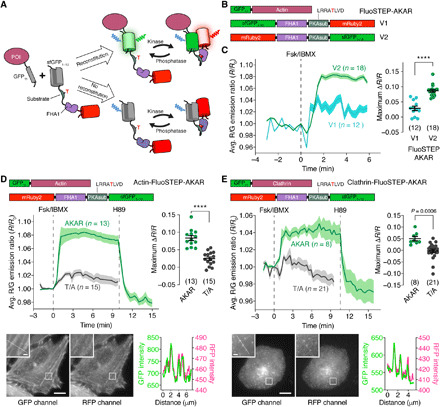
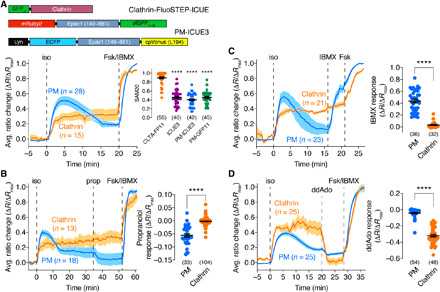
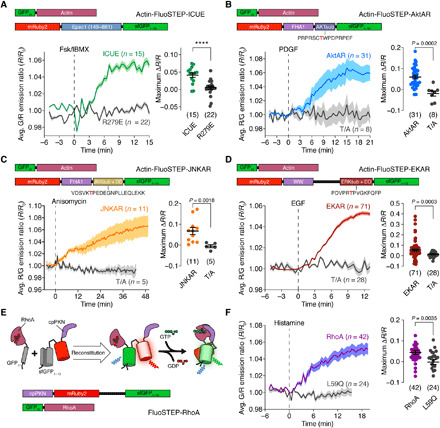
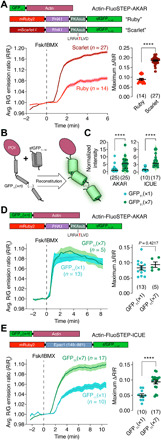
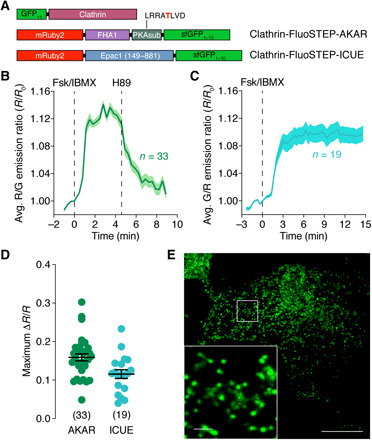
Growing evidence suggests that many essential intracellular signaling events are compartmentalized within kinetically distinct microdomains in cells. Genetically encoded fluorescent biosensors are powerful tools to dissect compartmentalized signaling, but current approaches to probe these microdomains typically rely on biosensor fusion and overexpression of critical regulatory elements. Here, we present a novel class of biosensors named FluoSTEPs (fluorescent sensors targeted to endogenous proteins) that combine self-complementing split green fluorescent protein, CRISPR-mediated knock-in, and fluorescence resonance energy transfer biosensor technology to probe compartmentalized signaling dynamics in situ. We designed FluoSTEPs for simultaneously highlighting endogenous microdomains and reporting domain-specific, real-time signaling events including kinase activities, guanosine triphosphatase activation, and second messenger dynamics in live cells. A FluoSTEP for 3',5'-cyclic adenosine monophosphate (cAMP) revealed distinct cAMP dynamics within clathrin microdomains in response to stimulation of G protein-coupled receptors, showcasing the utility of FluoSTEPs in probing spatiotemporal regulation within endogenous signaling architectures.
越来越多的证据表明,许多重要的细胞内信号事件在细胞内动力学上不同的微结构域中是分隔的。基因编码的荧光生物传感器是剖析分隔信号的强大工具,但目前探测这些微结构域的方法通常依赖于生物传感器融合和关键调控元件的过表达。在这里,我们提出了一类名为FluoSTEPs(靶向内源性蛋白质的荧光传感器)的新型生物传感器,它结合了自互补分裂绿色荧光蛋白、CRISPR介导的敲入和荧光共振能量转移生物传感器技术,以原位探测分隔信号动力学。我们设计FluoSTEPs用于同时突出内源性微结构域并报告特定结构域的实时信号事件,包括活细胞中的激酶活性、鸟苷三磷酸酶激活和第二信使动力学。一种用于3',5'-环磷酸腺苷(cAMP)的FluoSTEP显示,在网格蛋白微结构域内,响应G蛋白偶联受体的刺激,cAMP动力学明显不同,展示了FluoSTEPs在探测内源性信号结构中的时空调节方面的效用。