Department of Biomedical Engineering, College of Medicine, College of Engineering, National Taiwan University, Taipei, Taiwan.
Department of Dermatology, Chang Gung Memorial Hospital, Linkou Branch, Taoyuan, Taiwan.
Drug Deliv Transl Res. 2021 Aug;11(4):1498-1508. doi: 10.1007/s13346-021-01004-6. Epub 2021 May 22.
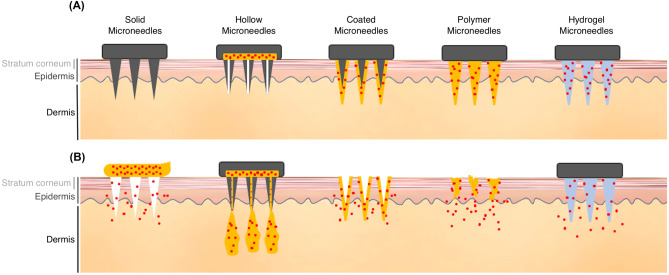
Transdermal drug delivery systems (TDDS) have many advantages and represent an excellent alternative to oral delivery and hypodermic injections. TDDS are more convenient and less invasive tools for disease and viral infection treatment, prevention, detection, and surveillance. The emerging development of microneedles for TDDS has facilitated improved skin barrier penetration for the delivery of macromolecules or hydrophilic drugs. Microneedle TDDS patches can be fabricated to deliver virus vaccines and potentially provide a viable alternative vaccine modality that offers improved immunogenicity, thermostability, simplicity, safety, and compliance as well as sharp-waste reduction, increased cost-effectiveness, and the capacity for self-administration, which could improve vaccine distribution. These advantages make TDDS-based vaccine delivery an especially well-suited option for treatment of widespread viral infectious diseases including pandemics. Because microneedle-based bioassays employ transdermal extraction of interstitial fluid or blood, they can be used as a minimally invasive approach for surveying disease markers and providing point-of-care (POC) diagnostics. For cutaneous viral infections, TDDS can provide localized treatment with high specificity and less systemic toxicity. In summary, TDDS, especially those that employ microneedles, possess special attributes that can be leveraged to reduce morbidity and mortality from viral infectious diseases. In this regard, they may have considerable positive impact as a modality for improving global health. In this article, we introduce the possible role and summarize the current literature regarding TDDS applications for fighting common cutaneous or systemic viral infectious diseases, including herpes simplex, varicella or herpes zoster, warts, influenza, measles, and COVID-19.
经皮给药系统(TDDS)有许多优点,是口服给药和皮下注射的极好替代品。TDDS 是用于治疗、预防、检测和监测疾病和病毒感染的更方便、侵入性更小的工具。用于 TDDS 的微针的新兴发展促进了大分子或亲水性药物的皮肤屏障穿透性的提高。可以制造微针 TDDS 贴片来输送病毒疫苗,并可能提供一种可行的替代疫苗模式,该模式提供了改善的免疫原性、热稳定性、简单性、安全性和顺应性,以及尖锐废物减少、成本效益提高和自我管理能力,这可能会改善疫苗的分发。这些优势使基于 TDDS 的疫苗输送成为治疗包括大流行在内的广泛病毒性传染病的特别合适的选择。由于基于微针的生物测定法采用经皮提取间质液或血液,因此它们可用作疾病标志物调查和提供即时护理(POC)诊断的微创方法。对于皮肤病毒性感染,TDDS 可以提供具有高度特异性和较少全身毒性的局部治疗。总之,TDDS,特别是那些使用微针的 TDDS,具有特殊的属性,可以利用这些属性来降低病毒性传染病的发病率和死亡率。在这方面,它们可能作为改善全球健康的一种模式产生相当大的积极影响。在本文中,我们介绍了 TDDS 用于治疗常见皮肤或全身病毒性传染病的可能作用,并总结了当前的文献,包括单纯疱疹、水痘或带状疱疹、疣、流感、麻疹和 COVID-19。