Ko Chih-Yuan, Lo Yangming Martin, Xu Jian-Hua, Chang Wen-Chang, Huang Da-Wei, Wu James Swi-Bea, Yang Cho-Hua, Huang Wen-Chung, Shen Szu-Chuan
Department of Respiratory and Critical Care Medicine The Second Affiliated Hospital of Fujian Medical University Quanzhou China.
Department of Clinical Nutrition The Second Affiliated Hospital of Fujian Medical University Quanzhou China.
Food Sci Nutr. 2021 Mar 13;9(5):2733-2742. doi: 10.1002/fsn3.2235. eCollection 2021 May.
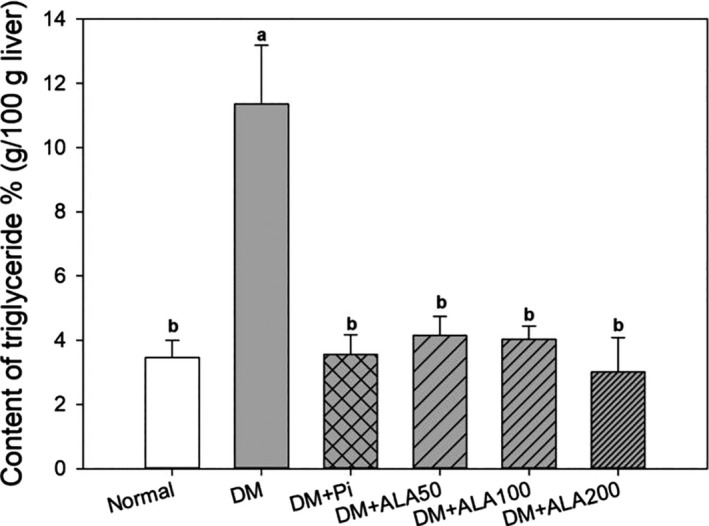
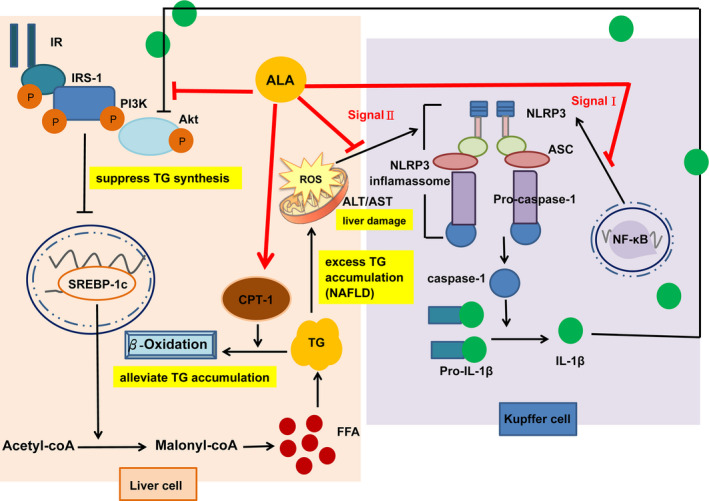
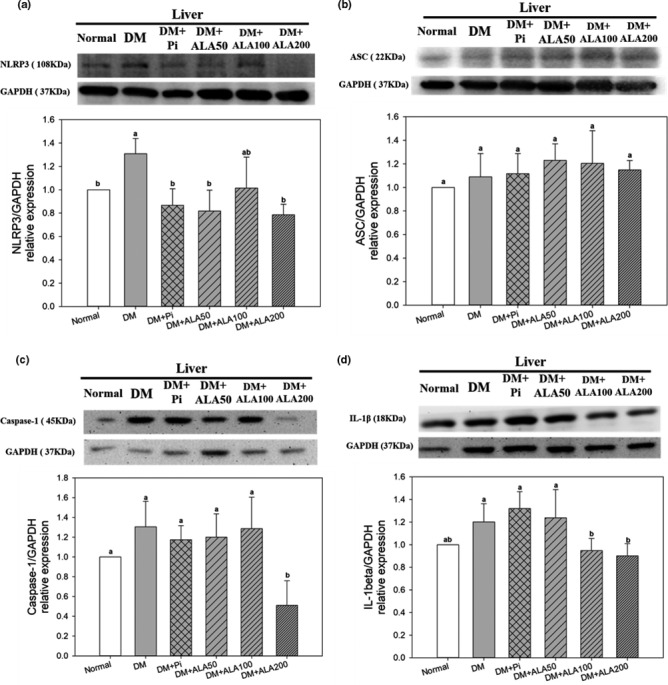
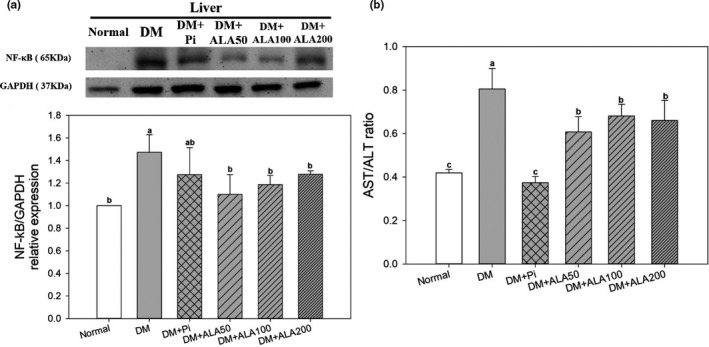
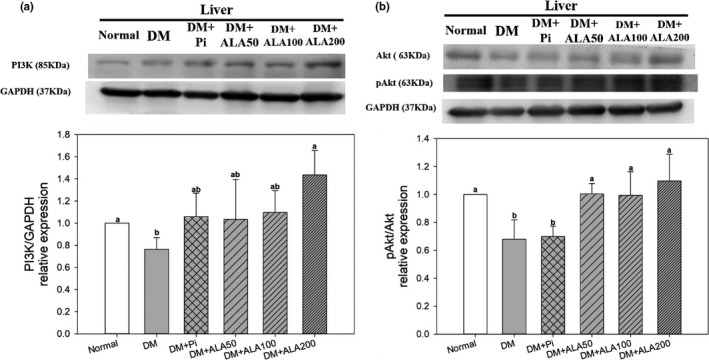
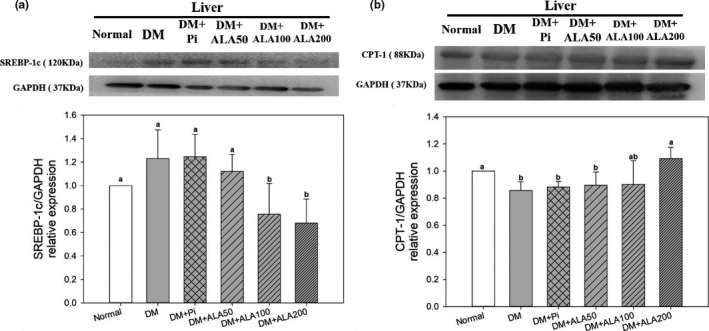
The occurrence of nonalcoholic fatty liver disease (NAFLD) is associated with type 2 diabetes mellitus (T2DM). The activation of nucleotide-binding domain and leucine-rich-containing family, pyrin domain-containing 3 (NLRP3) inflammasome in the liver may lead to hepatic fat accumulation. Alpha-lipoic acid (ALA) has been reported to improve IR in a T2DM rodent model. We investigated the effects of ALA on NLRP3 inflammasome activation and fat accumulation in the liver of a high-fat diet (HFD) plus streptozotocin (STZ)-induced T2DM rats. The HFD/STZ-induced T2DM rats were orally administered ALA (50, 100, or 200 mg/kg BW) once a day for 13 weeks. The results showed that the liver triglyceride contents of T2DM rats were 11.35 ± 1.84%, whereas the administration of 50, 100, and 200 mg/kg BW ALA significantly reduced the liver triglyceride contents of T2DM rats to 4.14 ± 0.59%, 4.02 ± 0.41%, and 3.01 ± 1.07%, respectively. Moreover, 200 mg/kg BW ALA significantly decreased the hepatic levels of NLRP3 inflammasome activation-related proteins NLRP3, caspase-1, and interleukin-1β expression by 40.0%, 60.1%, and 24.5%, respectively, in T2DM rats. Furthermore, the expression levels of hepatic fat synthesis-related proteins decreased, namely a 45.4% decrease in sterol regulatory element-binding protein-1c, whereas the expression of hepatic lipid oxidation-related proteins increased, including a 27.5% increase in carnitine palmitoyltransferase, in T2DM rats after 200 mg/kg BW ALA treatment. We concluded that ALA treatment may suppress hepatic NLRP3 inflammasome activation, consequently alleviating NAFLD and excess hepatic lipid accumulation in HFD/STZ-induced T2DM rats.
非酒精性脂肪性肝病(NAFLD)的发生与2型糖尿病(T2DM)相关。肝脏中含核苷酸结合结构域和富含亮氨酸重复序列的家族、含pyrin结构域3(NLRP3)炎性小体的激活可能导致肝脏脂肪堆积。据报道,α-硫辛酸(ALA)可改善T2DM啮齿动物模型的胰岛素抵抗(IR)。我们研究了ALA对高脂饮食(HFD)加链脲佐菌素(STZ)诱导的T2DM大鼠肝脏中NLRP3炎性小体激活和脂肪堆积的影响。给HFD/STZ诱导的T2DM大鼠每天口服ALA(50、100或200mg/kg体重),持续13周。结果显示,T2DM大鼠肝脏甘油三酯含量为11.35±1.84%,而给予50、100和200mg/kg体重的ALA可分别将T2DM大鼠肝脏甘油三酯含量显著降低至4.14±0.59%、4.02±0.41%和3.01±1.07%。此外,200mg/kg体重的ALA可使T2DM大鼠肝脏中NLRP3炎性小体激活相关蛋白NLRP3、半胱天冬酶-1和白细胞介素-1β的表达水平分别显著降低40.0%、60.1%和24.5%。此外,200mg/kg体重的ALA处理后,T2DM大鼠肝脏脂肪合成相关蛋白的表达水平降低,即固醇调节元件结合蛋白-1c降低45.4%,而肝脏脂质氧化相关蛋白的表达增加,包括肉碱棕榈酰转移酶增加27.5%。我们得出结论,ALA治疗可能抑制肝脏NLRP3炎性小体激活,从而减轻HFD/STZ诱导的T2DM大鼠的NAFLD和肝脏脂质过度堆积。