School of Mathematical Sciences Fudan University Shanghai 200433 China.
Shanghai Center for Mathematical Sciences Fudan University Shanghai 200433 China.
Adv Sci (Weinh). 2021 Mar 18;8(10):2003133. doi: 10.1002/advs.202003133. eCollection 2021 May.
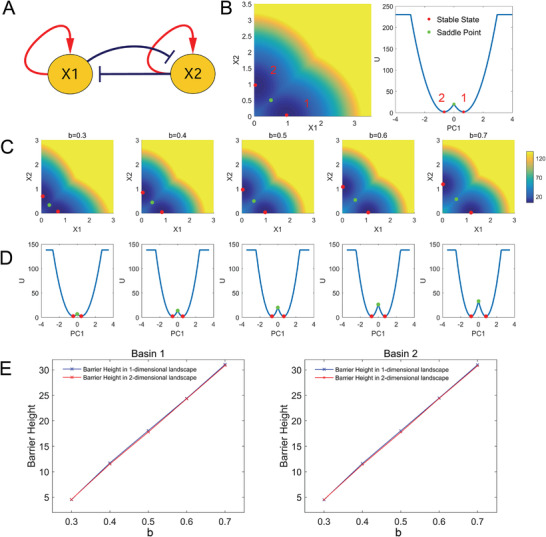
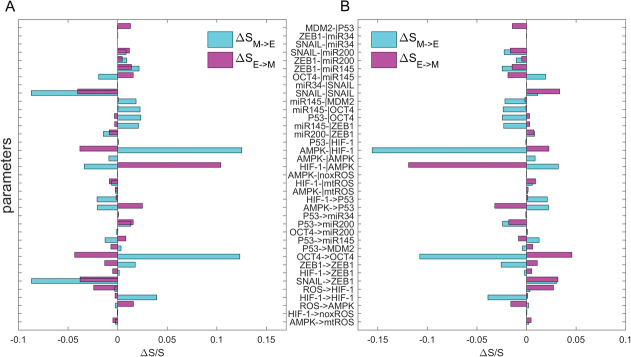
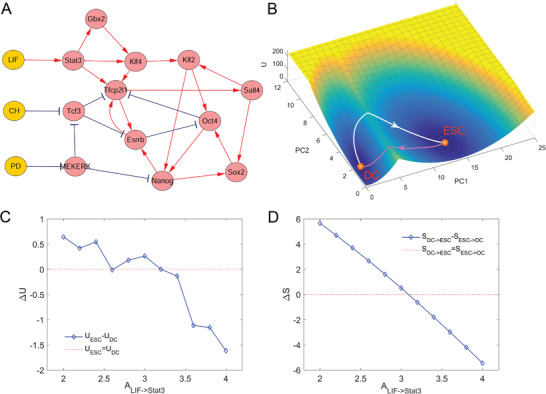
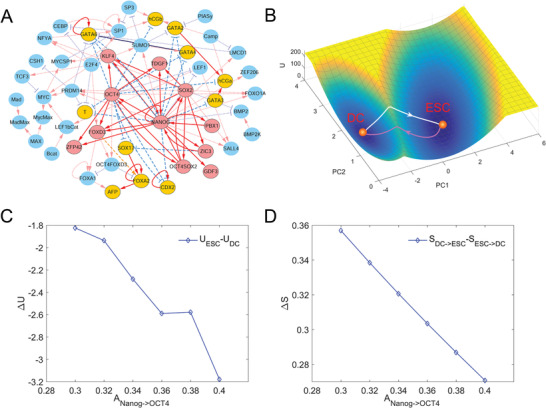
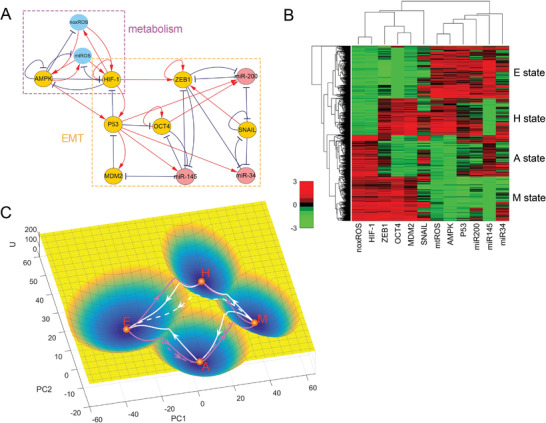
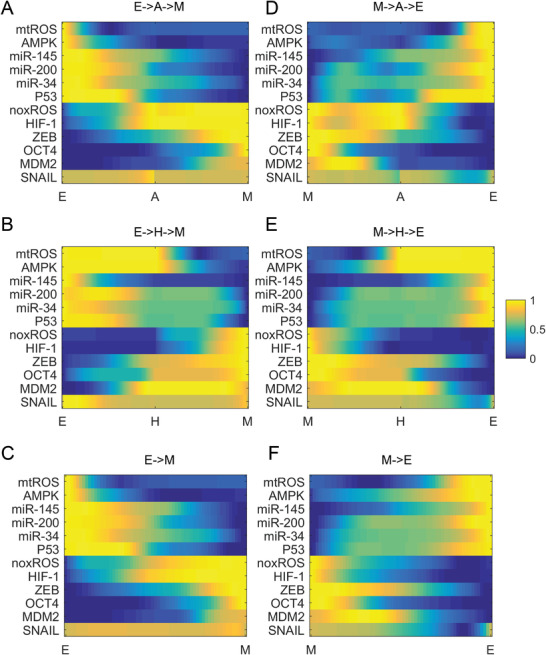
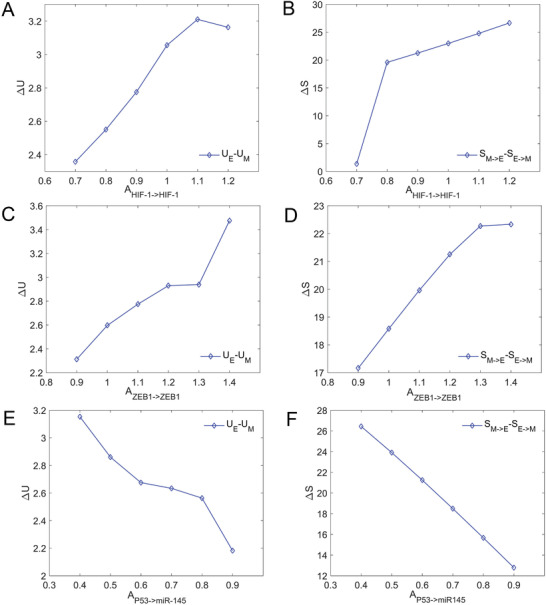
Dimension reduction is a challenging problem in complex dynamical systems. Here, a dimension reduction approach of landscape (DRL) for complex dynamical systems is proposed, by mapping a high-dimensional system on a low-dimensional energy landscape. The DRL approach is applied to three biological networks, which validates that new reduced dimensions preserve the major information of stability and transition of original high-dimensional systems. The consistency of barrier heights calculated from the low-dimensional landscape and transition actions calculated from the high-dimensional system further shows that the landscape after dimension reduction can quantify the global stability of the system. The epithelial-mesenchymal transition (EMT) and abnormal metabolism are two hallmarks of cancer. With the DRL approach, a quadrastable landscape for metabolism-EMT network is identified, including epithelial (E), abnormal metabolic (A), hybrid E/M (H), and mesenchymal (M) cell states. The quantified energy landscape and kinetic transition paths suggest that for the EMT process, the cells at E state need to first change their metabolism, then enter the M state. The work proposes a general framework for the dimension reduction of a stochastic dynamical system, and advances the mechanistic understanding of the underlying relationship between EMT and cellular metabolism.
降维是复杂动力系统中的一个具有挑战性的问题。这里,提出了一种复杂动力系统的景观降维(DRL)方法,通过将高维系统映射到低维能量景观上来实现。DRL 方法应用于三个生物网络,验证了新的降维维数保留了原始高维系统稳定性和转变的主要信息。从低维景观计算的势垒高度与从高维系统计算的转变行为的一致性进一步表明,降维后的景观可以量化系统的全局稳定性。上皮-间充质转化(EMT)和异常代谢是癌症的两个标志。利用 DRL 方法,确定了代谢-EMT 网络的四稳定景观,包括上皮(E)、异常代谢(A)、混合 E/M(H)和间充质(M)细胞状态。量化的能量景观和动力学转变路径表明,对于 EMT 过程,E 状态的细胞首先需要改变它们的代谢,然后进入 M 状态。该工作提出了随机动力系统降维的一般框架,并推进了 EMT 和细胞代谢之间潜在关系的机制理解。