Koch Alina, Jonsson Micael, Yeung Leo W Y, Kärrman Anna, Ahrens Lutz, Ekblad Alf, Wang Thanh
Man-Technology-Environment Research Centre, Örebro University, 70182 Örebro, Sweden.
Department of Ecology and Environmental Sciences, Umeå University, 90187 Umeå, Sweden.
Environ Sci Technol. 2021 Jun 15;55(12):7900-7909. doi: 10.1021/acs.est.0c07129. Epub 2021 May 24.
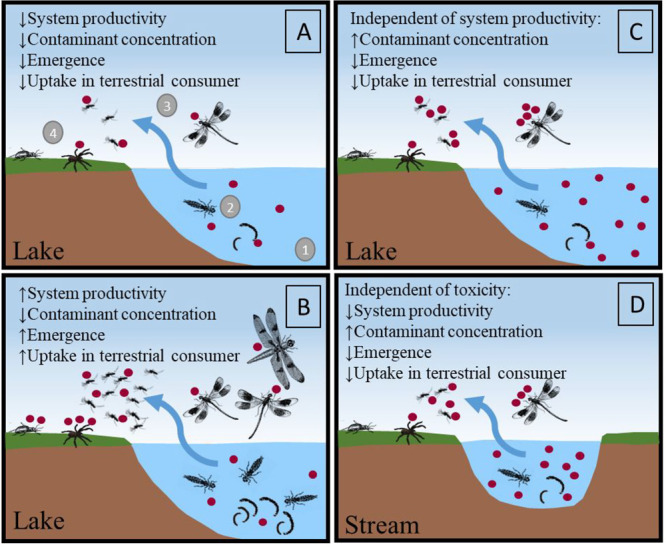
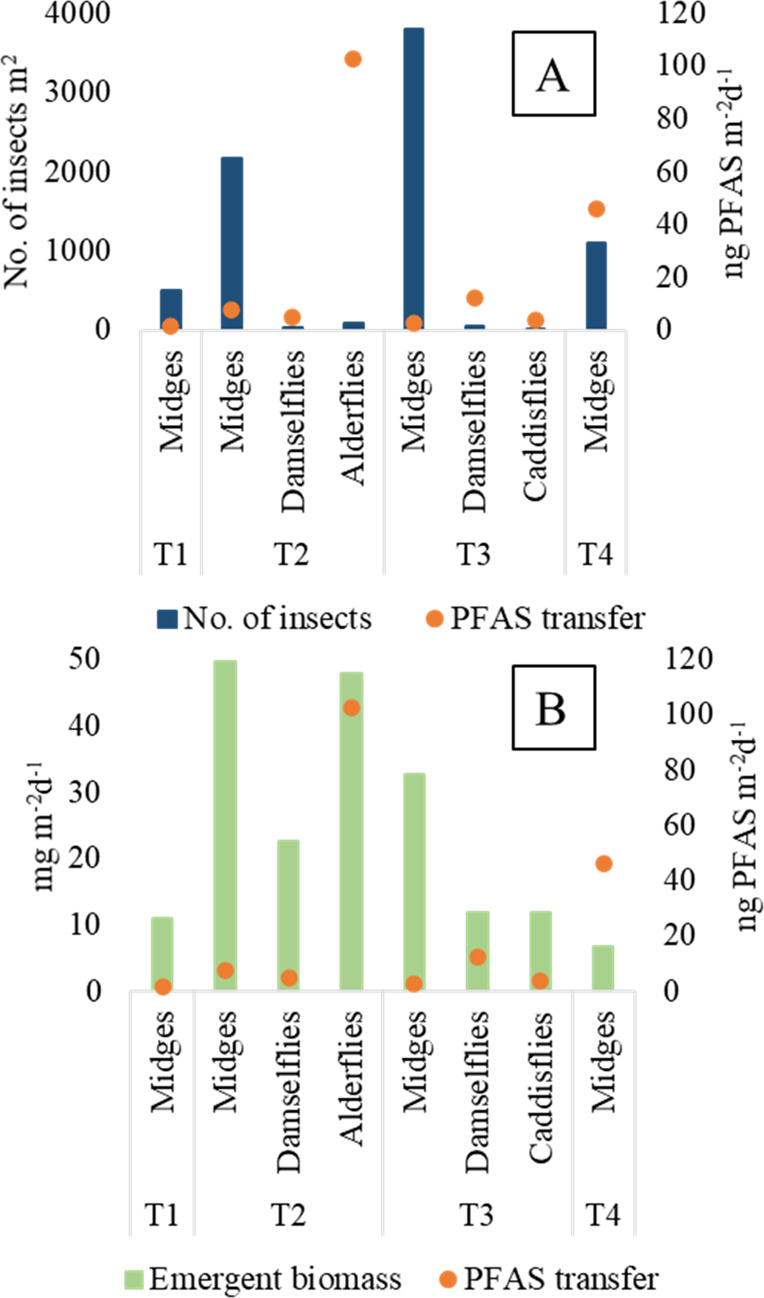
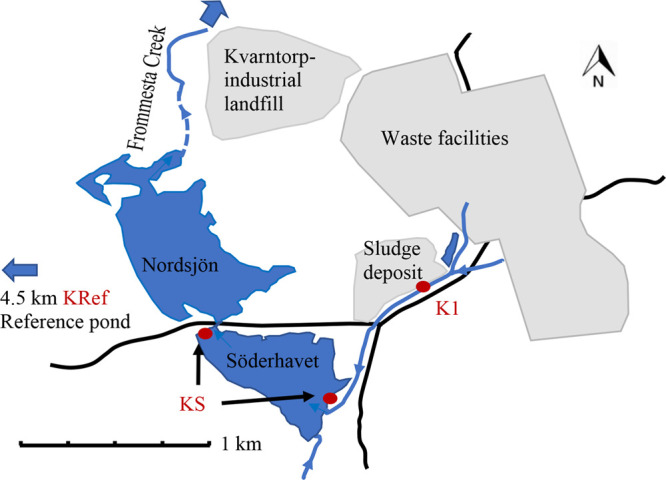
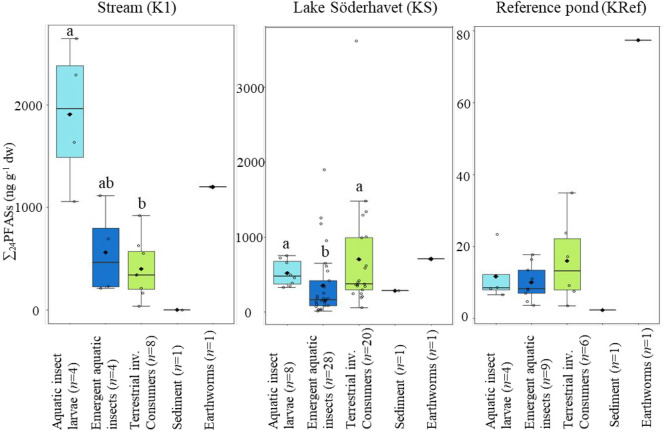
Emergent aquatic insects are important food subsidies to riparian food webs but can also transfer waterborne contaminants to the terrestrial environment. This study aimed to quantitatively assess this biodriven transfer for per- and polyfluoroalkyl substances (PFAS). Aquatic insect larvae, emergent aquatic insects, terrestrial consumers, sediment, and water were collected from a contaminated lake and stream and an uncontaminated pond, and analyzed for PFAS and stable isotopes of carbon and nitrogen. Top predators in this study were spiders, which showed the highest average ∑PFAS concentration of 1400 ± 80 ng g dry weight (dw) at the lake and 630 ng g dw at the stream. The transfer of PFAS from the lake to the riparian zone, via deposition of emergent aquatic insects, was 280 ng ∑PFAS m d in 2017 and only 23 ng ∑PFAS m d in 2018. Because of higher production of emergent aquatic insects, the lake had higher PFAS transfer and higher concentrations in terrestrial consumers compared to the stream, despite the stream having higher PFAS concentration in water and aquatic insect larvae. Our results indicate that biodriven transfer of PFAS from the aquatic systems and subsequent uptake in terrestrial food webs depend more on emergence amounts, i.e., aquatic prey availability, rather than on PFAS concentrations in water and aquatic prey.
羽化水生昆虫是河岸食物网重要的食物来源,但也会将水中污染物转移到陆地环境中。本研究旨在定量评估全氟和多氟烷基物质(PFAS)的这种生物驱动转移。从受污染的湖泊和溪流以及未受污染的池塘中收集水生昆虫幼虫、羽化水生昆虫、陆地消费者、沉积物和水,并分析其中的PFAS以及碳和氮的稳定同位素。本研究中的顶级捕食者是蜘蛛,在湖泊中其平均总PFAS浓度最高,为1400±80纳克/克干重(dw),在溪流中为630纳克/克干重。2017年,通过羽化水生昆虫的沉积,PFAS从湖泊向河岸带的转移量为280纳克总PFAS/平方米·天,而在2018年仅为23纳克总PFAS/平方米·天。尽管溪流中水中和水生昆虫幼虫中的PFAS浓度较高,但由于羽化水生昆虫的产量较高,与溪流相比,湖泊中PFAS的转移量更高,陆地消费者体内的浓度也更高。我们的结果表明,PFAS从水生系统的生物驱动转移以及随后在陆地食物网中的摄取更多地取决于羽化量,即水生猎物的可获得性,而不是水中和水生猎物中的PFAS浓度。