School of Public Health, University Vita-Salute San Raffaele, Milan, Italy.
Infection Control Committee, IRCCS San Raffaele Hospital, Milan, Italy.
J Hosp Infect. 2021 Aug;114:63-78. doi: 10.1016/j.jhin.2021.05.005. Epub 2021 May 21.
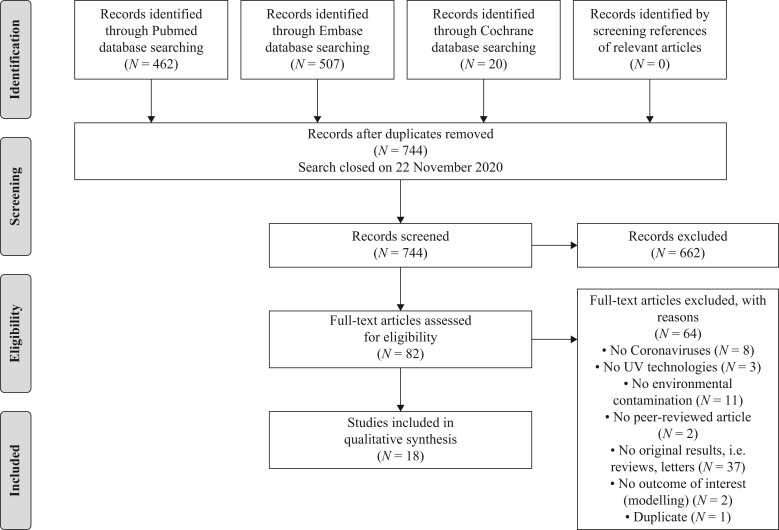
The ongoing pandemic of COVID-19 has underlined the importance of adopting effective infection prevention and control (IPC) measures in hospital and community settings. Ultraviolet (UV)-based technologies represent promising IPC tools: their effective application for sanitation has been extensively evaluated in the past but scant, heterogeneous and inconclusive evidence is available on their effect on SARS-CoV-2 transmission. With the aim of pooling the available evidence on the efficacy of UV technologies against coronaviruses, we conducted a systematic review following PRISMA guidelines, searching Medline, Embase and the Cochrane Library, and the main clinical trials' registries (WHO ICTRP, ClinicalTrials.gov, Cochrane and EU Clinical Trial Register). Quantitative data on studies' interventions were summarized in tables, pooled by different coronavirus species and strain, UV source, characteristics of UV light exposure and outcomes. Eighteen papers met our inclusion criteria, published between 1972 and 2020. Six focused on SARS-CoV-2, four on SARS-CoV-1, one on MERS-CoV, three on seasonal coronaviruses, and four on animal coronaviruses. All were experimental studies. Overall, despite wide heterogenicity within included studies, complete inactivation of coronaviruses on surfaces or aerosolized, including SARS-CoV-2, was reported to take a maximum exposure time of 15 min and to need a maximum distance from the UV emitter of up to 1 m. Advances in UV-based technologies in the field of sanitation and their proved high virucidal potential against SARS-CoV-2 support their use for IPC in hospital and community settings and their contribution towards ending the COVID-19 pandemic. National and international guidelines are to be updated and parameters and conditions of use need to be identified to ensure both efficacy and safety of UV technology application for effective infection prevention and control in both healthcare and non-healthcare settings.
持续的 COVID-19 大流行凸显了在医院和社区环境中采取有效感染预防和控制 (IPC) 措施的重要性。基于紫外线 (UV) 的技术代表了有前途的 IPC 工具:过去已经广泛评估了它们在卫生方面的有效应用,但关于它们对 SARS-CoV-2 传播的影响的证据很少且不一致。为了汇集有关 UV 技术对抗冠状病毒的功效的现有证据,我们按照 PRISMA 指南进行了系统评价,搜索了 Medline、Embase 和 Cochrane 图书馆以及主要的临床试验登记处(WHO ICTRP、ClinicalTrials.gov、Cochrane 和 EU 临床试验登记处)。对研究干预措施的定量数据进行了总结,并按不同的冠状病毒物种和株、UV 源、UV 光暴露的特征和结果进行了汇总。有 18 篇论文符合我们的纳入标准,发表时间在 1972 年至 2020 年之间。其中 6 篇专注于 SARS-CoV-2,4 篇专注于 SARS-CoV-1,1 篇专注于 MERS-CoV,3 篇专注于季节性冠状病毒,4 篇专注于动物冠状病毒。所有这些都是实验性研究。总体而言,尽管纳入的研究存在广泛的异质性,但据报道,包括 SARS-CoV-2 在内的表面或气溶胶化冠状病毒完全失活需要最长 15 分钟的最大暴露时间,并且需要从 UV 发射器最大 1 米的距离。UV 技术在卫生领域的进步及其对 SARS-CoV-2 的高病毒杀灭潜力支持将其用于医院和社区环境中的 IPC,并支持其为结束 COVID-19 大流行做出贡献。需要更新国家和国际指南,并确定使用参数和条件,以确保 UV 技术在医疗和非医疗环境中的应用的有效性和安全性,从而进行有效的感染预防和控制。