State Key Laboratory of Silicon Materials, School of Materials Science and Engineering, Zhejiang University, Hangzhou, 310027, P. R. China.
Department of Surgery Second Affiliated Hospital, Zhejiang University School of Medicine, Hangzhou, 310009, P. R. China.
Adv Sci (Weinh). 2021 Jul;8(14):e2100241. doi: 10.1002/advs.202100241. Epub 2021 May 24.
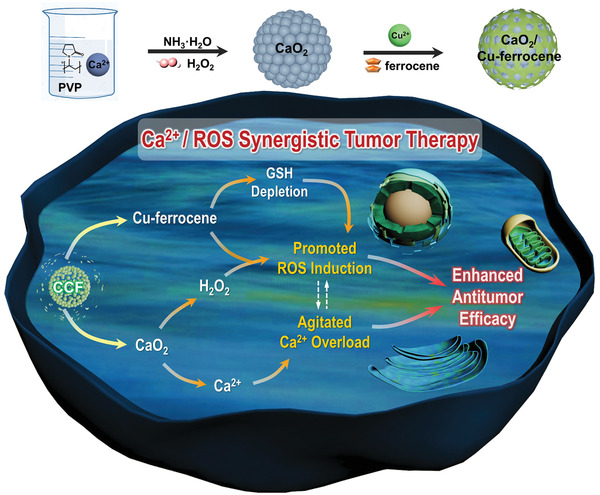
The conversion of endogenous H O into toxic hydroxyl radical ( OH) via catalytic nanoparticles is explored for tumor therapy and received considerable success. The intrinsic characteristics of microenvironment in tumor cells, such as limited H O and overexpressed glutathione (GSH), hinder the intracellular OH accumulation and thus weaken therapeutic efficacy considerably. In this study, fine CaO nanoparticles with Cu-ferrocene molecules at the surface (CaO /Cu-ferrocene) are successfully designed and synthesized. Under an acidic condition, the particles release Ca ions and H O in a rapid fashion, while they can remain stable in neutral. In addition, agitated production of OH occurs following the Fenton reaction of H O and ferrocene molecules, and GSH is consumed by Cu ions to avoid the potential OH consumption. More interestingly, in addition to the exogenous Ca released by the particles, the enhanced OH production facilitates intracellular calcium accumulation by regulating Ca channels and pumps of tumor cells. It turns out that promoted OH induction and intracellular calcium overload enable significant in vitro and in vivo antitumor phenomena.
通过催化纳米粒子将内源性 H2O 转化为有毒的羟基自由基( OH),用于肿瘤治疗,已取得相当大的成功。肿瘤细胞内环境的固有特征,如有限的 H2O 和过表达的谷胱甘肽(GSH),阻碍了细胞内 OH 的积累,从而大大削弱了治疗效果。在这项研究中,成功设计和合成了表面带有铜二茂铁分子的精细 CaO 纳米粒子(CaO/Cu-二茂铁)。在酸性条件下,颗粒快速释放 Ca 离子和 H2O,而在中性条件下它们可以保持稳定。此外,H2O 和二茂铁分子的芬顿反应会产生剧烈的 OH 生成反应,而 Cu 离子会消耗 GSH,以避免潜在的 OH 消耗。更有趣的是,除了颗粒释放的外源性 Ca 之外,增强的 OH 生成通过调节肿瘤细胞的 Ca 通道和泵来促进细胞内钙积累。事实证明,促进 OH 诱导和细胞内钙超载可显著增强体外和体内的抗肿瘤现象。