Department of Neurology, West China Hospital of Sichuan University, Chengdu, Sichuan, China.
Department of Radiology, Mayo Clinic, Rochester, Minnesota, USA.
J Neuroimaging. 2021 Sep;31(5):1020-1027. doi: 10.1111/jon.12878. Epub 2021 May 25.
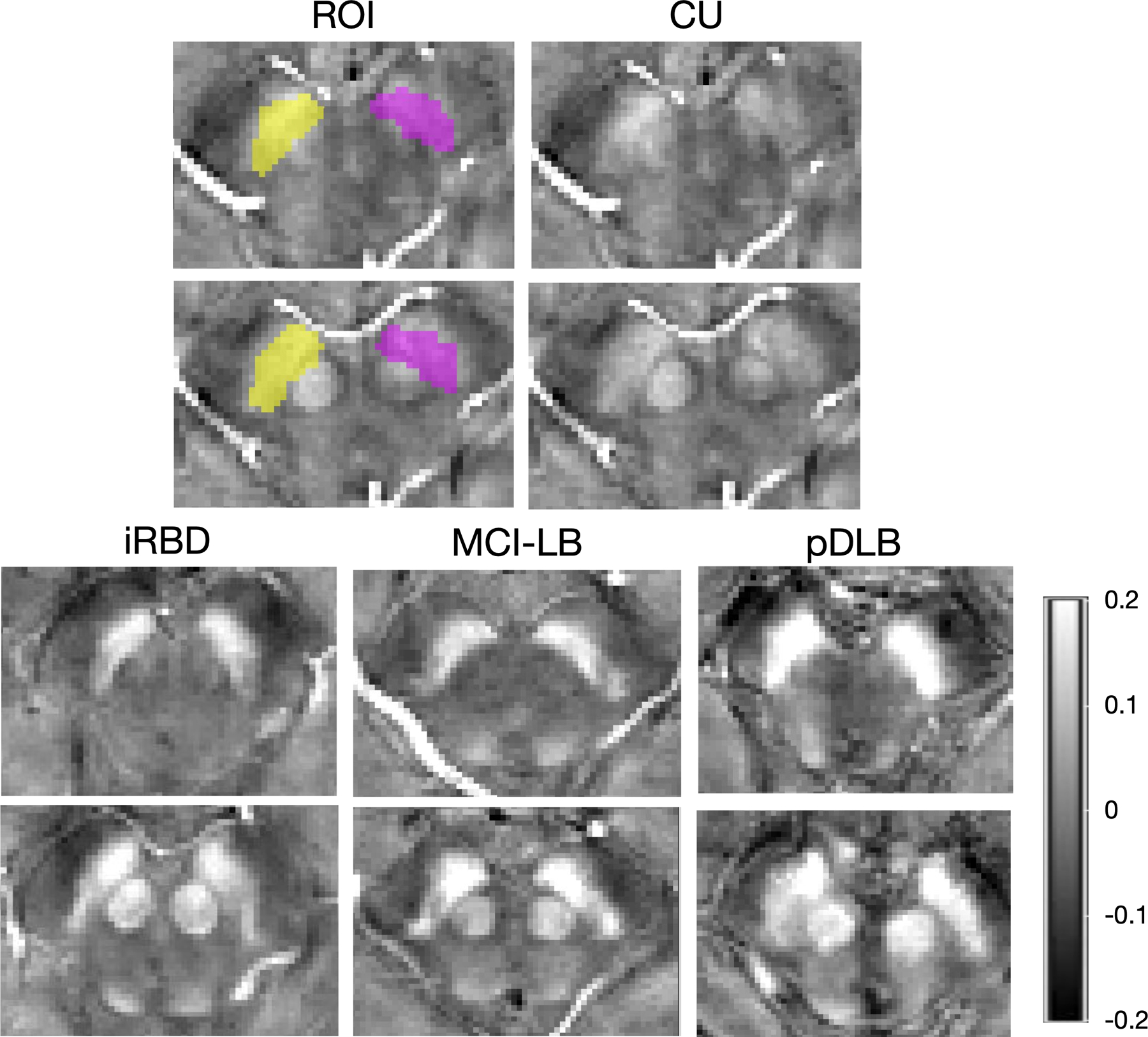
Neurodegeneration of the substantia nigra in Lewy body disease is associated with iron deposition, which increases the magnetic susceptibility of the substantia nigra on MRI. Our objective was to measure iron deposition in the substantia nigra in patients with probable dementia with Lewy bodies (pDLB) and patients who are at risk for pDLB by quantitative susceptibility mapping (QSM).
Participants included pDLB (n = 36), mild cognitive impairment with at least one core feature of DLB (MCI-LB; n = 15), idiopathic rapid eye movement sleep behavior disorder (iRBD; n = 11), and an age-and gender-matched clinically unimpaired control group (n = 102). QSM was derived from multi-echo 3D gradient recalled echo MRI at 3T, and groups were compared on mean susceptibility values of the substantia nigra and its relation to parkinsonism severity.
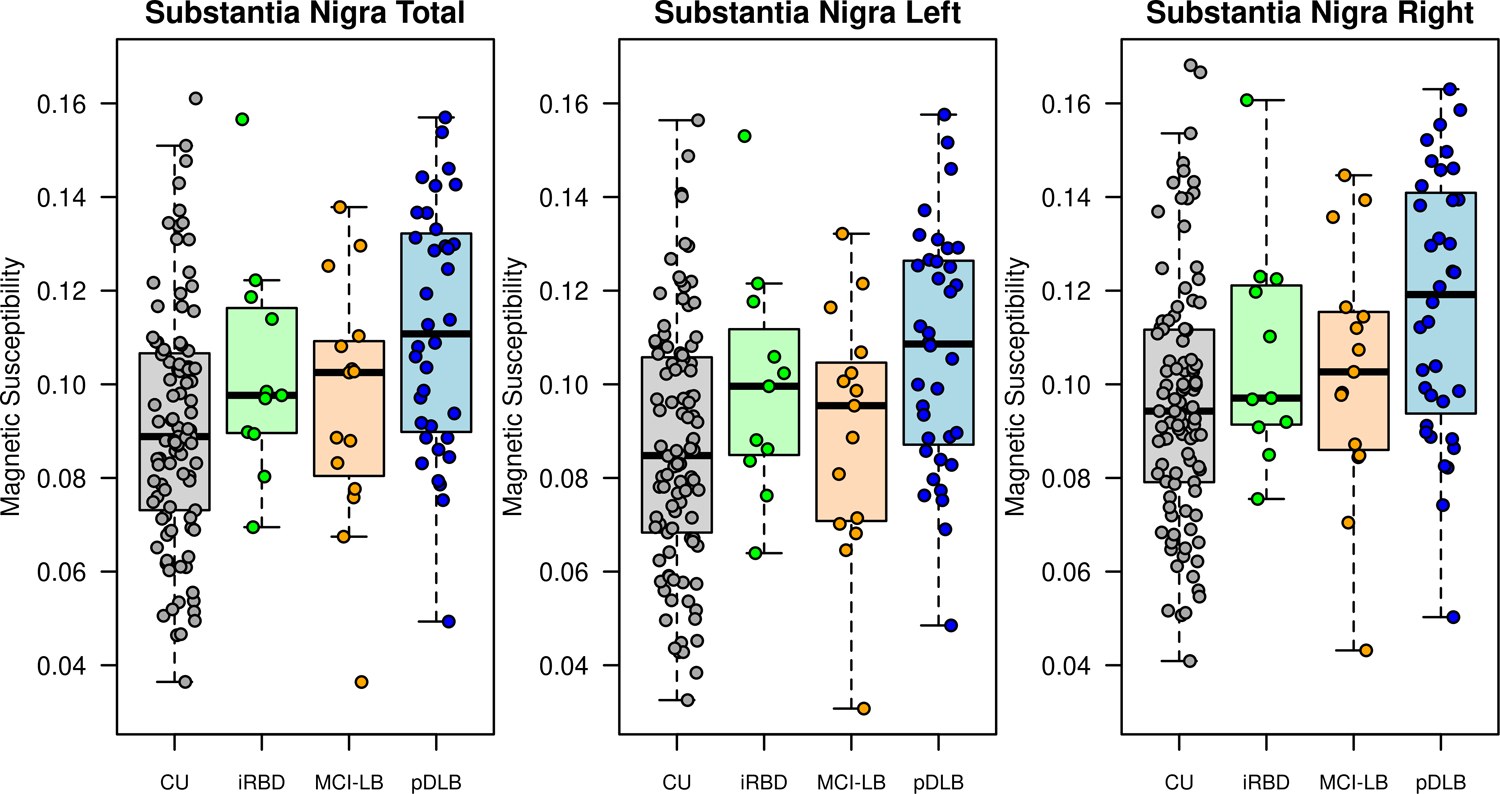
Patients with pDLB had higher susceptibility in the substantia nigra compared to controls (p< 0.001) and MCI-LB (p = 0.043). The susceptibility of substantia nigra showed an increasing trend from controls to iRBD and MCI-LB, and to pDLB (p< 0.001). Parkinsonism severity was not associated with the mean susceptibility in the substantia nigra in the patient groups.
Our data suggested that QSM is sensitive to the increased magnetic susceptibility due to higher iron content in the substantia nigra in pDLB. The trend of increasing susceptibility from controls to iRBD and MCI-LB, and to pDLB suggests that iron deposition in the substantia nigra starts to increase as early as the prodromal stage in DLB and continues to increase as the disease progresses, independent of parkinsonism severity.
路易体病(Lewy body disease)患者的黑质神经退行性变与铁沉积有关,这会增加黑质在磁共振成像(MRI)上的磁化率。我们的目的是通过定量磁化率映射(QSM)测量疑似路易体痴呆(probable dementia with Lewy bodies,pDLB)患者和有发生 pDLB 风险的患者的黑质铁沉积。
参与者包括 pDLB 患者(n = 36)、至少有一个路易体痴呆核心特征的轻度认知障碍患者(mild cognitive impairment with at least one core feature of DLB,MCI-LB;n = 15)、特发性快速眼动睡眠行为障碍患者(idiopathic rapid eye movement sleep behavior disorder,iRBD;n = 11)和年龄、性别匹配的临床未受损对照组(n = 102)。QSM 是从 3T 多回波 3D 梯度回波 MRI 衍生而来的,比较了各组黑质的平均磁化率及其与帕金森病严重程度的关系。
与对照组(p < 0.001)和 MCI-LB 组(p = 0.043)相比,pDLB 患者的黑质磁化率更高。黑质磁化率从对照组到 iRBD、MCI-LB,再到 pDLB 呈递增趋势(p < 0.001)。在患者组中,帕金森病严重程度与黑质平均磁化率无关。
我们的数据表明,QSM 对 pDLB 患者黑质因铁含量增加而导致的磁化率升高敏感。从对照组到 iRBD、MCI-LB,再到 pDLB 的磁化率递增趋势表明,铁沉积从路易体痴呆的前驱期开始增加,并随着疾病的进展继续增加,与帕金森病严重程度无关。