Xia Tao, Du Wen-Lin, Chen Xiao-Yi, Zhang You-Ni
Department of Gastrointestinal-Pancreatic Surgery, Zhejiang Provincial People's Hospital, People's Hospital of Hangzhou Medical College, Hangzhou, China.
Key Laboratory of Gastroenterology of Zhejiang Province, Zhejiang Provincial People's Hospital, People's Hospital of Hangzhou Medical College, Hangzhou, China.
J Cell Mol Med. 2021 Jul;25(13):5829-5841. doi: 10.1111/jcmm.16578. Epub 2021 May 25.
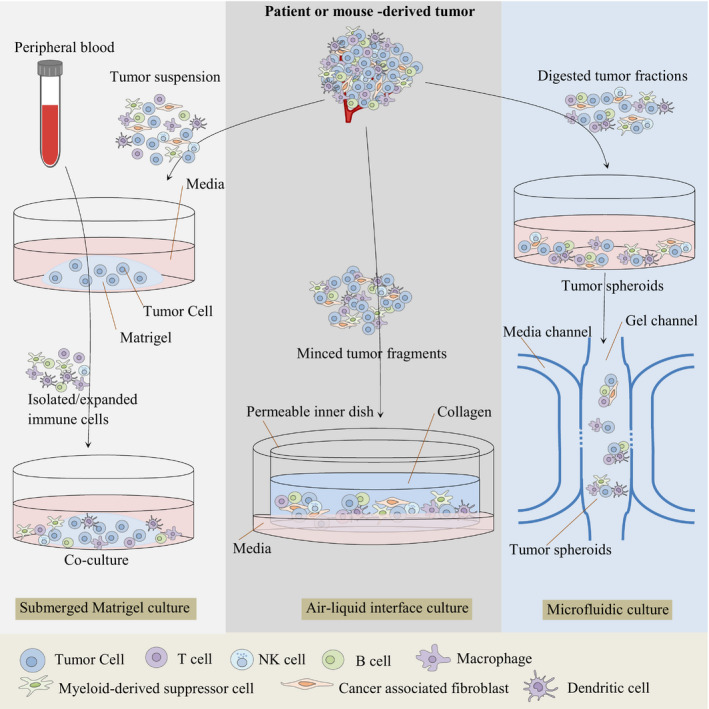
A small percentage of data obtained from animal/2D culture models can be translated to humans. Therefore, there is a need to using native tumour microenvironment mimicking models to improve preclinical screening and reduce this attrition rate. For this purpose, currently, the utilization of organoids is expanding. Tumour organoids can recapitulate tumour microenvironment that is including cancer cells and non-neoplastic host components. Indeed, tumour organoids, both phenotypically and genetically, resemble the tumour tissue that originated from it. The unique properties of the tumour microenvironment can significantly affect drug response and cancer progression. In this review, we will discuss about various organoid culture strategies for modelling the tumour immune microenvironment, their applications and advantages in cancer research such as testing cancer immunotherapeutics, developing novel approaches for personalized medicine, testing drug toxicity, drug screening, study cancer initiation and progression, and we will also review the limitations of organoid culture systems.
从动物/二维培养模型获得的一小部分数据可转化应用于人类。因此,需要使用模拟天然肿瘤微环境的模型来改进临床前筛查并降低这种损耗率。为此目的,目前类器官的应用正在不断扩展。肿瘤类器官可以重现包含癌细胞和非肿瘤宿主成分的肿瘤微环境。事实上,肿瘤类器官在表型和基因上都类似于起源于它的肿瘤组织。肿瘤微环境的独特特性可显著影响药物反应和癌症进展。在本综述中,我们将讨论用于模拟肿瘤免疫微环境的各种类器官培养策略、它们在癌症研究中的应用和优势,如测试癌症免疫疗法、开发个性化医学的新方法、测试药物毒性、药物筛选、研究癌症的发生和进展,我们还将综述类器官培养系统的局限性。