School of Sport, Rehabilitation and Exercise Sciences, University of Essex, Colchester, Essex CO43SQ, UK.
School of Sport, Rehabilitation and Exercise Sciences, University of Essex, Colchester, Essex CO43SQ, UK.
J Sport Health Sci. 2023 Mar;12(2):236-245. doi: 10.1016/j.jshs.2021.05.005. Epub 2021 May 24.
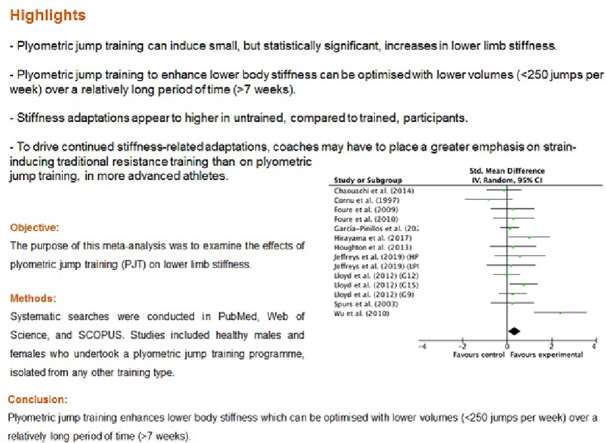
This study aimed to examine the effects of plyometric jump training (PJT) on lower-limb stiffness.
Systematic searches were conducted in PubMed, Web of Science, and Scopus. Study participants included healthy males and females who undertook a PJT programme isolated from any other training type.
There was a small effect size (ES) of PJT on lower-limb stiffness (ES = 0.33, 95% confidence interval (95%CI): 0.07-0.60, z = 2.47, p = 0.01). Untrained individuals exhibited a larger ES (ES = 0.46, 95%CI: 0.08-0.84, p = 0.02) than trained individuals (ES = 0.15, 95%CI: ‒0.23 to 0.53, p = 0.45). Interventions lasting a greater number of weeks (>7 weeks) had a larger ES (ES = 0.47, 95%CI: 0.06-0.88, p = 0.03) than those lasting fewer weeks (ES = 0.22, 95%CI: ‒0.12 to 0.55, p = 0.20). Programmes with ≤2 sessions per week exhibited a larger ES (ES = 0.39, 95%CI: 0.01-0.77, p = 0.04) than programmes that incorporated >2 sessions per week (ES = 0.20, 95%CI: -0.10 to 0.50, p = 0.18). Programmes with <250 jumps per week (ES = 0.50, 95%CI: 0.02-0.97, p = 0.04) showed a larger effect than programmes with 250-500 jumps per week (ES = 0.36, 95%CI: 0.00-0.72, p = 0.05). Programmes with >500 jumps per week had negative effects (ES = -0.22, 95%CI: -1.10 to 0.67, p = 0.63). Programmes with >7.5 jumps per set showed larger effect sizes (ES = 0.55, 95%CI: 0.02-1.08, p = 0.04) than those with <7.5 jumps per set (ES = 0.32, 95%CI: 0.01-0.62, p = 0.04).
PJT enhances lower-body stiffness, which can be optimised with lower volumes (<250 jumps per week) over a relatively long period of time (>7 weeks).
本研究旨在探讨增强式跳跃训练(PJT)对下肢刚度的影响。
在 PubMed、Web of Science 和 Scopus 中进行系统检索。研究参与者包括接受过 PJT 方案的健康男性和女性,该方案与任何其他训练类型均无关联。
PJT 对下肢刚度的影响具有较小的效应量(ES)(ES=0.33,95%置信区间(95%CI):0.07-0.60,z=2.47,p=0.01)。未训练个体的 ES 较大(ES=0.46,95%CI:0.08-0.84,p=0.02),而训练个体的 ES 较小(ES=0.15,95%CI:-0.23 至 0.53,p=0.45)。持续时间超过 7 周的干预措施具有更大的 ES(ES=0.47,95%CI:0.06-0.88,p=0.03),而持续时间少于 7 周的干预措施的 ES 较小(ES=0.22,95%CI:-0.12 至 0.55,p=0.20)。每周进行≤2 次训练的方案的 ES 较大(ES=0.39,95%CI:0.01-0.77,p=0.04),而每周进行>2 次训练的方案的 ES 较小(ES=0.20,95%CI:-0.10 至 0.50,p=0.18)。每周进行<250 次跳跃的方案的效应量较大(ES=0.50,95%CI:0.02-0.97,p=0.04),而每周进行 250-500 次跳跃的方案的效应量较小(ES=0.36,95%CI:0.00-0.72,p=0.05)。每周进行>500 次跳跃的方案则产生负面影响(ES=-0.22,95%CI:-1.10 至 0.67,p=0.63)。每次训练进行>7.5 次跳跃的方案具有更大的效应量(ES=0.55,95%CI:0.02-1.08,p=0.04),而每次训练进行<7.5 次跳跃的方案的效应量较小(ES=0.32,95%CI:0.01-0.62,p=0.04)。
PJT 可增强下肢刚度,通过相对较长的时间(>7 周)和较低的次数(<250 次/周)可以实现最佳效果。