State Key Laboratory for Conservation and Utilization of Subtropical Agro-Bioresources, College of Agriculture, South China Agricultural University, Guangzhou, 510642, China.
Scientific Observing and Experimental Station of Crop Cultivation in South China, Ministry of Agriculture and Rural Affairs, Guangzhou, 510642, China.
BMC Plant Biol. 2021 May 25;21(1):233. doi: 10.1186/s12870-021-03006-5.
Lanthanum (La) is a rare earth element that can influence plant growth and development. However, the effect of La on growth, yield formation and 2-acetyl-1-pyrroline (2-AP, a key compound responsible for the aroma of rice) biosynthesis in aromatic rice (Oryza sativa L. subsp. japonica Kato) has not been reported. Therefore, the present study investigated the effects of La on growth, photosynthesis, yield formation and 2-AP biosynthesis in aromatic rice through three experiments.
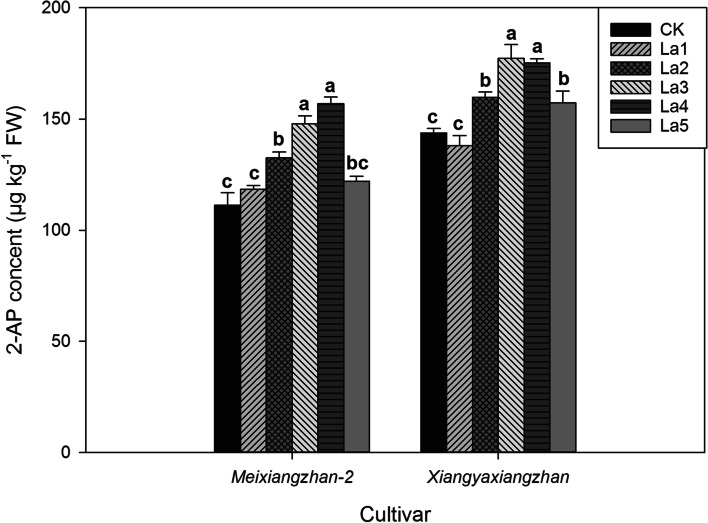
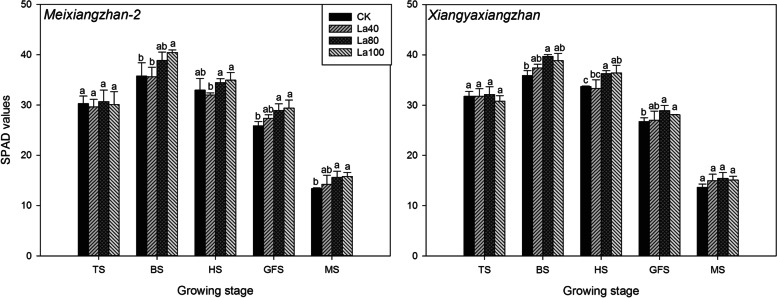
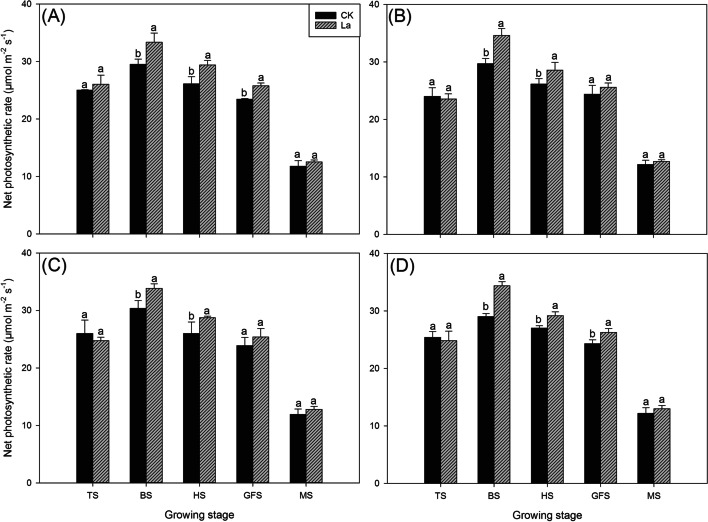
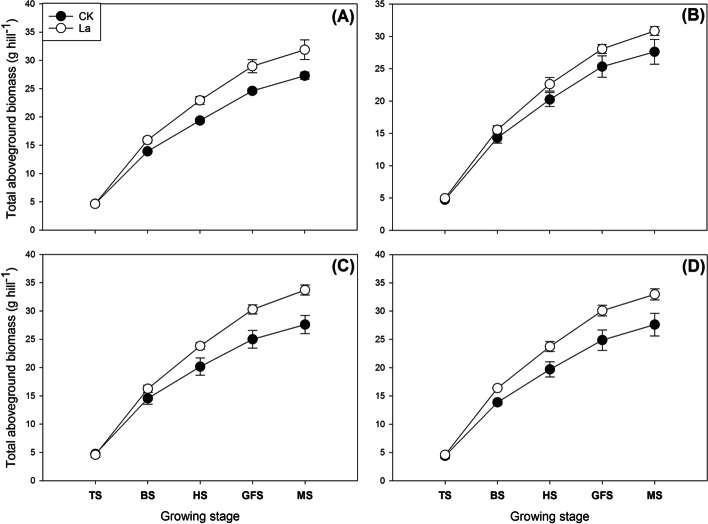
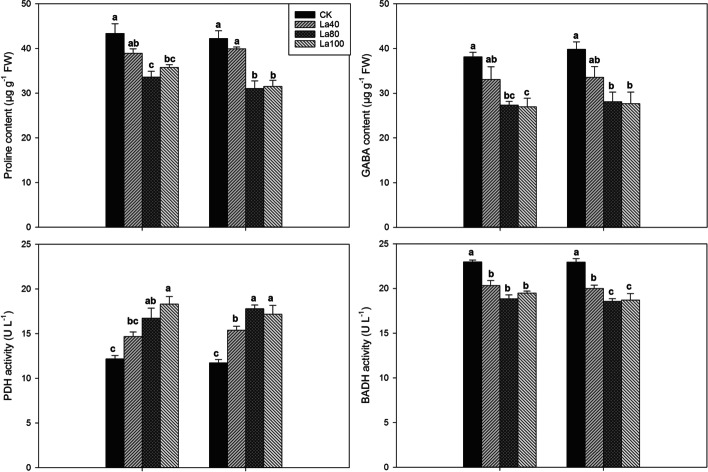
Two pot experiments and a two-year field trial were conducted with different rates of La application (20-120 LaCl mg kg and 12 kg ha LaCl), and treatments without La application were used as controls. The results showed that the application of LaCl at 80 and 100 mg kg and at 12 kg ha greatly increased the 2-AP content (by 6.45-43.03%) in aromatic rice seedlings and mature grains compared with the control. The La treatments also increased the chlorophyll content, net photosynthetic rate and total aboveground biomass of rice seedlings. Higher antioxidant enzyme (superoxide, peroxidase, and catalase) activity was detected in the La treatments than in the control. The La treatments also increased the grain yield, grain number per panicle and seed-setting rate of aromatic rice relative to the control. Moreover, the grain proline and γ-aminobutyric acid contents and the activity of betaine aldehyde dehydrogenase significantly decreased under the La treatment. The application of La to soil enhanced the activity of proline dehydrogenase by 20.62-56.95%.
La improved the growth, yield formation and 2-AP content of aromatic rice and enhanced 2-AP biosynthesis by increasing the conversion of proline to 2-AP and decreasing the conversion of GABald to GABA.
镧(La)是一种稀土元素,能够影响植物的生长和发育。然而,镧对香稻(Oryza sativa L. subsp. japonica Kato)生长、产量形成和 2-乙酰-1-吡咯啉(2-AP,一种负责大米香气的关键化合物)生物合成的影响尚未见报道。因此,本研究通过三项实验,研究了 La 对香稻生长、光合作用、产量形成和 2-AP 生物合成的影响。
进行了两项盆栽实验和一项为期两年的田间试验,分别采用不同浓度的 La 处理(20-120 LaCl mg kg 和 12 kg ha LaCl),并以不施 LaCl 的处理作为对照。结果表明,与对照相比,80 和 100 mg kg LaCl 以及 12 kg ha LaCl 处理显著增加了香稻幼苗和成熟谷粒中的 2-AP 含量(增加了 6.45-43.03%)。La 处理还增加了水稻幼苗的叶绿素含量、净光合速率和地上部总生物量。La 处理中超氧化物、过氧化物和过氧化氢酶等抗氧化酶的活性高于对照。La 处理还增加了香稻的产量、穗粒数和结实率。此外,与对照相比,La 处理下的谷粒脯氨酸和γ-氨基丁酸含量以及甜菜碱醛脱氢酶活性显著降低。La 处理还使土壤中脯氨酸脱氢酶的活性提高了 20.62-56.95%。
La 通过增加脯氨酸向 2-AP 的转化和减少 GABald 向 GABA 的转化,促进了香稻的生长、产量形成和 2-AP 含量的提高,增强了 2-AP 的生物合成。