Population & Health Sciences Institute, Newcastle University, Newcastle upon Tyne, UK
Population & Health Sciences Institute, Newcastle University, Newcastle upon Tyne, UK.
BMJ Open. 2021 May 25;11(5):e045567. doi: 10.1136/bmjopen-2020-045567.
A clear understanding of whether increases in longevity are spent in good health is necessary to support ageing, health and care-related policy.
We conducted a systematic review to update and summarise evidence on trends in health expectancies, in Organisation for Economic Co-operation and Development (OECD) high-income countries.
Four electronic databases (MEDLINE, 1946-19 September 2019; Embase 1980-2019 week 38; Scopus 1966-22 September 2019, Health Management Information Consortium, 1979-September 2019), and the UK Office for National Statistics website (November 2019).
English language studies published from 2016 that reported trends in healthy, active and/or disability-free life expectancy in an OECD high-income country.
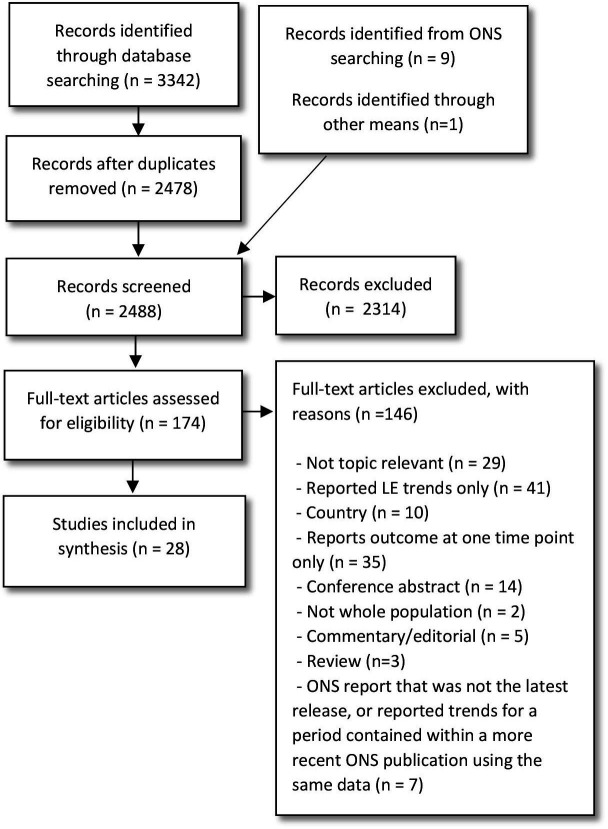
Records were screened independently by two researchers. Study quality was assessed using published criteria designed to identify sources of bias in studies reporting trends, and evidence summarised by narrative synthesis.
Twenty-eight publications from 11 countries were included, covering periods from 6 to 40 years, between 1970 and 2017. In most countries, gains in healthy and disability-free life expectancy do not match the growth in total life expectancy. Exceptions were demonstrated for women in Sweden, where there were greater gains in disability-free years than life expectancy. Gains in healthy and disability-free life expectancy were greater for men than women in most countries except the USA (age 85), Japan (birth), Korea (age 65) and Sweden (age 77).
An expansion of disability in later life is evident in a number of high-income countries, with implications for the sustainability of health and care systems. The recent COVID-19 pandemic may also impact health expectancies in the longer term.
为了支持老龄化、健康和护理相关政策,有必要清楚地了解寿命的延长是否是在健康状态下度过的。
我们进行了一项系统综述,以更新和总结经合组织高收入国家健康预期趋势的证据。
四个电子数据库(MEDLINE,1946 年至 1999 年 9 月 19 日;Embase,1980 年至 2019 年第 38 周;Scopus,1966 年至 2019 年 9 月 22 日,健康管理信息联合会,1979 年至 1999 年 9 月),以及英国国家统计局网站(2019 年 11 月)。
2016 年以英文发表的报告经合组织高收入国家健康、活跃和/或无残疾预期寿命趋势的研究。
两名研究人员独立筛选了记录。使用旨在识别报告趋势的研究中存在偏倚来源的已发表标准评估了研究质量,并通过叙述性综合总结了证据。
从 11 个国家的 28 篇出版物中纳入了 6 至 40 年的研究,涵盖了 1970 年至 2017 年的期间。在大多数国家,健康和无残疾预期寿命的增长与总预期寿命的增长不匹配。瑞典的女性是例外,她们在无残疾年限上的增长超过了预期寿命。在大多数国家,除了美国(85 岁)、日本(出生时)、韩国(65 岁)和瑞典(77 岁)外,男性的健康和无残疾预期寿命增长都大于女性。
在一些高收入国家,晚年残疾的扩大是显而易见的,这对卫生和保健系统的可持续性产生了影响。最近的 COVID-19 大流行也可能对长期的健康预期产生影响。