Department of Electrical and Computer Engineering, Northeastern University, Boston, MA, USA.
Department of Neurology, Massachusetts General Hospital, Harvard Medical School, Boston, MA, USA.
Nat Commun. 2021 May 25;12(1):3141. doi: 10.1038/s41467-021-23256-z.
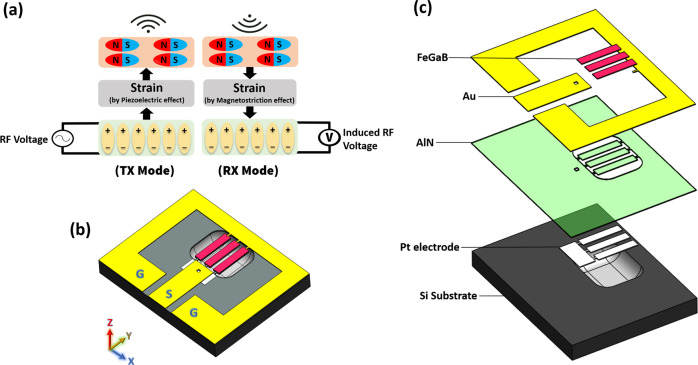
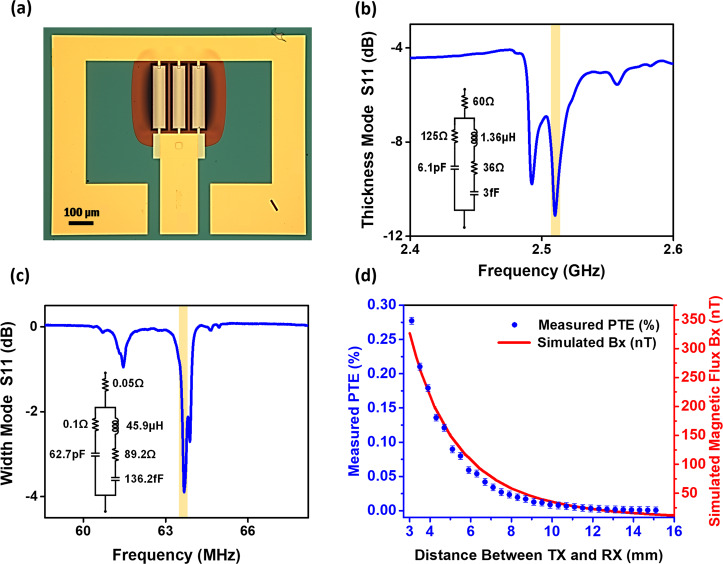
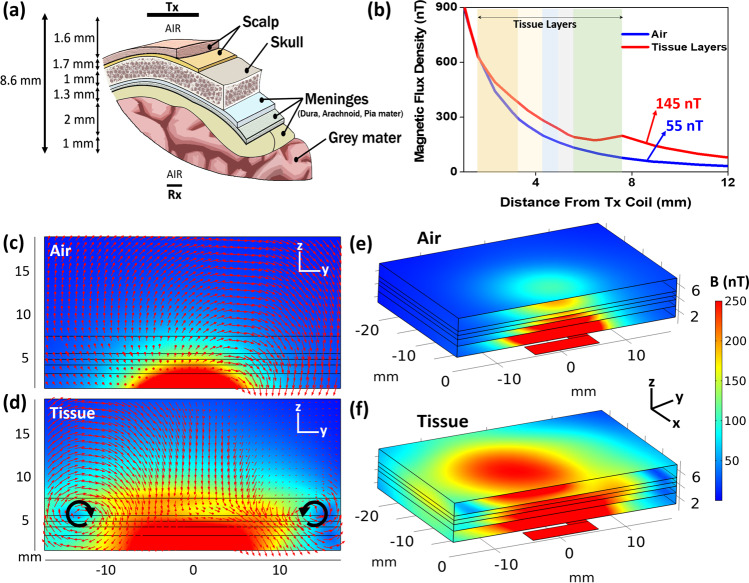
Ultra-compact wireless implantable medical devices are in great demand for healthcare applications, in particular for neural recording and stimulation. Current implantable technologies based on miniaturized micro-coils suffer from low wireless power transfer efficiency (PTE) and are not always compliant with the specific absorption rate imposed by the Federal Communications Commission. Moreover, current implantable devices are reliant on differential recording of voltage or current across space and require direct contact between electrode and tissue. Here, we show an ultra-compact dual-band smart nanoelectromechanical systems magnetoelectric (ME) antenna with a size of 250 × 174 µm that can efficiently perform wireless energy harvesting and sense ultra-small magnetic fields. The proposed ME antenna has a wireless PTE 1-2 orders of magnitude higher than any other reported miniaturized micro-coil, allowing the wireless IMDs to be compliant with the SAR limit. Furthermore, the antenna's magnetic field detectivity of 300-500 pT allows the IMDs to record neural magnetic fields.
超紧凑无线植入式医疗设备在医疗应用中需求量很大,特别是在神经记录和刺激方面。目前基于微型微线圈的植入式技术存在无线功率传输效率(PTE)低的问题,并且并不总是符合联邦通信委员会规定的特定吸收率。此外,目前的植入式设备依赖于电压或电流在空间上的差分记录,并且需要电极和组织之间的直接接触。在这里,我们展示了一种超紧凑的双频智能纳米机电系统磁电(ME)天线,尺寸为 250×174µm,可高效地进行无线能量收集和感应超小磁场。所提出的 ME 天线的无线 PTE 比任何其他报道的微型微线圈高 1-2 个数量级,这使得无线 IMD 能够符合 SAR 限制。此外,天线的磁场探测灵敏度为 300-500pT,使得 IMD 能够记录神经磁场。