Laboratory of Pneumology, GIGA Research Center, University of Liège, University Hospital of Liège, Liège, Belgium.
Laboratory of Rheumatology, GIGA Research Center, University of Liège, University Hospital of Liège, Liège, Belgium.
Sci Rep. 2021 May 25;11(1):10882. doi: 10.1038/s41598-021-90333-0.
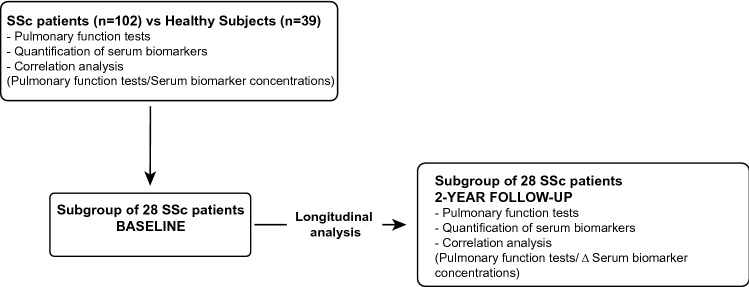
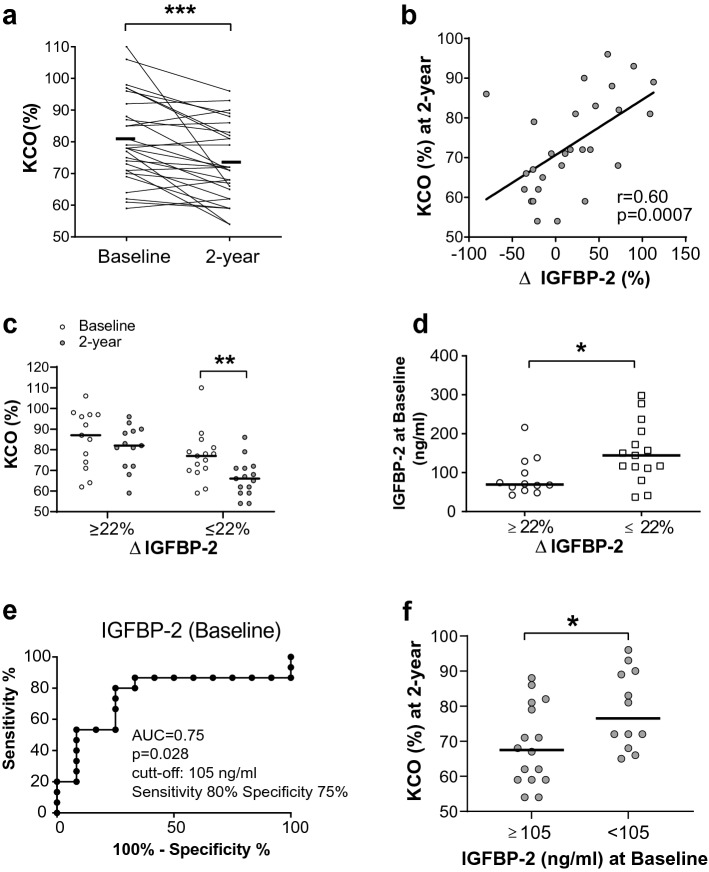
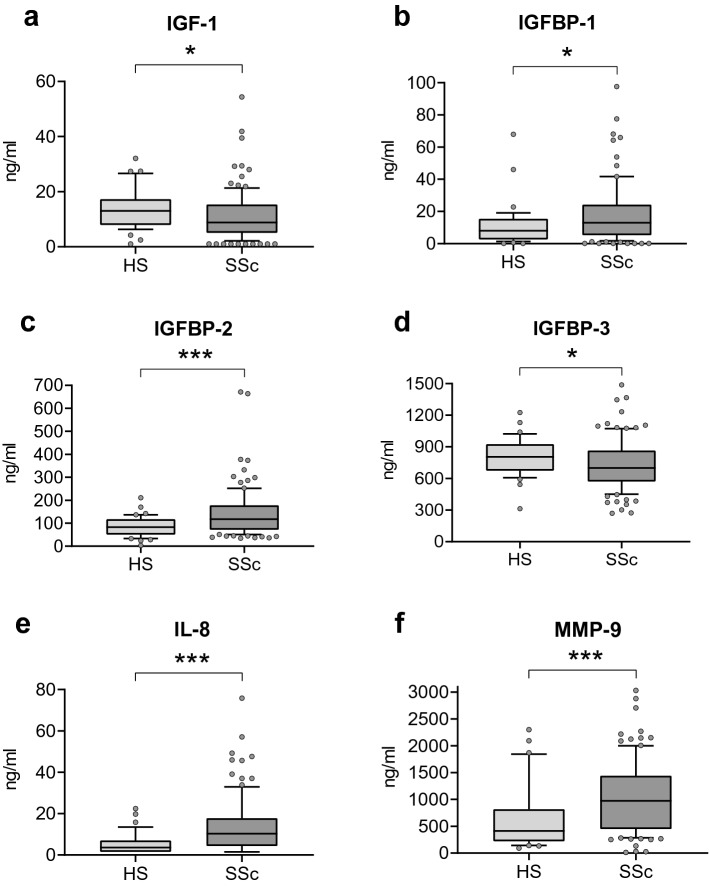
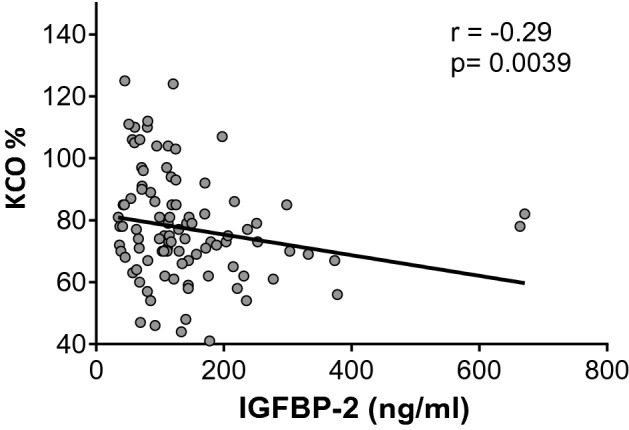
Systemic sclerosis (SSc) is a rare connective tissue disease associated with rapid evolving interstitial lung disease (ILD), driving its mortality. Specific biomarkers associated with the progression of this lung disease are highly needed. We aimed to identify specific biomarkers of SSc-ILD to predict the evolution of the disease. For this, we compared prospectively serum levels of several biomarkers associated with lung fibrosis in SSc patients (n = 102), among which SSc-no ILD (n = 63) and SSc-ILD (n = 39), compared to healthy subjects (HS) (n = 39). We also performed a longitudinal study in a subgroup of 28 patients analyzing biomarkers variations and pulmonary function tests over a period of 2 years. Serum level of IGFBP-2 was significantly increased in SSc patients compared to HS, and negatively correlated with pulmonary function (assessed by carbon monoxide transfer coefficient (KCO)) (r = - 0.29, p < 0.01). Two-year longitudinal analysis in a subgroup of 28 SSc patients determined that IGFBP-2 variation was positively correlated with KCO at 2-year follow-up (r = 0.6, p < 0.001). SSc patients with a lower variation of IGFBP-2 (less than 22%) presented significant deterioration of pulmonary function at 2-year follow-up (p < 0.01). ROC curve analysis enabled us to identify that baseline IGFBP-2 > 105 ng/ml was associated with a poor outcome (KCO < 70% predicted) at 2-year follow-up (AUC = 0.75, p < 0.05). We showed for the first time that serum levels of IGFBP-2 might be a prognostic factor of the development of SSc-ILD.
系统性硬化症(SSc)是一种罕见的结缔组织疾病,与快速进展的间质性肺病(ILD)相关,导致其死亡率增加。非常需要与这种肺部疾病进展相关的特定生物标志物。我们旨在确定 SSc-ILD 的特定生物标志物,以预测疾病的演变。为此,我们前瞻性地比较了 102 例 SSc 患者(其中 SSc 无 ILD(n=63)和 SSc-ILD(n=39)血清中几种与肺纤维化相关的生物标志物的水平,与健康受试者(HS)(n=39)相比。我们还对 28 例患者的亚组进行了纵向研究,分析了 2 年内生物标志物变化和肺功能测试。与 HS 相比,SSc 患者的 IGFBP-2 血清水平显着升高,与肺功能(通过一氧化碳转移系数(KCO)评估)呈负相关(r=-0.29,p<0.01)。在 28 例 SSc 患者的亚组中进行的 2 年纵向分析确定,IGFBP-2 变化与 2 年随访时的 KCO 呈正相关(r=0.6,p<0.001)。IGFBP-2 变化(小于 22%)较低的 SSc 患者在 2 年随访时肺功能明显恶化(p<0.01)。ROC 曲线分析使我们能够确定基线 IGFBP-2>105ng/ml 与 2 年随访时的不良结局(KCO<70%预测值)相关(AUC=0.75,p<0.05)。我们首次表明,血清 IGFBP-2 水平可能是 SSc-ILD 发展的预后因素。