Geto Zeleke, Gebremichael Saba, Belete Melaku Ashagrie, Gedefie Alemu, Molla Genet, Tesfaye Melkam, Demsiss Wondmagegn, Gebretsadik Daniel
Department of Biomedical Science, College of Medicine and Health Science, Wollo University, Wollo, Dessie, Ethiopia.
Department of Medical Laboratory Science, College of Medicine and Health Science, Wollo University, Wollo, Dessie, Ethiopia.
Int J Microbiol. 2021 May 4;2021:5549893. doi: 10.1155/2021/5549893. eCollection 2021.
The novel coronavirus disease (COVID-19) is lethal and extremely contagious, with a rapidly rising global prevalence. The World Health Organization has declared the outbreak a global pandemic; it is reported to have spread to nearly every country in the world. However, the prevalence varies across developed and developing countries, as well as within different regions of the same country. It is not hidden that estimating the magnitude of COVID-19 infection from the community surveys is critical for public health policymakers to make decisions to deal with the outbreak, optimize measures, and design mitigation plans.
A community-based cross-sectional study was conducted from 01 July to 31 August 2020 in the northeastern Ethiopia region. A simple random sampling technique was used to select study participants from the community survey, contact traces from confirmed cases, and infection suspects. After extraction of viral nucleic acid from oropharyngeal specimen, the real-time fluorescent polymerase chain reaction (RT-PCR) kit was used for detecting novel coronavirus.
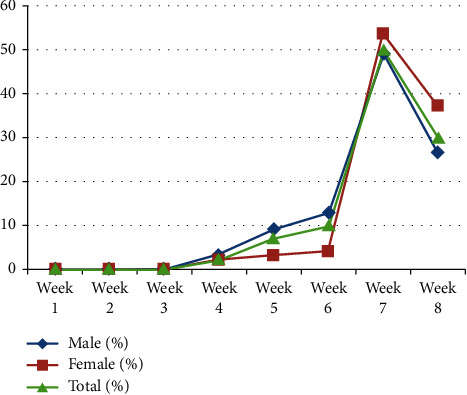
A total of 8752 study participants were included in this study. About 63.6% were males and 36.4% were females. Out of the total 8752 study participants, 291 (3.3%) were found to be infected with the virus. The first laboratory-confirmed cases of COVID-19 were detected in the fourth week of the study period, that is, from July 24 to July 31, 2020, and the peak prevalence was observed in the last two weeks. The COVID-19 infection was more prevalent among males and in the age group of 36-52 years. Participants tested via contact trace had 1.65 times (AOR = 1.65, 95% CI = 1.09-2.51, =0.018) the likelihood of COVID-19 infection in comparison to the other forms of community surveys.
The trend in the prevalence of COVID-19 infection in the northeastern region has shown increment, and increasing testing capacity has a greater benefit in identifying early infection for the prevention, treatment, and control of the international pandemic.
新型冠状病毒肺炎(COVID-19)具有致命性且极具传染性,全球患病率迅速上升。世界卫生组织已宣布此次疫情为全球大流行;据报道,它已蔓延至世界上几乎每个国家。然而,其患病率在发达国家和发展中国家以及同一国家的不同地区存在差异。显而易见,通过社区调查估计COVID-19感染规模对于公共卫生政策制定者做出应对疫情、优化措施和设计缓解计划的决策至关重要。
2020年7月1日至8月31日在埃塞俄比亚东北部地区开展了一项基于社区的横断面研究。采用简单随机抽样技术从社区调查、确诊病例的接触者追踪以及感染疑似者中选取研究参与者。从口咽拭子标本中提取病毒核酸后,使用实时荧光聚合酶链反应(RT-PCR)试剂盒检测新型冠状病毒。
本研究共纳入8752名研究参与者。其中约63.6%为男性,36.4%为女性。在8752名研究参与者中,有291人(3.3%)被发现感染了该病毒。COVID-19的首例实验室确诊病例在研究期间的第四周被检测到,即2020年7月24日至7月31日,且在最后两周观察到患病率峰值。COVID-19感染在男性和36 - 52岁年龄组中更为普遍。与其他形式的社区调查相比,通过接触者追踪检测的参与者感染COVID-19的可能性为其1.65倍(调整后比值比[AOR]=1.65,95%置信区间[CI]=1.09 - 2.51,P = 0.018)。
东北地区COVID-19感染患病率呈上升趋势,提高检测能力对于识别早期感染以预防、治疗和控制国际大流行具有更大益处。