Wilton Stephen B, Kaul Padma, Islam Sunjidatul, Atzema Clare L, Cruz Jennifer, MacFarlane Kendra, McKelvie Robert, Poon Stephanie, Lambert Laurie, Rush Kathy, Deyell Marc, Wyse D George, Cox Jafna L, Skanes Allan, Sandhu Roopinder K
Libin Cardiovascular Institute, University of Calgary, Calgary, Alberta, Canada.
Department of Medicine, Division of Cardiology, University of Alberta, Edmonton, Alberta, Canada.
CJC Open. 2021 Jan 13;3(5):609-618. doi: 10.1016/j.cjco.2021.01.003. eCollection 2021 May.
Whether advances in identification and management of atrial fibrillation and atrial flutter (collectively, AF) have led to improved outcomes is unclear. We sought to study trends in clinical outcomes selected as quality indicators for nonvalvular AF in Canada.
We identified hospitalized patients with a first diagnosis of nonvalvular AF between April 2006 and March 2015, in all of Canada except Quebec. We assessed trends in 1-year incidence of stroke/systemic embolism (SSE), major bleeding, and initial heart failure (HF) hospitalization.
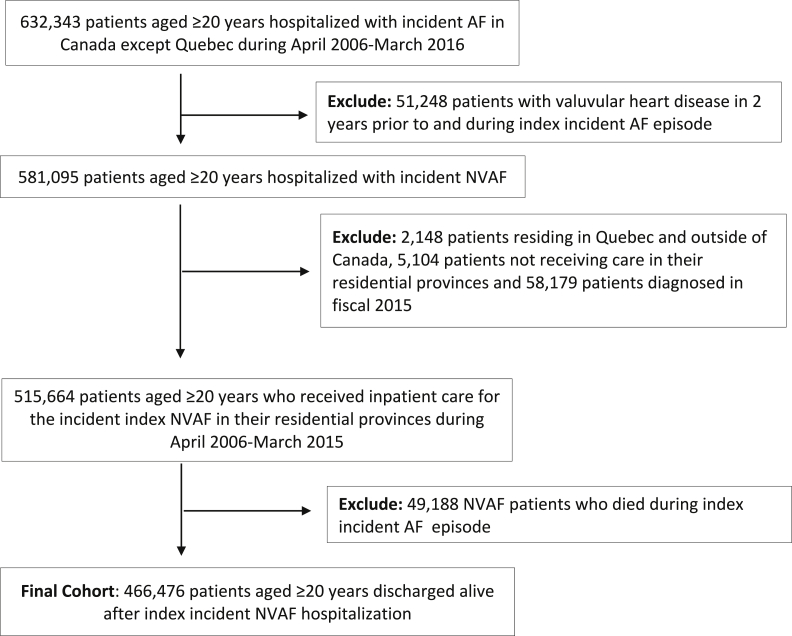
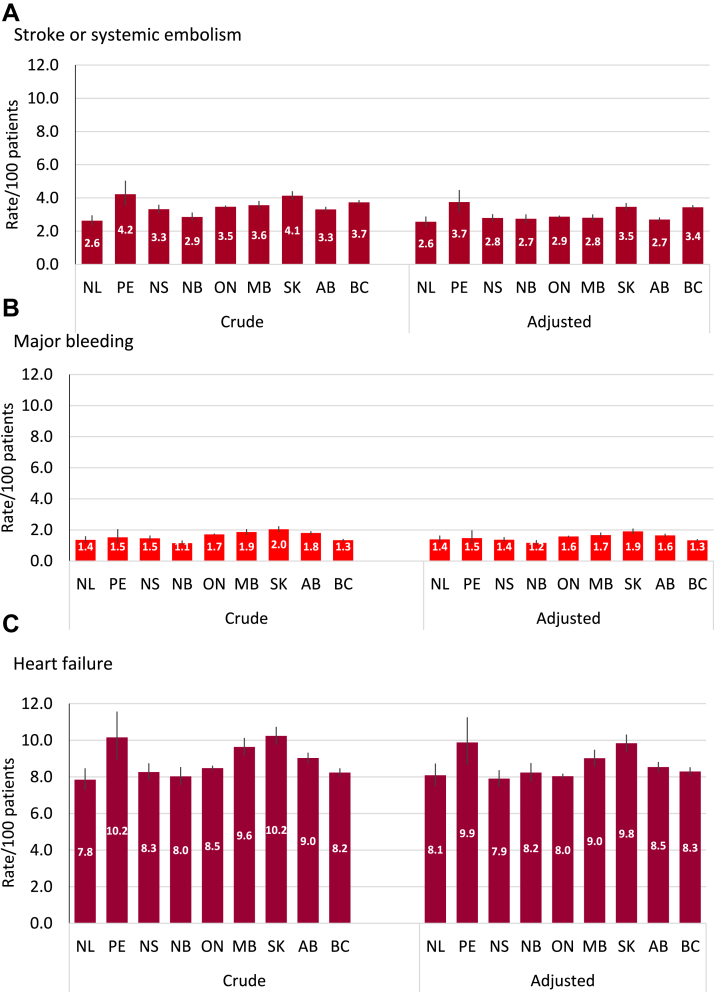
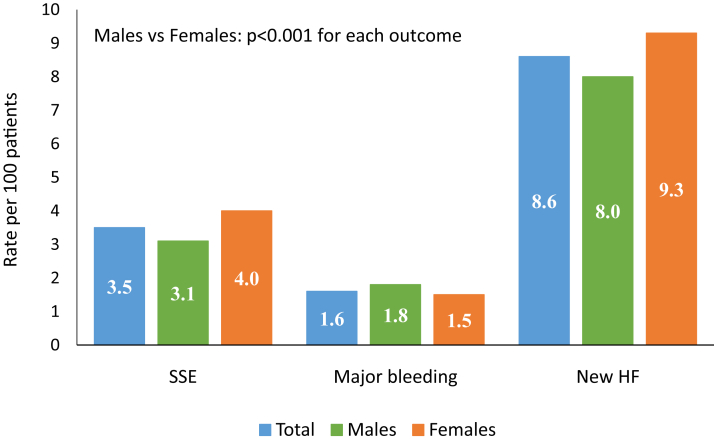
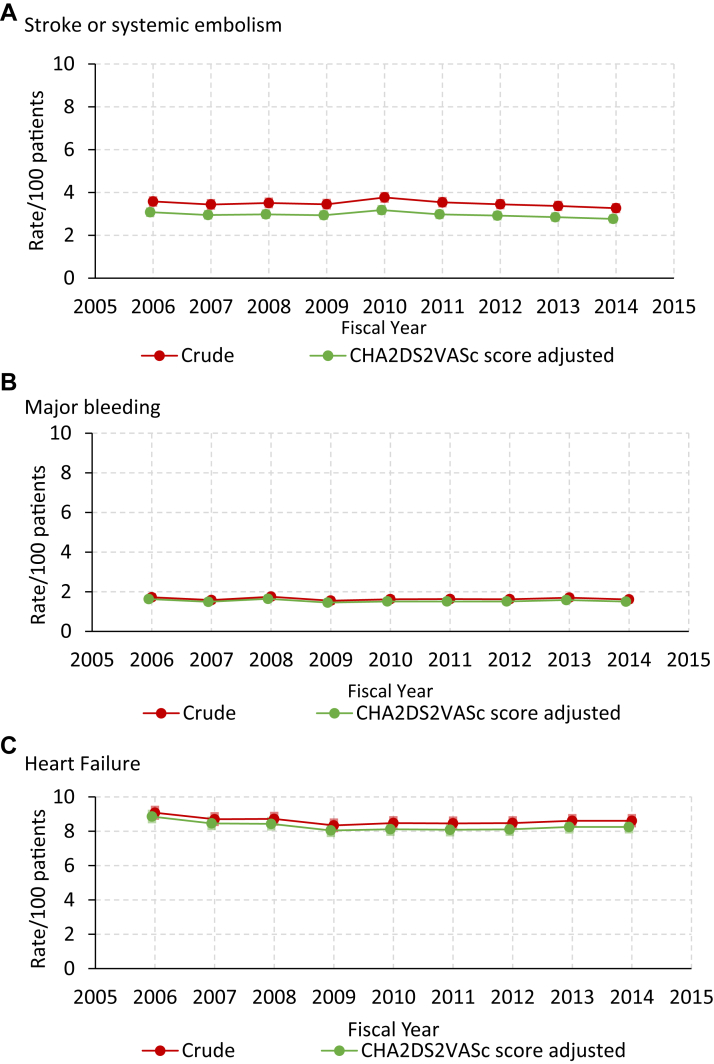
The cohort included 466,476 patients. The median age was 77 years (interquartile range, 68-84 years), 46% were female, and 68% had a ongestive Heart Failure, ypertension, ge (≥75 years), iabetes, troke/Transient Ischemic Attack, ascular Disease, ge (65-74 years), ex (Female) (CHADS-VASc) score > 3. Within 1 year of discharge, 3.5% were hospitalized for stroke or SSE, 1.6% for major bleeding, and 8.6% for new HF. Over the study period, the crude rate of SSE declined from 3.6% to 3.3% ( = 0.002), whereas the rates of hospitalization for new HF and for major bleeding did not significantly change. After adjustment for CHADS-VASc score, the yearly rates of incident SSE (risk ratio, 0.99; 95% confidence interval [CI], 0.98-0.99; = 0.002) and HF (risk ratio, 0.99; 95% CI, 0.99-1.00; = 0.001) declined ≤ 1% absolute, whereas major bleeding remained unchanged (risk ratio, 1.00; 95% CI, 0.99-1.00; = 0.28).
Among hospitalized patients with nonvalvular AF in Canada, the rate of SSE and new HF decreased modestly over a 10-year period, with no significant change in major bleeding. Efforts to study process-based quality indicators, with increased focus on HF prevention, are needed.
心房颤动和心房扑动(统称为房颤)的识别与管理进展是否带来了更好的治疗效果尚不清楚。我们试图研究加拿大选定为非瓣膜性房颤质量指标的临床结局趋势。
我们确定了2006年4月至2015年3月期间在加拿大除魁北克省外所有地区首次诊断为非瓣膜性房颤的住院患者。我们评估了卒中/全身性栓塞(SSE)、大出血和首次心力衰竭(HF)住院的1年发生率趋势。
该队列包括466,476名患者。中位年龄为77岁(四分位间距,68 - 84岁),46%为女性,68%的充血性心力衰竭、高血压、年龄(≥75岁)、糖尿病、卒中/短暂性脑缺血发作、血管疾病、年龄(65 - 74岁)、性别(女性)(CHADS - VASc)评分>3。出院后1年内,3.5%因卒中或SSE住院,1.6%因大出血住院,8.6%因新发HF住院。在研究期间,SSE的粗发生率从3.6%降至3.3%(P = 0.002),而新发HF和大出血的住院率没有显著变化。在调整CHADS - VASc评分后,SSE(风险比,0.99;95%置信区间[CI],0.98 - 0.99;P = 0.002)和HF(风险比,0.99;95% CI,0.99 - 1.00;P = 0.001)的年发生率绝对下降≤1%,而大出血保持不变(风险比,1.00;95% CI,0.99 - 1.00;P = 0.28)。
在加拿大非瓣膜性房颤住院患者中,SSE和新发HF的发生率在10年期间略有下降,大出血无显著变化。需要努力研究基于过程的质量指标,更加关注HF预防。