
人口死因死亡率与特定病因死亡率趋势:与新发心房颤动的关系。
Population Trends in All-Cause Mortality and Cause Specific-Death With Incident Atrial Fibrillation.
机构信息
Schulich Heart Center Sunnybrook Health Sciences Center Toronto Canada.
Department of Medicine Faculty of Medicine University of Toronto Canada.
出版信息
J Am Heart Assoc. 2020 Oct 20;9(19):e016810. doi: 10.1161/JAHA.120.016810. Epub 2020 Sep 13.
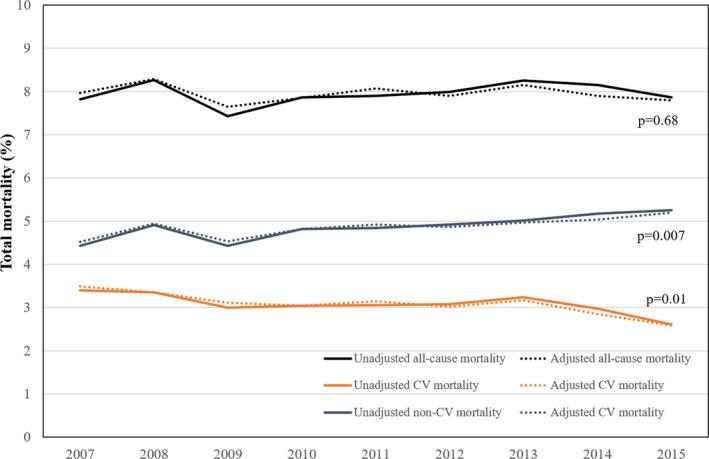
BACKGROUND Limited studies have evaluated population-level temporal trends in mortality and cause of death in patients with contemporary managed atrial fibrillation. This study reports the temporal trends in 1-year overall and cause-specific mortality in patients with incident atrial fibrillation. METHODS AND RESULTS Patients with incident atrial fibrillation presenting to an emergency department or hospitalized in Ontario, Canada, were identified in population-level linked administrative databases that included data on vital statistics and cause of death. Temporal trends in 1-year all-cause and cause-specific mortality was determined for individuals identified between April 1, 2007 (fiscal year [FY] 2007) and March 31, 2016 (FY 2015). The study cohort consisted of 110 302 individuals, 69±15 years of age with a median congestive heart failure, hypertension, age (≥75 years), diabetes mellitus, stroke (2 points), vascular disease, age (≥65 years), sex category (female) score of 2.8. There was no significant decline in the adjusted 1-year all-cause mortality between the first and last years of the study period (adjusted mortality: FY 2007, 8.0%; FY 2015, 7.8%; P for trend=0.68). Noncardiovascular death accounted for 61% of all deaths; the adjusted 1-year noncardiovascular mortality rate rose from 4.5% in FY 2007 to 5.2% in FY 2015 (P for trend=0.007). In contrast, the 1-year cardiovascular mortality rate decreased from 3.5% in FY 2007 to 2.6% in FY 2015 (P for trend=0.01). CONCLUSIONS Overall 1-year all-cause mortality in individuals with incident atrial fibrillation has not improved despite a significant reduction in the rate of cardiovascular death. These findings highlight the importance of recognizing and managing concomitant noncardiovascular conditions in patients with atrial fibrillation.
背景
目前仅有少数研究评估了当代管理心房颤动患者的人群水平死亡率和死因的时间趋势。本研究报告了在新诊断心房颤动患者中,1 年全因和特定病因死亡率的时间趋势。
方法和结果
在加拿大安大略省的人群水平链接行政数据库中,确定了因新发心房颤动而就诊于急诊或住院的患者,该数据库包括生命统计和死因数据。确定了在 2007 年 4 月 1 日(财政年度 [FY] 2007 年)至 2016 年 3 月 31 日(FY 2015 年)期间确定的个体的 1 年全因和特定病因死亡率的时间趋势。研究队列包括 110302 人,年龄 69±15 岁,中位数为充血性心力衰竭、高血压、年龄(≥75 岁)、糖尿病、卒中(2 分)、血管疾病、年龄(≥65 岁)、性别类别(女性)评分为 2.8。在研究期间的第一年和最后一年之间,调整后的 1 年全因死亡率没有显著下降(调整死亡率:FY 2007 年,8.0%;FY 2015 年,7.8%;趋势 P 值=0.68)。非心血管死亡占所有死亡的 61%;调整后的 1 年非心血管死亡率从 FY 2007 年的 4.5%上升至 FY 2015 年的 5.2%(趋势 P 值=0.007)。相比之下,1 年心血管死亡率从 FY 2007 年的 3.5%下降至 FY 2015 年的 2.6%(趋势 P 值=0.01)。
结论
尽管心血管死亡率显著下降,但新发心房颤动患者的 1 年全因死亡率仍未见改善。这些发现强调了在心房颤动患者中识别和管理并存的非心血管疾病的重要性。


 Zotero 插件