Neurobiology Research Unit, The Neuroscience Centre, Copenhagen University Hospital Rigshospitalet, Copenhagen, Denmark.
Faculty of Health and Medical Sciences, University of Copenhagen, Copenhagen, Denmark.
Brain Behav. 2021 Jul;11(7):e02175. doi: 10.1002/brb3.2175. Epub 2021 May 25.
Although aggression is conceptualized as a dimensional construct with violent behavior representing the extreme end of a spectrum, studies on the involvement of personality traits in human aggression have typically only included data representing a restricted spectrum of aggressive behaviors.
In the current study, we therefore examine whether trait aggression is associated with five-factor model personality traits in an enriched sample of 259 men with a broad continuum of trait aggression, ranging from very low to very high including 39 incarcerated aggressive violent offenders. All participants completed the NEO Personality Inventory-Revised (NEO PI-R) and the Buss-Perry Aggression Questionnaire (BPAQ). The association between each of the five NEO PI-R personality traits and trait aggression (BPAQ) was investigated using five linear regression models, covarying for group status, age and educational level.
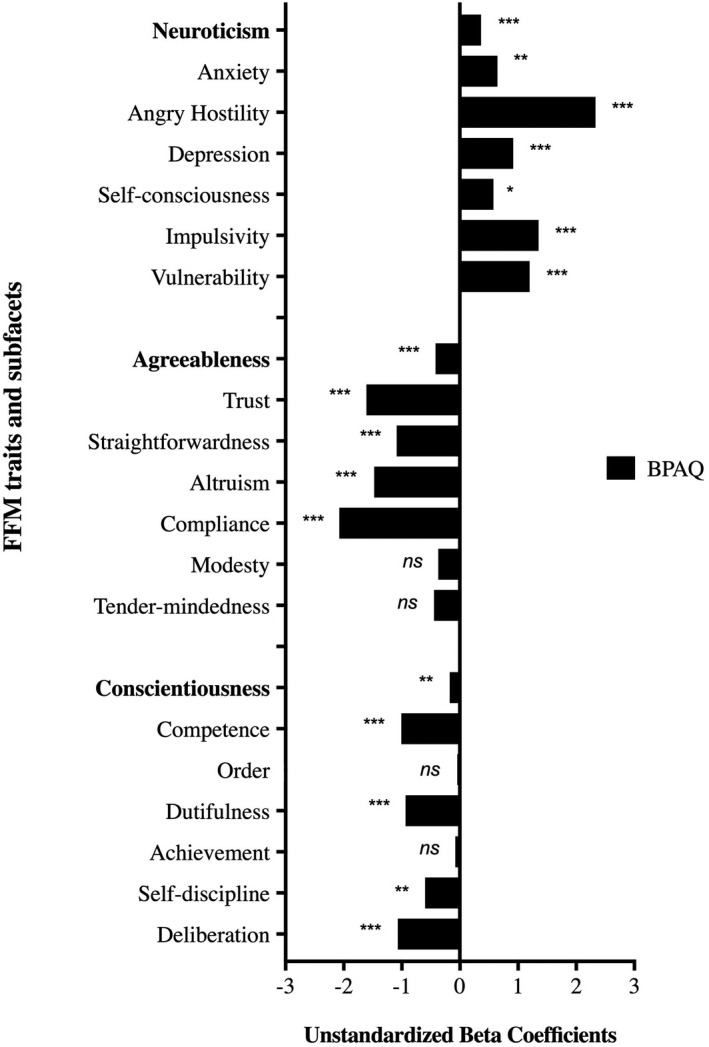
Higher BPAQ scores were positively associated with Neuroticism and negatively associated with Agreeableness and Conscientiousness.
Our results indicate that those high in Neuroticism and low in Agreeableness and Conscientiousness are at higher risk of exhibiting aggressive behavior, underlining the relevance of these higher order personality traits in understanding aggressive behavior. We argue that studying individual personality differences should be offered a greater attention within violent and criminal behaviors.
尽管攻击被概念化为一个具有维度的结构,其中暴力行为代表了一个连续谱的极端,但关于人格特质在人类攻击中的作用的研究通常只包括了代表有限的攻击行为范围的数据。
因此,在目前的研究中,我们在一个包含广泛的特质攻击连续谱的样本中,包括 39 名被监禁的攻击性暴力罪犯,检查特质攻击是否与五因素模型人格特质有关。所有参与者都完成了 NEO 人格量表修订版(NEO PI-R)和 Buss-Perry 攻击问卷(BPAQ)。使用五个线性回归模型,共变量为群体状态、年龄和教育水平,研究了五个 NEO PI-R 人格特质中的每一个与特质攻击(BPAQ)之间的关联。
更高的 BPAQ 得分与神经质呈正相关,与宜人性和尽责性呈负相关。
我们的结果表明,神经质水平高、宜人性和尽责性水平低的人更有可能表现出攻击行为,突出了这些高阶人格特质在理解攻击行为中的相关性。我们认为,在暴力和犯罪行为中,应该更加关注个体的人格差异。