Carnegie Mellon University, 5000 Forbes Avenue, Pittsburgh, PA 15213, United States of America.
University of Minnesota, Minneapolis, MN, United States of America.
J Neural Eng. 2021 Jun 9;18(4). doi: 10.1088/1741-2552/ac0584.
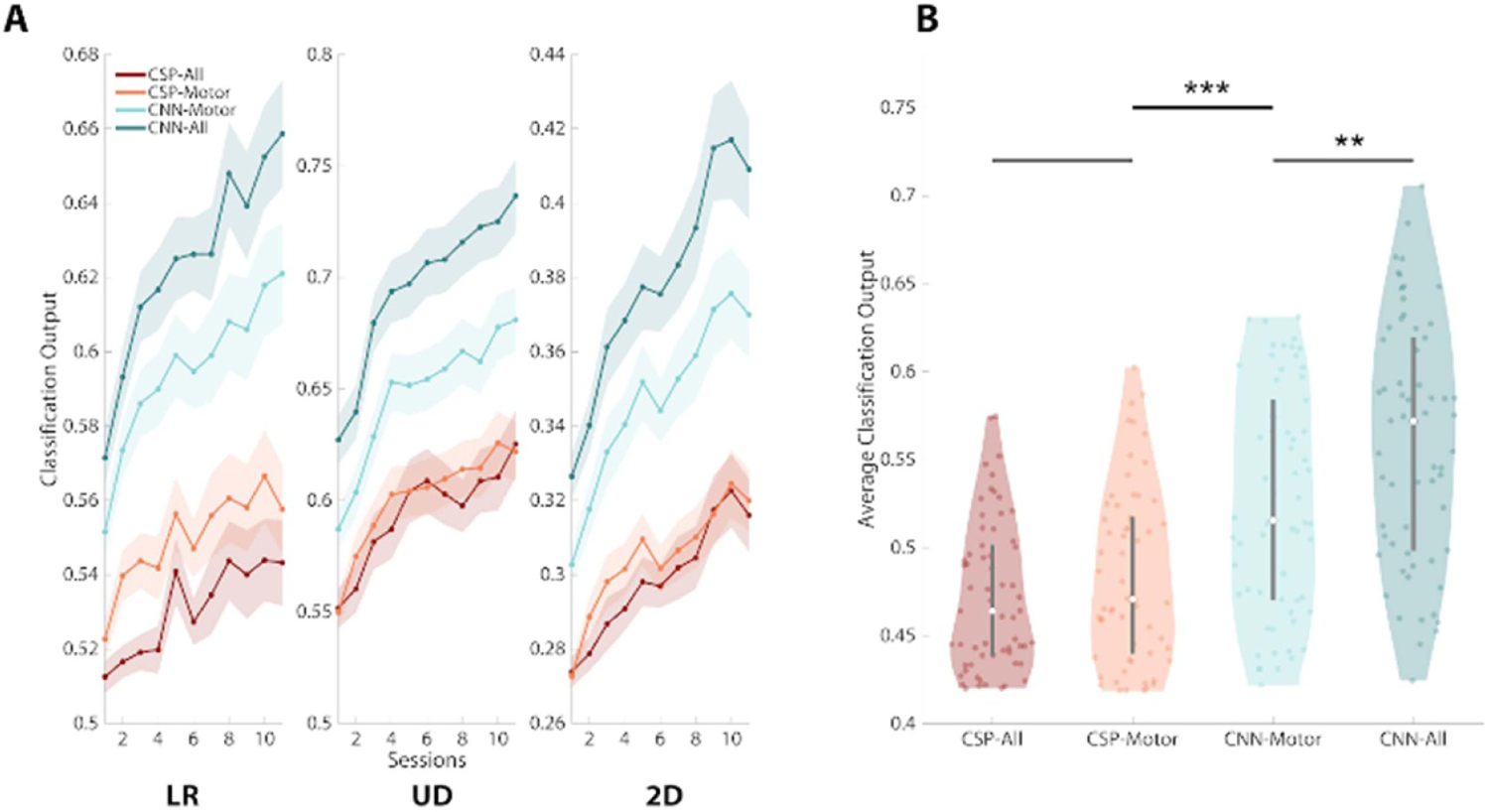
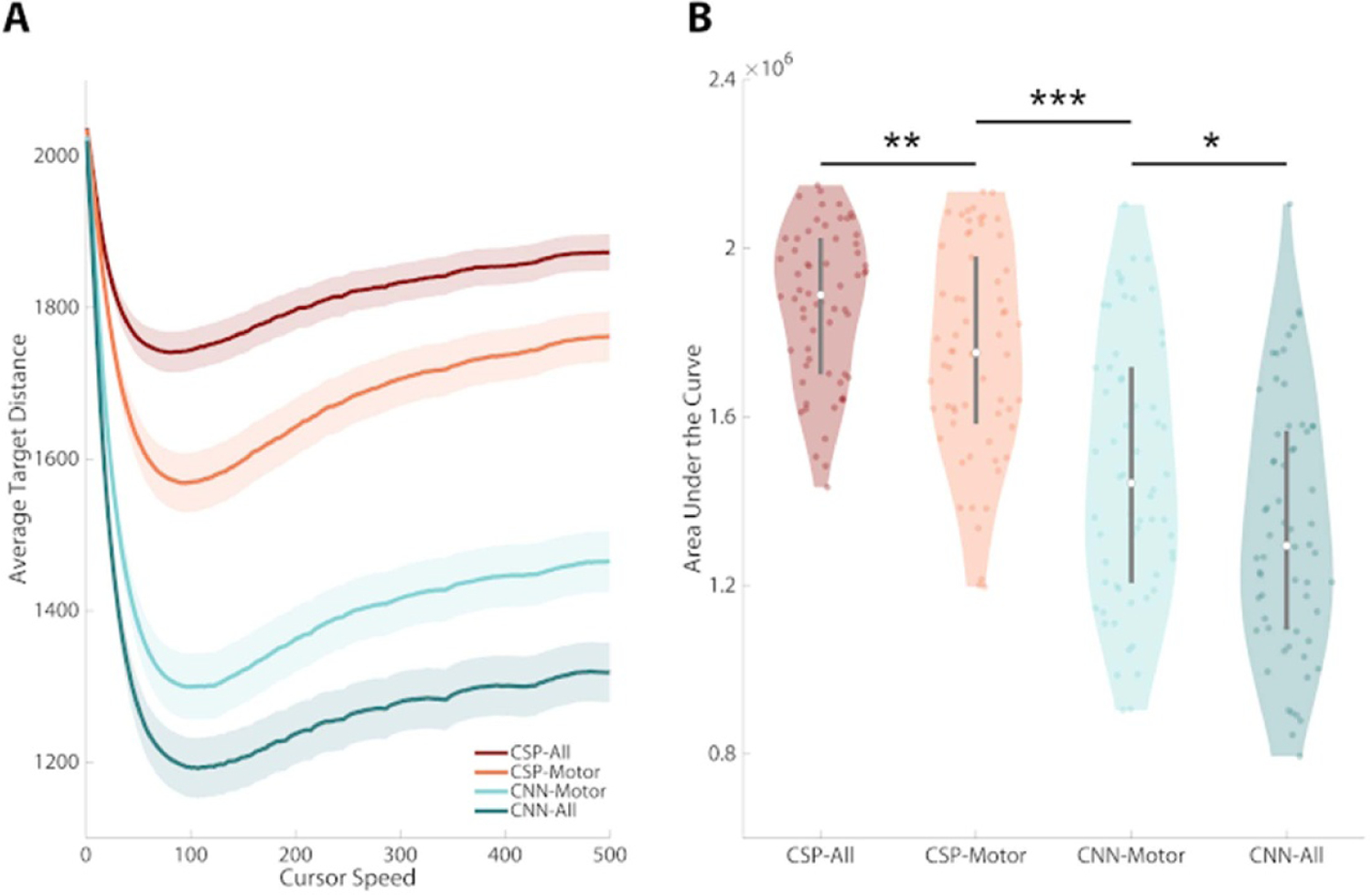
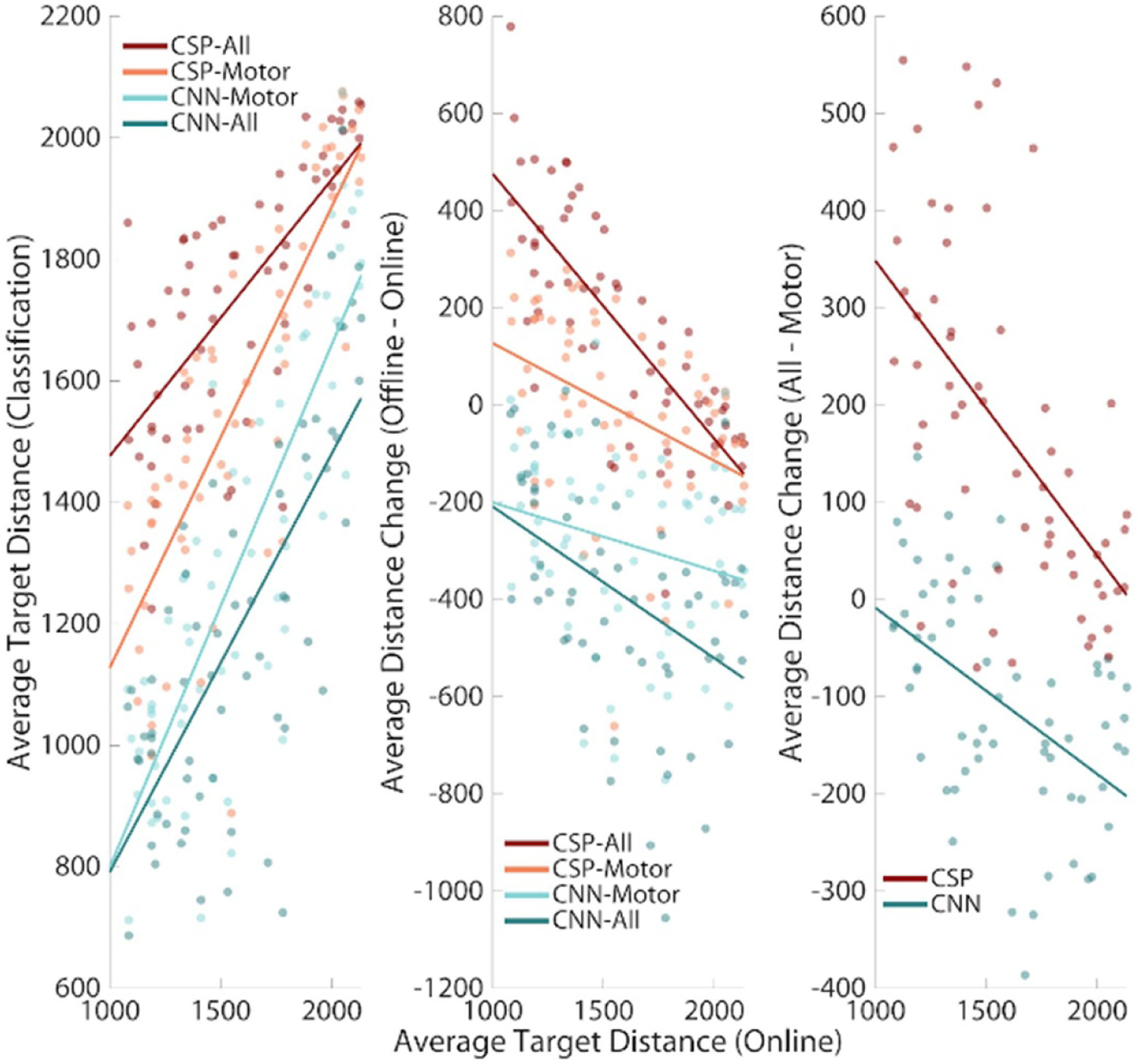
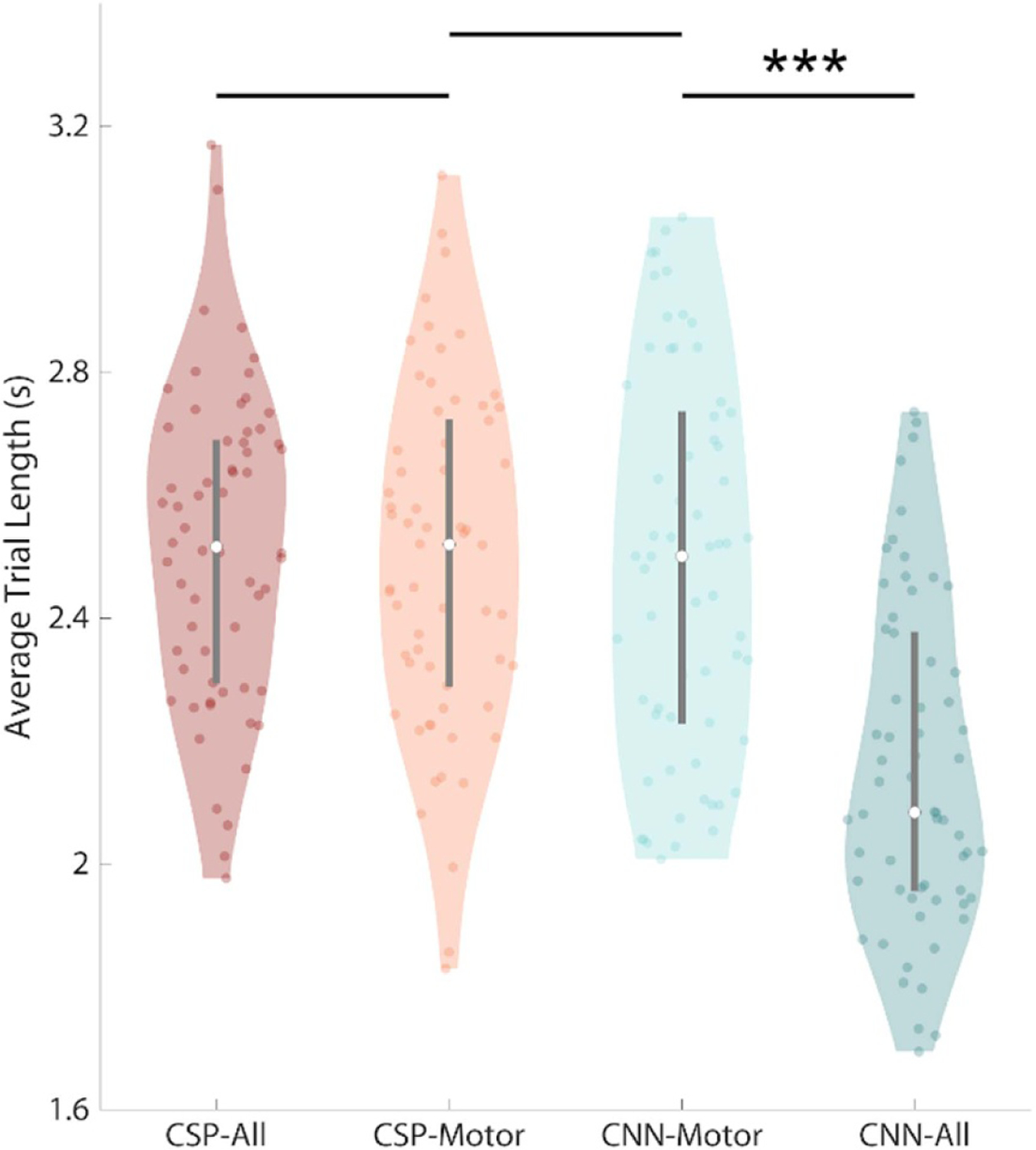
. Noninvasive brain-computer interfaces (BCIs) assist paralyzed patients by providing access to the world without requiring surgical intervention. Prior work has suggested that EEG motor imagery based BCI can benefit from increased decoding accuracy through the application of deep learning methods, such as convolutional neural networks (CNNs).. Here, we examine whether these improvements can generalize to practical scenarios such as continuous control tasks (as opposed to prior work reporting one classification per trial), whether valuable information remains latent outside of the motor cortex (as no prior work has compared full scalp coverage to motor only electrode montages), and the existing challenges to the practical implementation of deep-learning based continuous BCI control.. We report that: (1) deep learning methods significantly increase offline performance compared to standard methods on an independent, large, and longitudinal online motor imagery BCI dataset with up to 4-classes and continuous 2D feedback; (2) our results suggest that a variety of neural biomarkers for BCI, including those outside the motor cortex, can be detected and used to improve performance through deep learning methods, and (3) tuning neural network output will be an important step in optimizing online BCI control, as we found the CNN models trained with full scalp EEG also significantly reduce the average trial length in a simulated online cursor control environment.. This work demonstrates the benefits of CNNs classification during BCI control while providing evidence that electrode montage selection and the mapping of CNN output to device control will be important design choices in CNN based BCIs.
. 非侵入性脑机接口 (BCI) 通过提供无需手术干预即可与外界交互的途径来帮助瘫痪患者。先前的工作表明,基于脑电图运动想象的 BCI 可以通过应用深度学习方法(如卷积神经网络 (CNN))来提高解码准确性。. 在这里,我们研究了这些改进是否可以推广到实际场景,例如连续控制任务(而不是之前的工作报告每次试验进行一次分类),以及在运动皮层之外是否存在有价值的信息(因为没有之前的工作将全头皮覆盖与仅运动电极布局进行了比较),以及深度学习连续 BCI 控制实际实施存在的挑战。. 我们报告:(1) 与标准方法相比,深度学习方法在具有多达 4 类和连续 2D 反馈的独立、大型和纵向在线运动想象 BCI 数据集上,离线性能显著提高;(2) 我们的结果表明,BCI 的各种神经生物标志物,包括运动皮层之外的标志物,都可以通过深度学习方法检测和利用来提高性能,以及 (3) 调整神经网络输出将是优化在线 BCI 控制的重要步骤,因为我们发现使用全头皮 EEG 训练的 CNN 模型还可以显著缩短模拟在线光标控制环境中的平均试验长度。. 这项工作展示了 CNN 在 BCI 控制期间分类的优势,同时也证明了电极布局选择和 CNN 输出到设备控制的映射将是基于 CNN 的 BCI 中的重要设计选择。